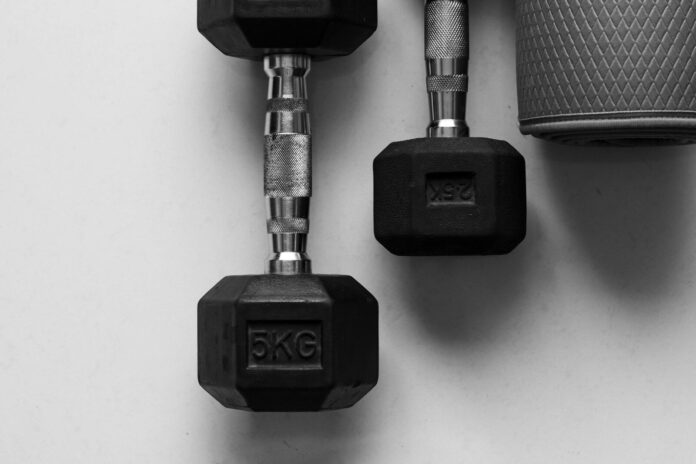

You do not need a gym membership, a squat rack or an hour of free time to build real strength after 35. A pair of adjustable dumbbells, a patch of floor and 30 minutes, three times a week, is enough to get stronger, build muscle and protect your back and shoulders for the long run. This guide gives you the exact plan.
Key takeaways
- The WHO recommends muscle-strengthening activity on at least two days a week; three 30-minute dumbbell sessions cover that comfortably.
- Research shows muscle growth is similar across a wide range of loads when sets are hard, so home dumbbells can build real muscle.
- Alternate two full-body workouts (A and B) built on a squat, hinge, push, pull and core or carry.
- When your dumbbells max out, progress with more reps, slower lowering, pauses and single-leg or single-arm versions.
- Protect your back and shoulders with a 5-minute warm-up, a neutral spine on hinges, neutral-grip presses and steady breathing.
Why a pair of adjustable dumbbells is enough
The main thing your muscles respond to is hard work done consistently over time, not a particular machine. A 2017 meta-analysis in the Journal of Strength and Conditioning Research compared low-load and high-load training and found similar muscle growth across a wide range of loads. Heavier loads did produce bigger gains in one-rep max strength, which matters if you want to test a heavy single, but not if your goal is a stronger, more muscular, more capable body.
The catch is effort: lighter weights work when the set is genuinely challenging. Adjustable dumbbells also solve the practical problems of home training:
- Space and progression: one pair replaces a rack of fixed weights, and you can raise the load in small steps.
- Versatility: squats, hinges, presses, rows, lunges and carries all work with dumbbells.
- Joint friendliness: each arm moves independently, so you can find a path that suits your shoulders.
When buying, choose a set whose maximum is comfortably above what you can goblet squat for 10 reps today; your legs will outgrow light dumbbells long before your arms. A bench is optional; a solid chair or sofa edge covers most needs.
If you are new to lifting, read our guide on how to start working out after 40 first. If you have gym access some days, our strength training after 35 plan pairs well with this one.
The 5-minute warm-up
Mayo Clinic advises 5 to 10 minutes of light aerobic activity before lifting, because cold muscles are more prone to injury. Harvard Health also recommends warming up before every strength session. Here is a quick routine that needs no extra equipment:
- 2 minutes of easy movement: marching on the spot, jumping jacks, stairs or a brisk walk around the house.
- 10 bodyweight squats to a comfortable depth.
- 10 hip hinges with hands on hips, pushing your hips back and keeping your back flat.
- 10 arm circles each way and 10 wall slides to wake up your shoulders.
- 5 slow push-ups from the floor or with hands on a table.
Then do one light set of the first exercise of the day with about half your working weight. A 2021 systematic review found mixed results overall, but some studies showed that a specific warm-up, practising the actual lift, helped strength performance, so do not skip that ramp-up set.
The 30-minute dumbbell home workout: plan A and plan B
Alternate the workouts: A, B, A one week, then B, A, B the next. Exercises marked 1 and 2 are paired: do a set of the first, rest, a set of the second, rest, and repeat. The American College of Sports Medicine (ACSM) recommends 1 to 2 minutes of rest for muscle-building work; because you alternate exercises, each muscle gets about two minutes between its own sets.
Workout A
| Exercise | Sets x reps | Rest | Form cue |
|---|---|---|---|
| A1. Goblet squat | 3 x 8–12 | 60 sec | Hold one dumbbell at your chest, sit down between your hips, keep your chest tall and knees tracking over your toes. |
| A2. Dumbbell floor press | 3 x 8–12 | 60 sec | Lie on the floor, palms facing each other, elbows about 45 degrees from your body; let your upper arms touch the floor lightly, then press. |
| B1. Dumbbell Romanian deadlift | 3 x 8–12 | 60 sec | Soft knees, push your hips back, slide the dumbbells down your thighs, stop when your back wants to round. |
| B2. One-arm dumbbell row | 3 x 10–12 each side | 45 sec | Support one hand on a chair or bench, flat back, pull your elbow towards your hip without twisting. |
| C. Dead bug | 2 x 8 each side | 30 sec | Lower back stays gently pressed to the floor as you slowly extend the opposite arm and leg. |
Workout B
| Exercise | Sets x reps | Rest | Form cue |
|---|---|---|---|
| A1. Dumbbell reverse lunge | 3 x 8–10 each leg | 60 sec | Step back softly, front knee over the middle of your foot, torso tall; push through your front heel to stand. |
| A2. Half-kneeling one-arm overhead press | 3 x 8–12 each side | 60 sec | Squeeze the glute of the down knee, keep ribs down, press with palm facing in, no leaning back. |
| B1. Dumbbell hip thrust | 3 x 10–15 | 60 sec | Upper back on a sofa or bench, dumbbell across your hips, drive through your heels and pause at the top without arching. |
| B2. Bent-over two-arm row | 3 x 10–12 | 60 sec | Hinge to about 45 degrees with a flat back, pull both dumbbells to your lower ribs, lower with control. |
| C. Suitcase carry | 3 x 30–40 sec each side | 30 sec | Hold one heavy dumbbell at your side, walk tall without leaning towards it. |
How hard each set should feel
Finish every set with about 1 to 3 good reps left. A 2023 meta-analysis in Sports Medicine found that training to momentary failure was not clearly better for muscle growth than stopping a little short, and stopping early keeps form clean when you train alone without a spotter.
Breathe out as you lift or push and in as you lower. Both Mayo Clinic and Harvard Health warn against holding your breath, and Harvard notes that straining while holding it can sharply raise blood pressure.
Progression when your dumbbells max out
Start with double progression: stay at one weight until you reach the top of the rep range on all sets, then move up to the next increment. The ACSM position stand suggests increasing load by about 2–10% once you can do one or two reps more than your target. Eventually, though, your goblet squat or Romanian deadlift will outgrow the heaviest setting. Here is how to keep progressing without buying more equipment.
1. Add reps
Because muscle growth is similar across a broad range of loads, moving from 8–12 to 15–20 reps still builds muscle if you finish close to failure. Use this first on lower-body exercises.
2. Slow the tempo
Slowing the lowering phase to 3 or 4 seconds, or adding a 2-second pause at the hardest point, makes a light weight feel much heavier. Do not overdo it: a meta-analysis by Schoenfeld and colleagues found similar muscle growth with repetition durations from about 0.5 to 8 seconds, while very slow reps of more than 10 seconds appeared to be less effective. A controlled 3-second lowering with a normal lift is a good default.
3. Go single-leg or single-arm
Training one side at a time puts much more of the dumbbell’s load on the working leg or arm. The ACSM recommends including both bilateral and unilateral exercises in a well-rounded programme. Useful swaps:
- Goblet squat → rear-foot-elevated split squat (back foot on a chair or sofa).
- Romanian deadlift → single-leg Romanian deadlift, with a hand on a wall for balance if needed.
- Hip thrust → single-leg hip thrust.
- Floor press → one-arm floor press, which also challenges your core.
4. Add a set
Once the above options are in place, add a fourth set to your first pair of exercises. If your goal becomes maximal strength, you will eventually need heavier loads; for muscle and everyday strength, these methods keep you progressing for a long time.
How to fit 3 sessions a week around work and kids
The WHO recommends muscle-strengthening activities that work all major muscle groups on two or more days a week. Harvard Health suggests allowing at least 48 hours of rest for a muscle group between strength sessions, and Mayo Clinic advises against working the same muscles two days in a row. Three full-body sessions with a day off in between fits both.
A 2022 meta-analysis in the British Journal of Sports Medicine linked muscle-strengthening activity with about 15% lower risk of death from any cause, with the largest benefit at around 30 to 60 minutes per week. These are observational findings, but they show you do not need hours in the gym to benefit. Three 30-minute sessions go a little beyond that range, which also gives you room to build muscle.
Pick your slots
- Before the house wakes up: 6:00 to 6:30 is often the only time that is truly yours. Lay out your dumbbells and clothes the night before.
- Lunch break on work-from-home days: 30 minutes, a quick wash and you are back at your desk.
- After the kids are in bed: fine for most people, but finish at least an hour or two before your own bedtime if late training affects your sleep.
A simple schedule is Monday, Wednesday and Friday. Put the sessions in your calendar like meetings.
Have a backup plan
- The 15-minute version: on chaotic days, do only the first pair of exercises for 3 rounds.
- Missed a day? Do the next workout the following day rather than doubling up.
- Involve the kids: let them do bodyweight squats or count your reps, at a safe distance from the dumbbells.
Muscle is built from the food and sleep that follow training. Our guide to protein after 35 explains how much you need, and our list of muscle-building foods covers easy options, including vegetarian staples such as paneer, Greek yogurt, lentils, tofu and eggs.
Safety: protecting your back and shoulders
Your lower back
- Hinge, do not round. On Romanian deadlifts and rows, push your hips back and keep your spine long. Stop the lowering where your back starts to round, even if that is just below the knees.
- Pick up dumbbells like a deadlift. Squat down with a flat back to lift them off the floor, or keep them on a low step.
- Start lighter on hinges. Build up the Romanian deadlift more slowly until the pattern feels natural.
Your shoulders
- Use a neutral grip. Palms facing each other on presses is usually more comfortable for shoulders than palms facing forward.
- Floor press before bench press. The floor limits how far your elbows travel, which protects the front of the shoulder.
- Press overhead from half-kneeling. It stops you leaning back and turning the press into a lower-back exercise.
- Own your range of motion. Harvard Health advises staying within a comfortable range and extending it gradually over time.
Muscle burn and mild next-day soreness are normal. Sharp, pinching or joint pain is not. Mayo Clinic’s advice is simple: if an exercise hurts, stop. Try it again a few days later with less weight or swap in an easier variation.
Safety note: If you have heart disease, high blood pressure, diabetes, a previous back or shoulder injury, or symptoms such as chest pain, dizziness or unusual breathlessness, talk to your doctor before starting. Stop immediately if you feel chest pain, faintness or sudden sharp pain. Clear your training space, check that adjustable dumbbell plates are locked before every set, and store dumbbells where small children cannot pull them over.
FAQ
Can you really build muscle with only dumbbells?
Yes. Research shows similar muscle growth across a wide range of loads when sets are taken reasonably close to failure. Dumbbells let you train every major muscle group, and techniques such as higher reps, slower tempo and single-leg work keep the challenge rising.
How heavy should my first dumbbells be?
Choose a weight you could lift for about 3 to 4 more reps than the target in your first two weeks while you learn the movements. After that, work closer to 1 to 3 reps in reserve. Most people need heavier dumbbells for squats and hinges than for presses and rows.
Do I need a bench?
No. This plan uses floor presses, a chair or sofa for support on rows, and the sofa edge for hip thrusts. A bench adds options, such as incline presses, but it is not essential.
Should I add cardio?
Yes, on separate days or after lifting. The WHO also recommends 150 to 300 minutes of moderate aerobic activity per week. Brisk walking, cycling or playing actively with your kids all count.
Free tool: pick the right dumbbell weights with the one rep max calculator.
Sources
- World Health Organization. Physical activity recommendations for adults.
- Schoenfeld BJ, Grgic J, Ogborn D, Krieger JW. Strength and hypertrophy adaptations between low- vs. high-load resistance training: a systematic review and meta-analysis. Journal of Strength and Conditioning Research, 2017.
- Schoenfeld BJ, Ogborn DI, Krieger JW. Effect of repetition duration during resistance training on muscle hypertrophy: a systematic review and meta-analysis. Sports Medicine, 2015.
- Refalo MC, Helms ER, Trexler ET, Hamilton DL, Fyfe JJ. Influence of resistance training proximity-to-failure on skeletal muscle hypertrophy: a systematic review with meta-analysis. Sports Medicine, 2023.
- American College of Sports Medicine. Position stand: progression models in resistance training for healthy adults. Medicine and Science in Sports and Exercise, 2009.
- Momma H, Kawakami R, Honda T, Sawada SS. Muscle-strengthening activities are associated with lower risk and mortality in major non-communicable diseases. British Journal of Sports Medicine, 2022.
- Ribeiro B, et al. The effect of warm-up in resistance training and strength performance: a systematic review. Motricidade, 2021.
- Mayo Clinic. Weight training: do’s and don’ts of proper technique.
- Harvard Health Publishing. 8 tips for safe and effective strength training.
This article is for general education and is not medical advice. Check with your doctor before starting a new training or nutrition plan, especially if you have a health condition.

