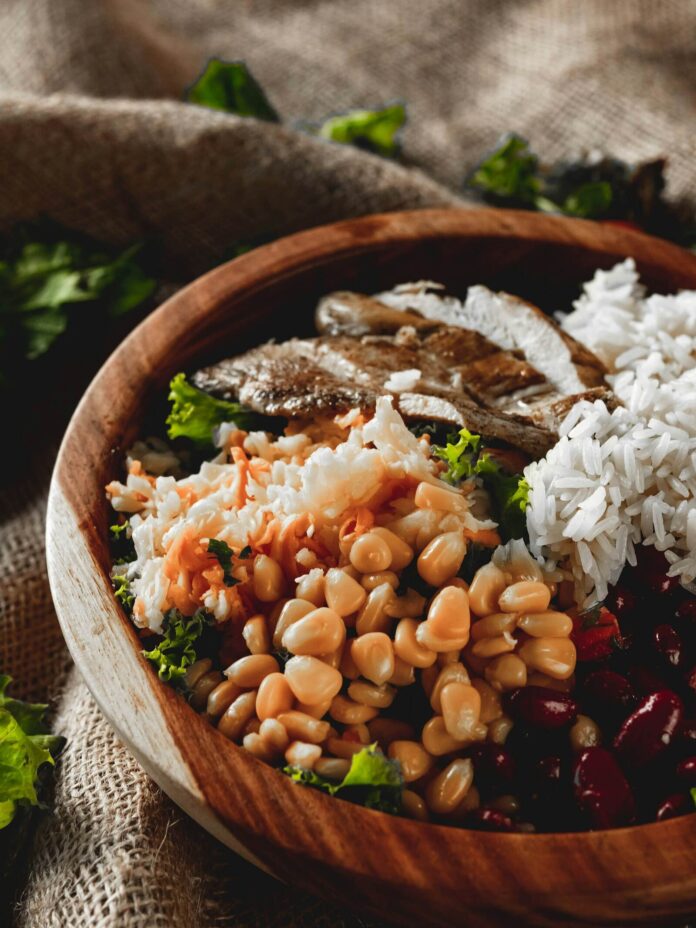

If you lift, want to lose fat without losing muscle, or simply want to age well, protein is the nutrient most likely to be holding you back. Most standard advice is built around the bare minimum, not around a 40-year-old man who trains and wants to perform. Here is what the research supports, plus three ready-made daily plans you can copy.
Free tool: get your exact number in 10 seconds with our protein calculator, including a sample vegetarian, vegan or meat-eater day.
Key takeaways
- The official minimum of 0.8 g per kg of body weight prevents deficiency; it is not an optimal target for active men.
- For building and keeping muscle, aim for about 1.6 g/kg per day, with a sensible range of 1.4–2.0 g/kg.
- Split protein across 3–4 meals of roughly 30–40 g each instead of loading it all into dinner.
- Meat-eaters, vegetarians and mixed eaters can all reach about 140 g a day with normal food; protein powder is optional.
- Higher protein intakes appear safe for healthy kidneys, but people with kidney disease need individual medical advice.
Why protein matters more after 35
From around 30, men gradually lose muscle. Harvard Health estimates the loss at up to 3–5% per decade. Strength training is the main signal that tells your body to keep muscle, and protein supplies the building material. If you have not started lifting yet, begin with our 3-day strength training plan for men over 35.
Age also changes how efficiently you use the protein you eat. In a study by Moore and colleagues, older men (average age about 71) needed roughly 0.40 g of protein per kg in a single meal to maximally stimulate muscle building. Younger men (about 22) needed only about 0.24 g/kg. At 35–50 you sit somewhere between those groups, so it makes sense to err on the generous side.
Three situations push your needs even higher:
- Regular training. Lifting increases the amount of protein your muscles can use for repair and growth.
- Fat loss. When you eat fewer calories, higher protein helps protect lean mass. See our guide on how to lose fat and keep muscle after 35.
- Getting older. The anabolic response to each meal tends to blunt with age, as the Moore data shows.
How much protein do you need? The evidence-based targets
The minimum: 0.8 g/kg
The Recommended Dietary Allowance (RDA) is 0.8 g of protein per kg of body weight per day. As Harvard Health points out, this is the minimum needed to avoid getting sick. It was never designed as a target for active people trying to build or hold on to muscle.
The training target: about 1.6 g/kg
Two key pieces of evidence point to the same zone:
- ISSN position stand (2017). The International Society of Sports Nutrition recommends 1.4–2.0 g/kg per day for most exercising people who want to build and maintain muscle.
- Morton et al. (2018). This meta-analysis pooled 49 randomised trials with 1,863 participants. Total protein intakes above about 1.62 g/kg per day produced no further gains in lean mass from resistance training. The statistical uncertainty around that figure was wide, with the upper bound reaching roughly 2.2 g/kg. The same analysis found that protein supplementation became less effective as age increased.
The practical takeaway: aim for about 1.6 g/kg as your daily baseline. Going up toward 2.0–2.2 g/kg is a reasonable buffer if you are older, training hard or want extra insurance.
During fat loss: higher still
The ISSN notes that resistance-trained people in a calorie deficit may need 2.3–3.1 g/kg to retain lean mass. That range comes from research on lean, trained individuals. For most men starting out, staying at 1.8–2.2 g/kg during a diet is a realistic and effective middle ground.
Per-meal distribution and the leucine idea
Your muscles respond to each protein-containing meal, so spreading intake through the day is smarter than one huge dinner. The ISSN suggests about 0.25 g/kg per meal, or 20–40 g, every 3–4 hours. Given the Moore findings, men over 35 can lean toward the upper end: around 0.3–0.4 g/kg per meal, which works out to roughly 25–35 g for an 85 kg man.
Leucine is an essential amino acid that acts as a key trigger for muscle protein synthesis. The ISSN recommends that each protein dose provide about 700–3,000 mg of leucine along with the other essential amino acids. Animal proteins, dairy and whey are generally rich in leucine. Plant proteins tend to contain less, so slightly bigger portions or combining sources (for example lentils with grains, or soy with dairy) helps close the gap.
One more evidence-backed tip from the ISSN: 30–40 g of casein protein before sleep can raise overnight muscle protein synthesis. Cottage cheese, Greek yogurt or a casein shake all work.
Adjusting the target for your body weight
The plans below hit about 140 g per day as a worked example for an 80–85 kg man. That equals roughly 1.65–1.75 g/kg. To find your own number, multiply your body weight in kg by 1.6 for a baseline, or by 2.0 for the upper end.
| Body weight | Daily target (1.6 g/kg) | Upper target (2.0 g/kg) | Per meal (4 meals) |
|---|---|---|---|
| 60 kg | 96 g | 120 g | 24–30 g |
| 70 kg | 112 g | 140 g | 28–35 g |
| 80 kg | 128 g | 160 g | 32–40 g |
| 90 kg | 144 g | 180 g | 36–45 g |
| 100 kg | 160 g | 200 g | 40–50 g |
If you carry a lot of extra body fat, calculating from your goal weight gives a more realistic number. To scale the sample plans, adjust portion sizes of the main protein foods up or down by roughly 10% for every 8–10 kg of difference.
Protein in common foods
Values are approximate and vary by brand, cut and cooking method, so check labels where you can. Figures come from UK and US food composition data (see Sources).
| Food | Serving | Approx. protein |
|---|---|---|
| Chicken breast, grilled, no skin | 100 g cooked | 32 g |
| Lean beef steak, grilled | 100 g cooked | 31 g |
| Salmon, grilled | 100 g cooked | 25 g |
| Tuna, canned in brine | 100 g drained | 25 g |
| Eggs | 1 large egg | 6–7 g |
| Milk | 250 ml | 9 g |
| Greek yogurt, plain nonfat | 200 g | 20 g |
| Cottage cheese | 200 g | 19 g |
| Cheddar cheese | 30 g | 8 g |
| Paneer | 100 g | 18–25 g (varies by brand) |
| Lentils, cooked | 1 cup (about 200 g) | 18 g |
| Chickpeas, cooked or canned | 1 cup | 14–15 g |
| Firm tofu | 150 g | 13–14 g (higher for extra-firm) |
| Tempeh | 1/2 cup | 16 g |
| Edamame | 1/2 cup | 10 g |
| Seitan | 100 g | about 25 g (varies by brand) |
| Almonds | 30 g | 6 g |
| Peanut butter | 2 tbsp | 6 g |
| Whey or plant protein powder | 1 scoop | about 20–25 g (check label) |
Three sample one-day plans (about 140 g)
Each plan spreads protein over four eating occasions and uses everyday foods available in India, Latin America and the US. Grains, vegetables and fruit add a few extra grams that are not counted here, so real totals will be slightly higher.
Plan 1: Meat-eater
- Breakfast: 3-egg omelette (about 19 g), 2 slices wholegrain toast (about 6 g), 250 ml milk (about 9 g). Total: about 34 g
- Lunch: 120 g cooked chicken breast (about 38 g) with rice and vegetables. Total: about 38 g
- Snack: 200 g Greek yogurt (about 20 g) with 30 g almonds (about 6 g). Total: about 26 g
- Dinner: 130 g grilled salmon (about 32 g) with 1/2 cup cooked lentils (about 9 g) and salad. Total: about 41 g
Daily total: about 139 g
Plan 2: Lacto-ovo vegetarian
- Breakfast: 3-egg omelette or bhurji (about 19 g), 2 slices wholegrain bread (about 6 g), 250 ml milk (about 9 g). Total: about 34 g
- Lunch: 1 cup cooked dal or lentils (about 18 g), 2 wholewheat rotis (about 7 g), 200 g Greek yogurt or thick hung curd (about 20 g). Total: about 45 g
- Snack: 1 scoop whey protein in water (about 24 g, check your label) and 30 g almonds (about 6 g). Total: about 30 g
- Dinner: 100 g paneer (about 18 g) cooked with 1 cup chickpeas (about 15 g), with rice or vegetables. Total: about 33 g
Daily total: about 142 g
No eggs? Swap them for 150 g firm tofu scramble plus an extra glass of milk, or a larger serving of Greek yogurt.
Plan 3: Mixed (mostly plants, some animal protein)
- Breakfast: 250 g Greek yogurt (about 25 g) and 2 slices toast with 2 tbsp peanut butter (about 12 g). Total: about 37 g
- Lunch: Tuna and chickpea salad: 100 g drained tuna (about 25 g) and 1 cup chickpeas (about 15 g). Total: about 40 g
- Snack: 250 ml milk (about 9 g) and 30 g cheese (about 8 g). Total: about 17 g
- Dinner: Stir-fry with 150 g firm tofu (about 14 g) and 100 g cooked chicken (about 32 g), with rice or noodles. Total: about 46 g
Daily total: about 140 g
Protein powder: useful, not essential
Powders are simply a convenient food. They help when you are travelling, short on time or struggling to reach your target with meals. A few points to keep in mind:
- Whey is fast-digesting and naturally rich in leucine, making it a good post-workout or snack option.
- Casein digests slowly and suits a pre-bed shake, in line with the ISSN guidance on 30–40 g before sleep.
- Plant powders (soy, pea or blends) work well for vegetarians, vegans and people who avoid dairy. Blends often improve the amino acid profile.
- Quality varies. Supplements are usually regulated less strictly than medicines, so look for products with independent third-party testing and a short ingredient list.
- Food first. Whole foods bring fibre, vitamins and minerals that a shake does not. Use powder to fill gaps, not replace meals.
Is high protein bad for your kidneys?
For healthy people, current evidence is reassuring. A 2018 meta-analysis in The Journal of Nutrition analysed 28 papers with more than 1,300 participants. It found no evidence that higher-protein diets harm kidney function in healthy adults. None of the participants had chronic kidney disease, however, so the findings do not apply to people who already do.
Kidney safety note: If you have chronic kidney disease, reduced kidney function, or risk factors such as long-standing diabetes or high blood pressure, do not raise your protein intake without medical advice. The US National Kidney Foundation generally advises a lower-protein diet for people with kidney disease who are not on dialysis, and recommends working with a kidney dietitian to set the right amount.
FAQ
Can my body only absorb 30 g of protein per meal?
No. That is a myth. Your body digests and absorbs the protein in a bigger meal too; the real question is how much your muscles put toward building in the hours that follow. Doses of 20–40 g, spread across the day, are a practical way to get the most from each meal. A larger meal is not wasted, but even distribution is a simple win.
Do I need more protein on rest days?
Keep your intake roughly the same every day. Muscle repair and growth continue for a day or more after training, so rest days are part of the process.
Can vegetarians build muscle as well as meat-eaters?
Yes, as long as total protein is high enough. Dairy and eggs are excellent leucine-rich sources. Plant-based eaters can combine legumes, soy, seitan and grains, and aim for slightly larger portions to make up for lower leucine content.
Should I calculate protein from my current weight or goal weight?
If you are fairly lean, use your current weight. If you have a lot of excess body fat, using your goal weight gives a more achievable number and still supports muscle.
Is 2 g/kg too much?
For healthy men, intakes up to about 2 g/kg sit within the ISSN range, and higher amounts are commonly used during dieting phases. The main trade-off is that more protein leaves fewer calories for other foods, so balance it with plenty of vegetables, fruit and whole grains.
Keep reading
Free tools: build a high-protein meal with the protein plate builder or get a full week of meals from the meal planner.
Sources
- Jäger R, et al. International Society of Sports Nutrition position stand: protein and exercise. Journal of the International Society of Sports Nutrition, 2017.
- Morton RW, et al. A systematic review, meta-analysis and meta-regression of the effect of protein supplementation on resistance training-induced gains in muscle mass and strength in healthy adults. British Journal of Sports Medicine, 2018.
- Moore DR, et al. Protein ingestion to stimulate myofibrillar protein synthesis requires greater relative protein intakes in healthy older versus younger men. Journals of Gerontology Series A, 2015.
- Harvard Health Publishing. How much protein do you need every day?
- Harvard Health Publishing. Declining muscle mass is part of aging, but not inevitable (2016).
- McMaster University. Summary of Devries MC, et al. Changes in kidney function do not differ between healthy adults consuming higher- compared with lower- or normal-protein diets. The Journal of Nutrition, 2018.
- National Kidney Foundation. CKD diet: how much protein is the right amount?
- British Nutrition Foundation. Protein in the diet (food composition table).
- Tufts Health and Nutrition Letter. What are the best plant-based protein sources?
- USDA FoodData Central (Greek yogurt, firm tofu, lentils, seitan entries).
This article is for general education and is not medical advice. Check with your doctor before starting a new training or nutrition plan, especially if you have a health condition.

