
Losing weight after 35 is not the hard part. Losing the right weight is. To lose fat and keep muscle after 35, you need a plan that protects the tissue keeping you strong and metabolically healthy, plus a way to track progress that goes beyond the bathroom scale.
Free tool: get your daily calorie target, protein goal and a timeline to your goal weight with our calorie and fat-loss calculator.
Key takeaways
- Aim to lose roughly 0.5–1% of your bodyweight per week. Slower loss tends to protect more muscle.
- Eat around 1.6–2.2 g of protein per kg of bodyweight daily, spread over three or four meals.
- Lift weights at least 2–3 times per week and try to keep your strength steady. This is the main signal that tells your body to hold on to muscle.
- Walk more. Daily steps burn meaningful energy without hurting recovery.
- Protect your sleep. Short sleep during a diet shifts more of the loss toward lean mass.
- Judge progress by waist size, photos and gym performance, not just scale weight or smart-scale body-fat readings.
Why muscle matters more after 35
From around age 30, adults gradually lose muscle mass. The U.S. National Institutes of Health puts the typical loss at roughly 3–5% per decade. It is easy to miss at first, but over time it chips away at strength and everyday capability.
Dieting can speed that process up. Harvard Health notes that a sizeable share of weight lost can come from muscle, and that rapid weight loss tends to cost more of it. A crash diet can leave you lighter but softer and weaker.
The goal is not “weight loss.” It is fat loss with muscle preservation: better body composition.
Why the scale misleads you
Your bodyweight is the sum of fat, muscle, bone, organs, water and the food currently in your gut. Only one of those is the thing you are trying to lose.
- Water swings are normal. Carbohydrates are stored in muscle and liver as glycogen, which holds water. Cut carbs and you drop water quickly; eat a big pasta dinner and you can gain a kilogram overnight. Neither is fat.
- Salt, stress and sleep shift fluid too. A salty meal can mask a week of real fat loss.
- Muscle and fat can change in opposite directions. If you are new to lifting, you may lose fat while adding some muscle, so the scale barely moves while your waist shrinks.
Use the scale as one data point. Weigh in daily or several times a week under the same conditions, then look at the weekly average rather than reacting to any single day.
Set a moderate calorie deficit
You must eat less energy than you burn, but the size of the deficit shapes what you lose.
An evidence review on natural bodybuilding preparation by Helms and colleagues recommends a pace of about 0.5–1% of bodyweight per week to maximize muscle retention. A randomized trial in elite athletes by Garthe and colleagues supports the logic: the group losing about 0.7% of bodyweight weekly increased lean mass, while the group losing about 1.4% weekly saw no lean-mass gain, even though both groups lost similar total weight.
Those were young athletes, so treat the findings as directional. The message still holds: slower is safer for muscle.
What that looks like in practice
- At 90 kg, 0.5–1% per week is about 0.45–0.9 kg per week.
- Start by trimming your usual intake by a few hundred calories a day, mainly from snacks, sugary drinks, alcohol and oversized portions.
- After two to three weeks, check your weekly average weight. Losing too fast? Eat a little more. Not moving? Trim a little more or add steps.
- If you carry a lot of excess fat, you can sit toward the faster end. If you are already fairly lean, stay near 0.5%.
Make protein the anchor of every meal
Protein supplies the raw material for muscle repair and helps you feel full on fewer calories.
A 2018 meta-analysis by Morton and colleagues in the British Journal of Sports Medicine, covering 49 trials, found that gains in fat-free mass from resistance training levelled off at a total protein intake of about 1.6 g per kg per day. The International Society of Sports Nutrition recommends 1.4–2.0 g/kg/day for most exercising people and notes that higher intakes may help trained lifters retain lean mass while dieting.
Dieting itself raises the stakes. In a four-week study by Longland and colleagues, young men in a steep calorie deficit who ate 2.4 g/kg of protein (with hard training) gained lean mass and lost more fat than those eating 1.2 g/kg.
Your protein target
- Aim for roughly 1.6–2.2 g/kg of bodyweight per day. At 85 kg, that is about 135–185 g.
- Split it into three or four servings of roughly 0.25 g/kg (about 20–40 g), which matches the ISSN’s per-meal guidance.
- Build meals around eggs, Greek yogurt or curd, paneer, chicken, fish, lean meat, lentils with dairy, tofu or a whey shake when you are short on time.
For food lists and vegetarian options, see our guide to protein after 35. If you have kidney disease or another medical condition, ask your doctor what intake is right for you.
Lift weights: the muscle-sparing signal
Protein provides the materials. Resistance training provides the reason to use them. A review in Advances in Nutrition on preserving muscle during weight loss concluded that exercise, and resistance training in particular, helps retain muscle mass and improves strength while you diet.
During a fat-loss phase your job in the gym is simple: keep your strength. You do not need to set records. If your main lifts hold steady while your weight drops, you are almost certainly keeping muscle.
- Train each major muscle group at least twice a week. Three full-body sessions of 45–60 minutes work well for busy schedules.
- Prioritize compound lifts: squats or leg presses, hinges such as deadlifts or hip thrusts, presses, rows and pull-downs.
- Keep the loads challenging. Most working sets should finish with one to three reps left in reserve.
- Do not slash volume or switch to light “toning” weights. That removes the very signal you need.
New to lifting or returning after years away? Start with our guide to strength training after 35.
Steps and NEAT: the quiet fat-burner
NEAT stands for non-exercise activity thermogenesis, the energy you burn through everyday movement: walking, standing, taking the stairs, playing with your kids. It often falls without you noticing when you diet, because your body tries to conserve energy.
Walking is the easiest way to keep it up. It burns energy, is gentle on recovery and does not compete with your lifting. A 2022 meta-analysis of 15 cohorts in The Lancet Public Health also linked more daily steps with lower risk of death, with benefits levelling off at around 8,000–10,000 steps per day in adults under 60.
- Find your current daily average, then add 1,500–2,000 steps.
- Work toward roughly 8,000–10,000 steps on most days.
- Take calls on foot or walk 10 minutes after meals.
Sleep and stress: the hidden variables
Sleep is not a soft extra. In a small controlled study by Nedeltcheva and colleagues, adults on the same calorie-restricted diet slept either 8.5 or 5.5 hours a night for two weeks. Total weight loss was similar, but with short sleep they lost less than half as much fat (0.6 kg versus 1.4 kg) and more fat-free mass.
Poor sleep also raises hunger and makes training feel harder. With young children, perfect sleep may be unrealistic, so control what you can:
- A consistent bedtime and wake time, even on weekends.
- No caffeine after early afternoon.
- A dark, cool room and screens away for the last 30 minutes.
Chronic work stress pushes many men toward late-night eating and skipped sessions. Walking and fixed training slots in your calendar help.
How to track progress properly
Use several measures together. If most move the right way, you are on track.
- Weekly average weight: trend over 2–4 weeks, not day to day.
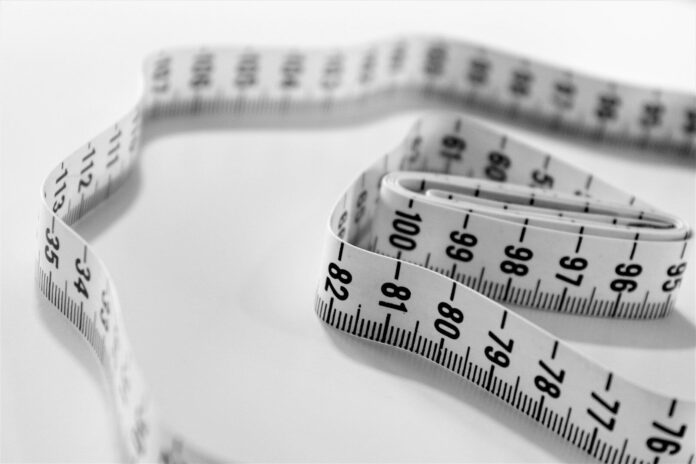
- Waist circumference: measure at the navel, relaxed, same time of day, once a week. A shrinking waist with steady strength is the clearest sign of fat loss.
- Photos: front, side and back, same lighting, every two to four weeks.
- Strength: log your main lifts. Stable or rising numbers suggest you are keeping muscle.
A word on smart scales
Most home smart scales estimate body fat using bioelectrical impedance analysis (BIA), sending a small current through your body. The reading depends heavily on hydration, so it can jump after a workout, a drink or a salty meal.
A 2021 study in JMIR mHealth and uHealth compared three consumer smart scales with DEXA scans. The scales measured weight accurately, but their body-fat and muscle-mass estimates were poor, with fat mass underestimated by a median of roughly 2–4.5 kg. Use the weight reading, and treat the body-fat percentage as a rough trend at best.
A simple weekly framework
A template that fits around work and family. Adjust days to suit you.
| Day | Training | Movement | Nutrition focus |
|---|---|---|---|
| Monday | Full-body strength A (45–60 min) | 8,000+ steps | Protein at every meal; weigh in |
| Tuesday | Rest or 20–30 min easy cardio | 8,000–10,000 steps | Hit protein target; plan the week’s meals |
| Wednesday | Full-body strength B | 8,000+ steps | Protein-rich lunch to curb evening snacking |
| Thursday | Rest or mobility | 8,000–10,000 steps; walk after dinner | Keep alcohol off weeknights |
| Friday | Full-body strength A (aim to match or beat Monday) | 8,000+ steps | Pre-plan any social meals |
| Saturday | Optional: family activity, hike or sport | Long walk or active outing | Flexible meal, still protein-first |
| Sunday | Rest | Easy walk | Weekly check-in: average weight, waist, photos, lift log |
Want to add more conditioning once this feels routine? Our guide to VO2 max after 35 explains how to build aerobic fitness without undermining your strength work.
Plateaus and diet breaks
A stall of a week or two usually means water is masking fat loss. A real plateau is three or more weeks with no change in average weight and no change in waist size.
Before cutting more food, check the basics: honest portions, weekend creep and step count.
If you have been dieting for several months and feel flat, a planned diet break can help. In the MATADOR trial, men with obesity alternated two weeks of dieting with two weeks at maintenance calories. Compared with continuous dieting, they lost more weight and fat overall, though the process took longer. Evidence is still limited, but a one- to two-week break at maintenance every 8–12 weeks is a reasonable tool if motivation or training quality is slipping.
Alcohol: the overlooked obstacle
Alcohol adds calories that are easy to overlook, lowers your guard around food and disrupts sleep. It may also blunt recovery. In a study by Parr and colleagues, heavy drinking after a workout (roughly 12 standard drinks for an average-sized man) reduced muscle protein synthesis by about 24% even when protein was consumed alongside it.
That was a large dose, so an occasional drink is not a disaster. Still, during a fat-loss phase, keep alcohol to a few drinks a week, avoid drinking right after training and choose lower-calorie options.
A note on GLP-1 medications
GLP-1 medications such as semaglutide and tirzepatide are now widely prescribed for weight management. Whether they suit you is a conversation for you and your doctor. If you do use them, the principles in this guide matter even more: Harvard Health notes that faster weight loss can come with greater muscle loss, so adequate protein and regular resistance training become key ways to protect lean mass. Your doctor can help you set protein and training targets that fit your situation.
Safety note: If you have heart disease, diabetes, kidney disease, high blood pressure or any other medical condition, or you take regular medication, talk to your doctor before cutting calories, raising protein substantially or starting a new training plan. Seek medical advice promptly if you experience chest pain, dizziness or unusual shortness of breath during exercise.
Common mistakes to avoid
- Cutting too hard. Big deficits make you hungrier, weaker and more likely to lose muscle.
- Swapping lifting for cardio. Cardio helps, but it does not replace the signal from lifting.
- Under-eating protein. Many men eat far less than they think, especially at breakfast.
- Reacting to daily weigh-ins. Follow the weekly trend, not the morning number.
- Trusting smart-scale body-fat numbers. Use the tape measure and the mirror instead.
- Weekend drift. Two loose days can erase five careful ones.
FAQ
Can I build muscle while losing fat after 35?
Often, yes, especially if you are new to lifting, returning after a break or carrying a fair amount of excess fat. With high protein, consistent lifting and a modest deficit, many men add some muscle while losing fat. Leaner, experienced lifters should usually aim simply to maintain.
How fast should I lose weight?
About 0.5–1% of your bodyweight per week is a sound target for keeping muscle. Faster loss is possible, especially early on when water drops, but sustained rapid loss raises the risk of losing muscle and stalling your training.
Do I need protein shakes?
No. Whole foods work fine. A shake is simply convenient on busy days.
Is cardio bad for muscle?
Not in sensible amounts. Walking and moderate cardio support fat loss and heart health. Just keep strength training the priority and avoid cardio that leaves you too tired to lift.
How long should a fat-loss phase last?
That depends on how much fat you want to lose. Many people do well with phases of 8–16 weeks, followed by a break at maintenance calories, before deciding whether to continue.
Keep reading
Free tools: track your weekly averages with the progress tracker and estimate your body fat with the body fat calculator.
Sources
- NIH News in Health. Slowing Sarcopenia (2025).
- Harvard Health Publishing. Trying to lose weight? Be careful not to lose muscle.
- Helms ER, Aragon AA, Fitschen PJ. Evidence-based recommendations for natural bodybuilding contest preparation: nutrition and supplementation. J Int Soc Sports Nutr. 2014.
- Garthe I, et al. Effect of two different weight-loss rates on body composition and strength and power-related performance in elite athletes. Int J Sport Nutr Exerc Metab. 2011.
- Morton RW, et al. A systematic review, meta-analysis and meta-regression of the effect of protein supplementation on resistance training-induced gains in muscle mass and strength in healthy adults. Br J Sports Med. 2018.
- Jäger R, et al. International Society of Sports Nutrition Position Stand: protein and exercise. J Int Soc Sports Nutr. 2017.
- Longland TM, et al. Higher compared with lower dietary protein during an energy deficit combined with intense exercise promotes greater lean mass gain and fat mass loss. Am J Clin Nutr. 2016.
- Cava E, Yeat NC, Mittendorfer B. Preserving healthy muscle during weight loss. Adv Nutr. 2017.
- Paluch AE, et al. Daily steps and all-cause mortality: a meta-analysis of 15 international cohorts. Lancet Public Health. 2022.
- Nedeltcheva AV, et al. Insufficient sleep undermines dietary efforts to reduce adiposity. Ann Intern Med. 2010.
- Frija-Masson J, et al. Accuracy of smart scales on weight and body composition: observational study. JMIR Mhealth Uhealth. 2021.
- Byrne NM, et al. Intermittent energy restriction improves weight loss efficiency in obese men: the MATADOR study. Int J Obes. 2018.
- Parr EB, et al. Alcohol ingestion impairs maximal post-exercise rates of myofibrillar protein synthesis following a single bout of concurrent training. PLoS One. 2014.
This article is for general education and is not medical advice. Check with your doctor before starting a new training or nutrition plan, especially if you have a health condition.

