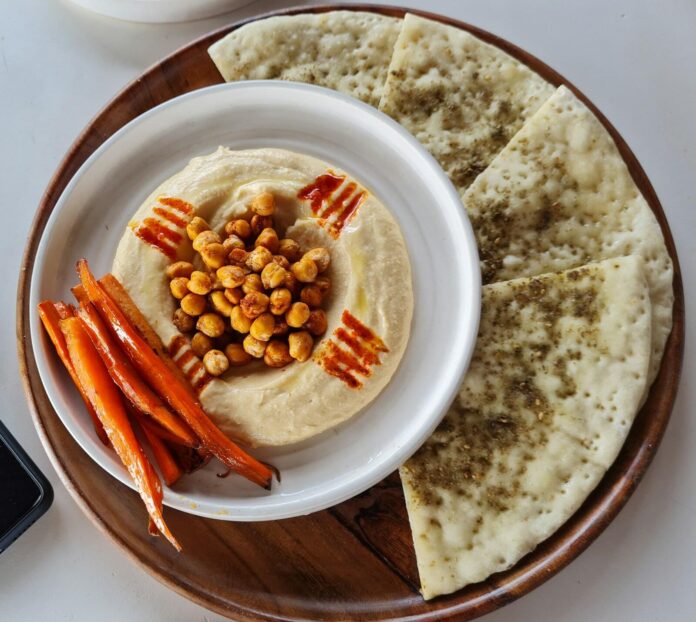

Shop-bought hummus is fine, but a typical 100 g tub delivers only 7 or 8 g of protein, and most of us eat it with crackers. This high-protein hummus doubles down on legumes, blending chickpeas with white beans and a generous dose of tahini, then pairs it with a full plate of raw vegetable sticks. The result is about 13 g of protein and 11 g of fibre per serving for roughly 330 kcal, made in 10 minutes with no cooking. It is a snack that actually holds you until the next meal, and it is naturally vegan.
At a glance
- Time: 10 minutes prep, no cooking
- Serves: 4 (about 160 g / 2/3 cup hummus each, plus vegetable sticks)
- Protein per serving: about 13 g
- Calories per serving: about 330 kcal
- Diet: Vegan, vegetarian, gluten-free, dairy-free
Ingredients
Makes 4 servings.
- 240 g (1 1/2 cups) canned chickpeas, drained and rinsed (one 400 g / 15 oz can)
- 240 g (1 1/2 cups) canned white beans such as cannellini or navy beans, drained and rinsed (one 400 g / 15 oz can)
- 4 tbsp (60 g / 2 oz) tahini, well stirred
- 3 tbsp (45 ml / 45 g) fresh lemon juice, about 1 lemon
- 2 garlic cloves, about 6 g
- 1 tbsp (15 g) extra-virgin olive oil
- 1 tsp (2 g) ground cumin
- 1/2 tsp salt and 60 to 90 ml (1/4 to 1/3 cup) ice-cold water (not counted)
- To serve: 240 g (8.5 oz, 3 medium) carrots, 240 g (8.5 oz, 1 medium) cucumber and 240 g (8.5 oz, 2 medium) red bell peppers, cut into sticks
- Optional garnish: a pinch of smoked paprika and chopped parsley (not counted)
Method
- Whip the tahini. Put the tahini, lemon juice and garlic in a food processor or high-speed blender and run it for 1 minute. The mixture will seize and then turn pale and creamy; this step is what gives you smooth hummus without peeling the chickpeas.
- Add the legumes. Add the drained chickpeas, white beans, olive oil, cumin and salt. Process for 1 minute until the mixture is thick and grainy.
- Thin with ice water. With the motor running, pour in the ice-cold water a tablespoon at a time. Keep going for 2 to 3 minutes, scraping down the sides once, until the hummus is completely smooth and slightly fluffy. Cold water keeps it light rather than pasty.
- Taste and adjust. Add more lemon for sharpness, more salt if it tastes flat, or a splash more water if it is too stiff. The hummus thickens as it rests, so stop a little looser than you want it.
- Cut the vegetables. Peel the carrots and cut them, the cucumber and the peppers into sticks about 1 cm (1/2 inch) thick and 8 to 10 cm (3 to 4 inches) long.
- Serve or store. Spoon a quarter of the hummus (about 160 g) into a bowl, swirl the top, add paprika and parsley if using, and serve with a quarter of the vegetable sticks. Pack the rest in four containers for the week.
Nutrition per serving
Approximate values per serving, calculated from the ingredient weights above (USDA SR Legacy data).
| Nutrient | Per serving (approx.) |
|---|---|
| Calories | 330 kcal |
| Protein | 13 g |
| Carbohydrate | 43 g |
| Fat | 14 g |
| Fibre | 11 g |
Values include the carrot, cucumber and pepper sticks (one quarter of each per serving). Salt, water and the optional paprika and parsley garnish are not counted. The hummus alone, without vegetables, is about 280 kcal and 11 g of protein per serving.
Make it higher protein / lighter
- More protein: Blend in 4 tbsp (40 g) hulled hemp seeds with the legumes. That adds about 3 g of protein and 55 kcal per serving, taking you to roughly 16 g. Alternatively, swap the white beans for 240 g (1 1/2 cups) cooked, shelled edamame for a similar gain with almost no change in calories.
- Not vegan but higher protein: Replace the ice water with 100 g (3.5 oz) plain non-fat Greek yogurt. It adds about 2.5 g of protein and 15 kcal per serving and makes the hummus very creamy.
- Lighter: Halve the tahini to 2 tbsp (30 g) and leave out the olive oil. You drop to about 255 kcal per serving with only 1 g less protein. Use more lemon and a little extra water to keep it smooth.
- Batch and meal prep: The recipe doubles easily in a standard food processor. Hummus keeps for 5 days in the fridge and freezes for up to 3 months; stir well after thawing. Cut vegetables keep for 3 to 4 days in a container with a damp paper towel.
- Variation: Blend in 100 g (3.5 oz) roasted red pepper from a jar for a sweeter, smoky version, or add 1 tsp harissa and a squeeze more lemon for heat. For a green hummus, add a large handful of fresh coriander or parsley leaves.
FAQ
Why add white beans to hummus?
White beans have a protein content close to chickpeas but a milder flavour and softer texture, so they blend into a creamier hummus without tasting different. Using both doubles the legume base for the same amount of tahini and oil, which is how this version lands at 13 g of protein per serving while keeping fat moderate.
Can I use dried chickpeas instead of canned?
Yes. Soak 100 g (1/2 cup) dried chickpeas overnight, then simmer for 60 to 90 minutes until very soft; this gives roughly 240 g cooked. Do the same with 100 g dried white beans, or use one can of each to keep it a 10-minute recipe. Cooked-from-dry chickpeas tend to be softer and make an even smoother hummus.
Is hummus a good snack around training?
It works well as an afternoon snack 2 to 3 hours before an evening session: the carbohydrate and protein are slow to digest thanks to the fibre, so you get steady energy rather than a spike. Right after training, pair a serving with a protein-rich food such as eggs, cottage cheese, tofu or a shake, since 13 g alone is below the amount most people aim for in a post-workout meal.
How long does homemade hummus keep?
Store it in an airtight container in the fridge for up to 5 days. A thin film of olive oil on top slows browning and drying. It also freezes well in single portions for up to 3 months; thaw overnight in the fridge and stir in a teaspoon of water to bring back the texture.
Snacks like this are easiest to fit in when you know your daily target, so check it with the protein calculator and build it into the 7-day meal planner. For more plant-based options, see our list of muscle-building foods, including vegetarian picks, and pair this with the high-protein overnight oats for a no-cook day.
Sources
- USDA National Nutrient Database for Standard Reference, Release 28 (SR Legacy), NDB No. 16359 Chickpeas (garbanzo beans, bengal gram), mature seeds, canned, drained, rinsed in tap water. fdc.nal.usda.gov
- USDA National Nutrient Database for Standard Reference, Release 28 (SR Legacy), NDB No. 16051 Beans, white, mature seeds, canned. fdc.nal.usda.gov
- USDA National Nutrient Database for Standard Reference, Release 28 (SR Legacy), NDB No. 12166 Seeds, sesame butter, tahini, from roasted and toasted kernels. fdc.nal.usda.gov
- USDA National Nutrient Database for Standard Reference, Release 28 (SR Legacy), NDB No. 04053 Oil, olive, salad or cooking. fdc.nal.usda.gov
- USDA National Nutrient Database for Standard Reference, Release 28 (SR Legacy), NDB No. 11124 Carrots, raw. fdc.nal.usda.gov
- USDA National Nutrient Database for Standard Reference, Release 28 (SR Legacy), NDB No. 11821 Peppers, sweet, red, raw. fdc.nal.usda.gov
Nutrition values are estimates and vary by brand and portion. This is general information, not medical advice.

