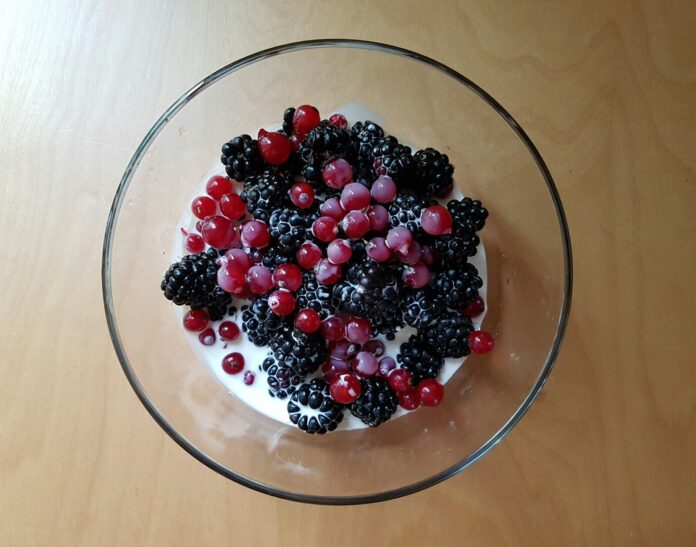

This Greek yogurt protein bowl is for anyone over 35 who trains a few hours a week and wants breakfast sorted in five minutes without a pan. Each bowl gives you about 33 g of protein and 440 kcal from plain Greek yogurt, berries, almonds and chia seeds, which lands inside the 20–40 g per-meal range that sports nutrition bodies recommend for building and keeping muscle. Compared with a bowl of cereal and milk or a pastry and coffee, you get roughly three times the protein, more fibre and far less sugar, and you can carry it to work in a jar.
At a glance
- Time: 5 minutes prep, no cooking
- Serves: 2
- Protein per serving: about 33 g
- Calories per serving: about 440 kcal
- Diet: Vegetarian, gluten-free; vegan option below
Ingredients
Makes 2 servings. Weigh the yogurt, nuts and seeds if you can; they decide the protein and calorie numbers.
- 500 g (2 cups / 18 oz) plain Greek yogurt, nonfat (0% or “fat-free”)
- 160 g (1 cup) fresh blueberries
- 160 g (1 cup, halved) fresh strawberries
- 40 g (1/3 cup / about 1.4 oz) almonds, roughly chopped
- 30 g (2 tbsp) chia seeds
- 20 g (1 tbsp) honey
- Optional, not counted: a pinch of ground cinnamon, a few drops of vanilla extract, a little lemon zest
Method
- Weigh the yogurt. Spoon 250 g (1 cup) of Greek yogurt into each of two bowls or jars. If you are using vanilla or cinnamon, stir it in now so the flavour runs through the whole bowl rather than sitting on top.
- Prep the fruit. Rinse the blueberries. Hull the strawberries and halve or quarter them depending on size. Pat both dry so they do not water down the yogurt.
- Chop the almonds. Roughly chop 40 g of almonds with a knife, or crush them in a bag with the base of a pan. Big, uneven pieces give more crunch than fine slivers.
- Build the bowl. Divide the blueberries and strawberries between the two bowls, keeping a few berries back for the top. Scatter half the almonds over each.
- Add chia and honey. Sprinkle 15 g (1 tbsp) of chia seeds over each bowl and drizzle 10 g (about half a tablespoon) of honey across the fruit. Eat straight away for crunchy chia, or wait 10 minutes and the seeds soften and thicken the yogurt slightly.
- Finish or pack. Top with the reserved berries and lemon zest if using. To take it with you, layer the yogurt in a jar, then fruit, then chia, and keep the almonds in a small bag until you eat.
Nutrition per serving
Approximate values per serving, calculated from the ingredient weights above (USDA SR Legacy data).
| Nutrient | Per serving (approx.) |
|---|---|
| Calories | 440 kcal |
| Protein | 33 g |
| Carbohydrate | 46 g |
| Fat | 16 g |
| Fibre | 11 g |
The optional cinnamon, vanilla and lemon zest are not counted. Values assume nonfat Greek yogurt; low-fat or whole-milk yogurt adds fat and calories and slightly lowers protein.
Make it higher protein / lighter
- More protein: Stir a scoop (about 25–30 g) of unflavoured or vanilla whey into the yogurt before adding fruit; most whey powders add roughly 20 g of protein per scoop and make the yogurt thicker and sweeter, so you can skip the honey. Hemp seeds (3 tbsp, about 30 g) in place of chia add a few extra grams too.
- Lighter: Leave out the honey and use half the almonds (20 g per recipe instead of 40 g). Based on the ingredient data above that saves about 90 kcal per serving while keeping protein at around 31 g. The strawberries and blueberries carry enough sweetness for most people.
- Make it vegan: Use an unsweetened soy yogurt, ideally a thick “Greek-style” one, and swap the honey for maple syrup. Soy yogurt usually has about half the protein of Greek yogurt per 100 g, so expect roughly 18–20 g per bowl instead of 33 g; stir in a scoop of pea or soy protein powder to bring it back above 30 g. Coconut and oat yogurts are much lower in protein and do not suit this recipe.
- Batch and meal prep: Portion yogurt and chia into four jars at the weekend. Add berries the night before you eat each one and keep the almonds separate so they stay crunchy. Yogurt and chia keep for 4–5 days in the fridge.
- Variations: Swap the berries for 150 g of diced mango with lime zest, or sliced banana with 1 tbsp of peanut butter and cocoa powder. In winter, warm 160 g of frozen berries for a minute in the microwave and spoon them, juice and all, over cold yogurt.
FAQ
Can I make this the night before?
Yes. Yogurt, chia and berries sit happily together overnight in a sealed jar; the chia swells and the texture becomes closer to a thick pudding. Keep the almonds separate and add them in the morning, because nuts go soft after a few hours in yogurt. Eat within 24 hours once the fruit is in.
Does it have to be nonfat Greek yogurt?
No, but the numbers change. USDA data for whole-milk Greek yogurt shows about 97 kcal and 9 g protein per 100 g, against 59 kcal and 10 g for nonfat, so a 250 g portion of whole-milk yogurt adds roughly 95 kcal and takes about 3 g of protein off the total. Low-fat (2%) sits in between. Skyr or Icelandic-style yogurt works well too and is usually even higher in protein. Avoid “Greek-style” yogurts that are thickened with starch rather than strained; check that protein is at least 9 g per 100 g on the label.
When should I eat it around training?
It suits both ends of a session. Before an early workout, the carbohydrate from the fruit and honey gives you quick fuel and the yogurt is easy to digest for most people if you allow 45–60 minutes. After training, 33 g of protein plus carbohydrate is a sensible recovery meal. If you train at lunchtime, this bowl at breakfast and a protein-rich lunch keeps your intake spread out across the day, which the sports nutrition guidance below favours.
Can I use frozen berries?
Yes, and they are cheaper for most of the year. Frozen unsweetened strawberries and blueberries have almost the same calories, protein and fibre per 100 g as fresh. Thaw them in the fridge overnight or microwave for 60–90 seconds, then spoon them over the yogurt with their juice. Skip sweetened frozen fruit, which can double the carbohydrate.
Not sure how much protein you need in a day? Work it out with our protein calculator, then slot this bowl into the meal planner. For the reasoning behind the target, read how much protein you need after 35, and if you want more mornings like this one, see our 20 vegetarian high-protein breakfasts and the high-protein overnight oats recipe.
Sources
- USDA National Nutrient Database for Standard Reference, Release 28 (SR Legacy), NDB No. 01256 Yogurt, Greek, plain, nonfat. fdc.nal.usda.gov
- USDA National Nutrient Database for Standard Reference, Release 28 (SR Legacy), NDB No. 09050 Blueberries, raw. fdc.nal.usda.gov
- USDA National Nutrient Database for Standard Reference, Release 28 (SR Legacy), NDB No. 09316 Strawberries, raw. fdc.nal.usda.gov
- USDA National Nutrient Database for Standard Reference, Release 28 (SR Legacy), NDB No. 12061 Nuts, almonds. fdc.nal.usda.gov
- USDA National Nutrient Database for Standard Reference, Release 28 (SR Legacy), NDB No. 12006 Seeds, chia seeds, dried. fdc.nal.usda.gov
- USDA National Nutrient Database for Standard Reference, Release 28 (SR Legacy), NDB No. 19296 Honey. fdc.nal.usda.gov
- Jäger R, Kerksick CM, Campbell BI, et al. International Society of Sports Nutrition Position Stand: protein and exercise. Journal of the International Society of Sports Nutrition, 2017. Recommends 1.4–2.0 g/kg/day for exercising adults, in doses of about 20–40 g spread every 3–4 hours. cdr.lib.unc.edu
Nutrition values are estimates and vary by brand and portion. This is general information, not medical advice.

