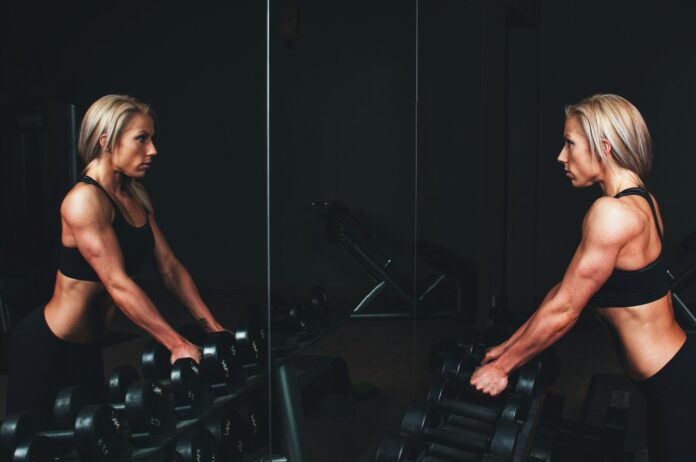

Strength training for women over 35 does not need hours in the gym. Three full-body sessions of about 40 minutes a week, built around squats, hinges, pushes, pulls and carries, is enough to build strength, protect your bones and keep you capable for decades. A large 2022 meta-analysis linked just 30 to 60 minutes of muscle-strengthening activity a week with roughly 10 to 20% lower risk of early death, heart disease and cancer.
Key takeaways
- Health guidelines from the NHS and CDC ask adults to do muscle-strengthening work on at least 2 days a week, covering all major muscle groups.
- Muscle mass can fall by as much as 3 to 5% per decade from age 30 if you do nothing to keep it, and lifting is the most effective way to slow that loss.
- Women gain muscle at a similar relative rate to men when they train, so lifting heavy will make you stronger and more toned, not “bulky”.
- The plan below uses two alternating full-body workouts (A and B) three days a week, with clear rules for when to add weight.
- Choose weights that leave you with 2 to 3 good reps in reserve. Weights that feel too easy are a common reason progress stalls.
Why strength training matters more after 35
Your mid-thirties are when muscle quietly starts to slip away. Harvard Health notes that after 30 you can lose as much as 3 to 5% of your muscle mass per decade. You rarely notice it year to year. You notice it when stairs feel harder, a suitcase feels heavier or your back complains after a day of gardening.
Strength training reverses much of that trend at any age. Mayo Clinic lists its benefits as stronger bones, better weight and body-composition management, improved balance and lower fall risk, help with chronic conditions such as arthritis, heart disease, diabetes and depression, and sharper thinking in older adults.
The longevity link
A 2022 systematic review in the British Journal of Sports Medicine pooled 16 cohort studies of adults. People who did muscle-strengthening activities had a 10 to 17% lower risk of all-cause death, cardiovascular disease, total cancer, diabetes and lung cancer. The biggest benefit appeared at about 30 to 60 minutes a week. That is the time you will spend on the plan below, so you do not need marathon sessions to get the payoff.
Bones need load, not just calcium
Bone responds to force. The LIFTMOR trial tested heavy, supervised lifting in 101 postmenopausal women with low bone mass. Twice-weekly 30-minute sessions of 5 sets of 5 reps at more than 85% of their maximum, for eight months, improved bone density at the spine (about +2.9% versus -1.2% in the low-intensity group) and at the hip. Only one minor adverse event, a back spasm, was reported.
Those women were older than you and closely supervised, so this is not a beginner template. It does show that progressively heavier lifting is a bone-building tool, not a risk to avoid. Starting in your 30s and 40s lets you build strength before bone loss speeds up around menopause. If you are in perimenopause or menopause and have questions about symptoms or bone health, talk to your doctor, because they can tell you whether a bone density scan or other checks make sense for you.
Myth vs evidence: what holds women back
| Myth | What the evidence says |
|---|---|
| “Lifting will make me bulky.” | A 2025 meta-analysis of 29 studies found women build muscle at a similar relative rate to men, while absolute gains slightly favour men. Getting very large takes years of dedicated training and eating for it. For most women, lifting creates a firmer, stronger shape. |
| “Women should use light weights and high reps.” | Light weights only work if you take sets close to fatigue. Mayo Clinic advises choosing a weight heavy enough to tire your muscles in about 12 to 15 reps. Heavier loads for fewer reps work too, and are especially useful for bone. |
| “Cardio is better for fat loss.” | Both burn energy, but only resistance training reliably preserves muscle while you lose fat. Do both: the plan leaves room for walking and easy cardio. |
| “Women respond less to training.” | A 2020 meta-analysis found women had greater relative gains in upper-body strength than men and similar gains in lower-body strength. |
| “It’s too late to start after 40.” | The LIFTMOR participants averaged 65 years old and still gained bone and function. Your starting point does not cap your progress. |
Your 2-minute starting self-test
Before week 1, write down three numbers. Retest at week 6 and week 12. Seeing them rise is one of the best reasons to keep going.
- 30-second chair stand: sit on a firm chair, arms crossed over your chest. Count how many times you can stand fully and sit back down in 30 seconds.
- Push-up test: do as many push-ups as you can with good form, using a kitchen counter, a bench or the floor. Note which height you used.
- Front plank: hold a forearm plank with a straight line from head to heels. Stop when your hips sag.
There is no pass or fail. These are your personal baselines. For more simple checks, try the sitting-rising and balance tests.
The simple 3-day strength plan
You will alternate two full-body workouts across three non-consecutive days, such as Monday, Wednesday and Friday. Week 1 is A-B-A. Week 2 is B-A-B. Each session takes 35 to 45 minutes including a warm-up.
| Workout A | Sets x reps | Workout B | Sets x reps |
|---|---|---|---|
| Goblet squat | 3 x 8–12 | Romanian deadlift (dumbbells or barbell) | 3 x 8–12 |
| Dumbbell bench press or push-up | 3 x 8–12 | Standing dumbbell shoulder press | 3 x 8–12 |
| One-arm dumbbell row | 3 x 10–12 per side | Lat pulldown or band pulldown | 3 x 10–12 |
| Glute bridge or hip thrust | 2 x 10–15 | Reverse lunge or split squat | 2 x 8–10 per leg |
| Front plank | 3 x 20–40 sec | Farmer’s carry | 3 x 30–40 m (about 100–130 ft) |
Rest 60 to 90 seconds between sets of the bigger lifts and 45 to 60 seconds for the smaller ones. If you are short on time, pair an upper-body and a lower-body move and alternate between them.
Warm-up (5 minutes)
- 2 minutes of brisk walking, cycling or marching on the spot.
- 10 bodyweight squats, 10 glute bridges, 10 band pull-aparts or arm circles.
- One light set of your first exercise at about half your working weight.
Home and gym swaps
You can run the whole plan at home with a pair of adjustable dumbbells, a resistance band and a sturdy chair. Use a band anchored to a door for pulldowns, the floor for presses and a backpack or two shopping bags for carries. In a gym, swap in a leg press, cable rows or a barbell when you are ready. Not sure which muscles a move works? Tap them on our muscle map.
How heavy should you lift?
This is where most programmes go wrong. Pick a weight that lets you finish every rep with good form, but leaves only 2 or 3 more reps “in the tank” at the end of the set. If you could have done 8 more, the weight is too light.
That matches the NHS advice to do strength exercises “to the point where you need a short rest” before repeating. It does not mean grinding to total failure, which adds fatigue and injury risk without much extra benefit for beginners.
The double-progression rule
- Start each exercise at the bottom of its rep range, for example 3 sets of 8.
- Each session, try to add a rep or two at the same weight.
- When you can do the top of the range (3 x 12) with good form, increase the weight by the smallest step available, usually 1 to 2.5 kg (2.5 to 5 lb) per dumbbell.
- Drop back to the bottom of the range and build up again.
Your first 12 weeks
| Weeks | Focus | Sets | Effort |
|---|---|---|---|
| 1–2 | Learn the movements, find starting weights | 2 per exercise | 3–4 reps in reserve |
| 3–6 | Build: add reps, then weight | 3 per main exercise | 2–3 reps in reserve |
| 7 | Lighter week: same weights, one set fewer | 2 | Easy, focus on form |
| 8–12 | Progress loads on squats, hinges and presses | 3–4 on main lifts | 1–3 reps in reserve |
After week 12, retest your three baseline numbers. Then keep the same structure and change a few exercises, such as swapping goblet squats for a barbell or split squats for step-ups.
Fitting it into a busy week
You do not need to choose between strength and cardio. NHS and CDC guidelines ask for at least 150 minutes of moderate activity a week, plus muscle-strengthening work on 2 or more days. A realistic 3 to 4 hour week looks like this:
- 3 strength sessions of about 40 minutes (2 hours).
- 2 easy cardio sessions of 30 to 40 minutes, such as brisk walking, cycling, swimming or a dance class. Our zone 2 training guide explains how to pace them.
- Daily walking in between. See walking vs running for fat loss for step targets.
On a chaotic week, two sessions still count. Our guide to the minimum effective dose of exercise shows how little you need to hold on to your progress.
Recovery: where the results happen
Muscle grows between sessions, not during them. Three things matter most:
- Sleep: aim for 7 to 9 hours. Our guide to sleeping better after 35 has practical fixes.
- Protein at every meal: include a palm-sized portion of eggs, Greek yogurt, fish, chicken, tofu, tempeh, lentils, chickpeas or paneer at each meal. Vegetarian sources work well when you combine a few across the day.
- Rest days: keep at least one day between strength sessions. Light walking on those days helps soreness settle.
Some muscle soreness in the first two weeks is normal. Sharp pain, or pain that gets worse during a set, is not.
Safety note: If you have heart disease, high blood pressure, a joint or back problem, osteoporosis, or you are pregnant or recently gave birth, check with your doctor or a physiotherapist before starting. Stop and seek medical help if you feel chest pain, unusual breathlessness, dizziness or palpitations during exercise. Learn each lift with a light weight first, and consider one or two sessions with a qualified coach to check your form.
FAQ
How many days a week should a woman over 35 strength train?
Two days a week is the minimum in NHS and CDC guidelines. Three full-body sessions, as in this plan, gives you more practice and faster progress while still leaving rest days.
Will strength training make me lose weight?
Lifting builds and preserves muscle, which helps your body composition and daily function. Fat loss itself comes mainly from a modest, sustainable calorie deficit. Combining both is the best way to lose fat while staying strong.
Should I lift heavy or light weights?
Both work if the set ends close to fatigue. Use the 2 to 3 reps-in-reserve rule and keep adding weight over time. As you gain experience, heavier sets of 5 to 8 reps on main lifts are useful for strength and bone.
Can I do this plan at home?
Yes. Adjustable dumbbells, a resistance band and a chair cover every exercise. If the dumbbells become too light, slow the lowering phase to 3 seconds or move to single-leg versions.
How long until I see results?
Most beginners notice strength gains within 3 to 4 weeks as their nervous system learns the movements. Visible muscle changes usually take 8 to 12 weeks of consistent training.
Free tool: count your squats and push-ups hands-free with the AI rep counter, and see how your fitness could look in 10 or 20 years with Future You.
Sources
- Momma H, Kawakami R, Honda T, Sawada SS. Muscle-strengthening activities are associated with lower risk and mortality in major non-communicable diseases: a systematic review and meta-analysis of cohort studies. Br J Sports Med, 2022.
- Watson SL et al. High-intensity resistance and impact training improves bone mineral density and physical function in postmenopausal women with osteopenia and osteoporosis: the LIFTMOR randomized controlled trial. J Bone Miner Res, 2018.
- Refalo MC et al. Sex differences in absolute and relative changes in muscle size following resistance training in healthy adults: a systematic review with Bayesian meta-analysis. PeerJ, 2025.
- Roberts BM, Nuckols G, Krieger JW. Sex differences in resistance training: a systematic review and meta-analysis. J Strength Cond Res, 2020.
- Harvard Health Publishing. Preserve your muscle mass.
- Mayo Clinic. Strength training: get stronger, leaner, healthier.
- NHS. Physical activity guidelines for adults aged 19 to 64.
- CDC. Adult activity: an overview.
This article is for general education and is not medical advice. Check with your doctor before starting a new training or nutrition plan, especially if you have a health condition.

