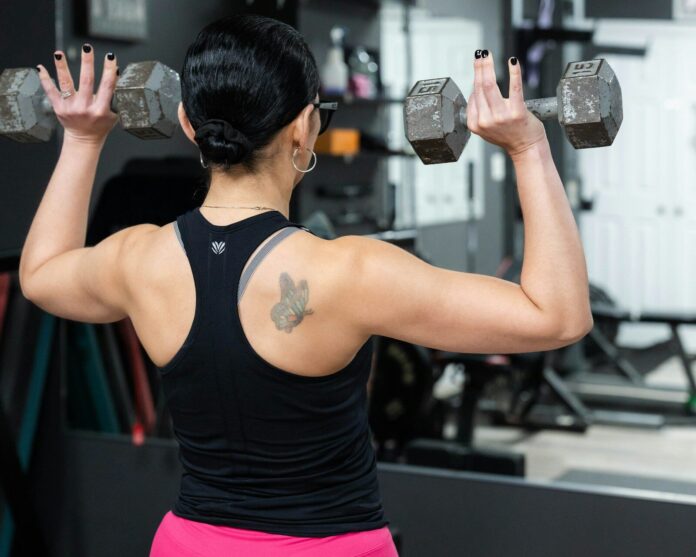

Strength training for women over 35 works best as three short full-body sessions a week, about 40–45 minutes each, built on squats, hinges, pushes, pulls and carries. That fits inside a busy week and meets the health guidelines with room to spare. And the payoff may be bigger than you think: in a study of more than 400,000 US adults, women who did regular muscle-strengthening exercise had a 19% lower risk of death from any cause, compared with 11% for men.
Key takeaways
- Health guidelines from the US CDC and the UK’s NHS both ask for muscle-strengthening work on at least 2 days a week, on top of 150 minutes of moderate cardio.
- Only about 1 in 4 US women aged 45–64 meets that strength guideline, so starting now puts you ahead of most of your peers.
- A simple 3-day plan with 5–6 exercises per session, 2–3 sets of 8–12 reps, covers every major muscle group.
- Progress by adding reps first, then weight. Finish most sets with 1–3 reps still “in the tank”.
- Heavier lifting is not dangerous by default. A supervised trial in women with low bone mass found heavy, well-coached training improved bone density with very few problems.
Why strength training matters more after 35
Muscle is the tissue that lets you carry shopping up the stairs, lift a child or a suitcase, get up off the floor and stay steady on your feet. You keep it by using it. Cardio is great for your heart, but it does not load your muscles and bones enough to replace lifting, which is why every major guideline lists strength work as a separate target.
What the guidelines actually say
The US Centers for Disease Control and Prevention (CDC) recommends at least 150 minutes of moderate-intensity activity a week plus muscle-strengthening activity on 2 or more days that works all the major muscle groups: legs, hips, back, abdomen, chest, shoulders and arms. The UK’s NHS gives the same advice and adds a useful test of effort: work each exercise to the point where you need a short rest before repeating it.
Most women are not there yet. A CDC survey report for 2020 found that 26.9% of US women met the muscle-strengthening guideline. By age group, that was 34.1% of women aged 18–44, falling to 23.8% at 45–64 and 17.2% at 65 and over. The habit tends to fade exactly when it matters most. Globally, the World Health Organization reports that women are less active than men by an average of 5 percentage points.
The research on strength and long life
A 2022 meta-analysis in the British Journal of Sports Medicine pooled 16 cohort studies. Muscle-strengthening activity was linked with a 10–17% lower risk of death from any cause, cardiovascular disease, total cancer, diabetes and lung cancer. The largest benefit for mortality appeared at around 30–60 minutes of strength work per week, and people who combined lifting with aerobic exercise had about a 40% lower risk of death than those who did neither.
The 2024 study in the Journal of the American College of Cardiology looked at sex differences. Women who did muscle-strengthening work had a 19% lower risk of all-cause death and a 30% lower risk of cardiovascular death. For men, both figures were 11%. Women also got equivalent or greater benefit from a single strength session a week than men got from three.
These are observational studies, so they cannot prove lifting alone causes the benefit. Active people tend to have other healthy habits too. But the direction is consistent, and the cost of trying is low: two or three short sessions a week.
Myths that keep women away from the weights
| Myth | What the evidence says |
|---|---|
| “Lifting will make me bulky.” | Building large muscles takes years of targeted training and eating. Three sessions a week mainly make you stronger and firmer. |
| “Light weights and lots of reps are safer for women.” | Both the NHS and CDC define effective strength work by effort, not by weight. The last reps of a set should feel hard. |
| “Heavy lifting is risky after menopause.” | In the LIFTMOR trial, women with low bone mass (average age 65) did supervised sets of 5 at over 85% of their maximum. Spine bone density rose 2.9% while the control group lost 1.2%, with one minor adverse event. |
| “Cardio is enough.” | Guidelines list strength work separately because aerobic exercise does not replace it. |
| “I need an hour in the gym.” | Mortality benefits in the 2022 meta-analysis peaked at roughly 30–60 minutes of strength work a week. |
Your 2-minute starting test
Before you start, take a quick baseline so you can see progress. There is no pass or fail here. Write down your numbers and repeat the test after 6 and 12 weeks.
- Chair stand (30 seconds): sit on a firm chair, arms crossed over your chest. Count how many times you can stand fully and sit back down in 30 seconds.
- Push-ups (to form failure): on the floor, on your knees or with your hands on a kitchen counter. Note which version you used and how many clean reps you managed.
- Plank (up to 60 seconds): forearms and toes, or forearms and knees. Time how long you hold a straight line from head to heels or knees.
If you would like a second opinion on your form, our free AI rep counter uses your phone camera to count squats and push-ups.
The simple 3-day strength plan
Train on three non-consecutive days, for example Monday, Wednesday and Friday. Each session takes about 40–45 minutes, including a 5-minute warm-up. You can do it in a gym or at home with a pair of adjustable dumbbells, a resistance band and a sturdy chair or step.
| Exercise | Day A | Day B | Day C |
|---|---|---|---|
| Knee-dominant (legs) | Goblet squat, 3 × 8–12 | Step-up, 3 × 8–10 each leg | Reverse lunge, 3 × 8–10 each leg |
| Hip hinge (back of legs, glutes) | Dumbbell Romanian deadlift, 3 × 8–12 | Glute bridge or hip thrust, 3 × 10–15 | Kettlebell or dumbbell deadlift, 3 × 8–10 |
| Push | Incline push-up, 3 × 6–12 | Dumbbell shoulder press, 3 × 8–12 | Dumbbell floor or bench press, 3 × 8–12 |
| Pull | One-arm dumbbell row, 3 × 8–12 each side | Band or cable pulldown, 3 × 10–15 | Chest-supported row, 3 × 8–12 |
| Core and carry | Front plank, 3 × 20–40 s | Side plank, 2 × 20–30 s each side | Farmer’s carry, 3 × 30–40 m |
How to warm up
Spend 5 minutes getting warm: brisk marching or a few minutes on a bike, then 10 bodyweight squats, 10 glute bridges, 10 arm circles each way and 10 band pull-aparts. Do one light set of your first exercise before your working sets.
How heavy should you lift?
Pick a weight that lets you finish the target reps with 1–3 reps left in reserve. In plain terms: the last two reps should be slow and hard, but your form should still look the same as the first rep. If you could do five more, it is too light. If your form breaks down, it is too heavy.
Rest 60–90 seconds between sets of the same exercise. To save time, pair a lower-body and an upper-body exercise and alternate them, resting about 45 seconds between each.
Home and gym swaps
- No dumbbells yet? A backpack loaded with books or water bottles works for squats, Romanian deadlifts and rows.
- No pull-up bar or cable? Loop a resistance band over a closed door with a door anchor for pulldowns.
- Knee discomfort on lunges? Swap to step-ups on a low step, or split squats holding a chair for balance.
- Want more of a challenge on push-ups? Lower the incline over time: counter, then a sturdy table, then a low step, then the floor.
How to progress over 12 weeks
The single most important rule is gradual progression. Use “double progression”: stay at the same weight until you hit the top of the rep range on all sets with good form, then increase the weight slightly and drop back to the bottom of the range.
| Weeks | Sets per exercise | Effort | Focus |
|---|---|---|---|
| 1–2 | 2 | 3–4 reps in reserve | Learn the movements, find your starting weights |
| 3–6 | 3 | 2–3 reps in reserve | Add reps each week, then add weight |
| 7–10 | 3 | 1–2 reps in reserve | Increase load on squats, deadlifts, rows and presses |
| 11 | 2 | 3–4 reps in reserve | Lighter week to recover |
| 12 | 3 | 1–2 reps in reserve | Retest your 2-minute baseline |
Typical weight jumps are 1–2 kg (2–5 lb) for upper-body exercises and 2–4 kg (5–10 lb) for lower-body ones. Adjustable dumbbells make small jumps easier.
When to move on
After 12 weeks, you can keep the same structure and keep adding load, or move to a 4-day split. If you want a more detailed progression with barbells, our strength training after 35 guide covers longer-term planning that applies to anyone.
Fitting it into a busy week
If you train 3–4 hours a week, a sensible split looks like this:
- 3 strength sessions of 40–45 minutes (about 2 hours).
- 1–2 easy cardio sessions of 30–45 minutes: brisk walking, cycling, swimming or a dance class. Our zone 2 training guide explains how to pace them.
- Daily walking on top. Our 12-week walking plan for busy women shows how to build it up. If fat loss is a goal, see also our breakdown of walking vs running for fat loss.
Short on time this week? Do Day A and Day C only. Two sessions still meet the guidelines. Even one session a week was linked with meaningful benefit for women in the 2024 study.
Recovery, protein and sleep
Muscle adapts between sessions, not during them. Two habits make the biggest difference. First, eat a source of protein at each meal: eggs, Greek yoghurt, cottage cheese, fish, chicken, tofu, tempeh, lentils, chickpeas or paneer all work, and a protein shake is an easy backup if you are short on time. Our guide to protein powder vs food explains when a shake helps. Second, protect your sleep, aiming for 7 or more hours.
Some women notice changes in energy, sleep or recovery during perimenopause and menopause. Strength training is still recommended through that stage, but if symptoms are getting in the way, talk to your doctor about what is right for you.
Safety note: If you are new to exercise, have a heart, lung or joint condition, have osteoporosis or are recovering from an injury, check with your doctor or a physiotherapist before you start, and consider a few sessions with a qualified coach to learn technique. Stop and get checked if you feel chest pain, unusual breathlessness, dizziness or sharp joint pain while training. Muscle soreness for a day or two after a new session is normal; pain that is sharp, lasts more than a few days or gets worse is not.
FAQ
How many days a week should a woman over 35 lift weights?
Two to three days a week covers the guidelines. Three full-body sessions give you more practice and faster progress, while two is enough to maintain strength in busy weeks.
Is it too late to start strength training at 40 or 50?
No. In the LIFTMOR trial, women with an average age of 65 safely built bone density with supervised heavy training. Start with the lighter weeks described above and build up.
Should women lift heavy or light weights?
What matters is effort. Choose a weight that makes the last two reps of each set hard while your form stays clean. Over time that weight will rise, and that is the point.
Can I do this plan at home?
Yes. A pair of adjustable dumbbells, a resistance band and a sturdy chair or step cover every exercise in the plan. A loaded backpack works as a stand-in while you get started.
Will strength training help with weight loss?
It helps you keep or build muscle while you lose fat, which is what changes how you look and feel. For fat loss itself, pair it with daily walking and a sustainable calorie intake.
Free tool: count your squats and push-ups with the AI rep counter, or see how today’s habits could shape your fitness at 50, 60 and 70 with Future You.
Sources
- Centers for Disease Control and Prevention. Adult activity: an overview.
- CDC. QuickStats: Percentage of adults who met the federal guidelines for muscle-strengthening physical activity, by age group and sex, 2020. MMWR, 2022.
- NHS. Physical activity guidelines for adults aged 19 to 64.
- NHS. Strength exercises.
- World Health Organization. Physical activity fact sheet, 2024.
- Momma H, Kawakami R, Honda T, Sawada SS. Muscle-strengthening activities are associated with lower risk and mortality in major non-communicable diseases: a systematic review and meta-analysis of cohort studies. Br J Sports Med, 2022.
- Ji H et al. Sex differences in association of physical activity with all-cause and cardiovascular mortality. J Am Coll Cardiol, 2024.
- Watson SL et al. High-intensity resistance and impact training improves bone mineral density and physical function in postmenopausal women with osteopenia and osteoporosis: the LIFTMOR randomized controlled trial. J Bone Miner Res, 2018.
This article is for general education and is not medical advice. Check with your doctor before starting a new training or nutrition plan, especially if you have a health condition.

