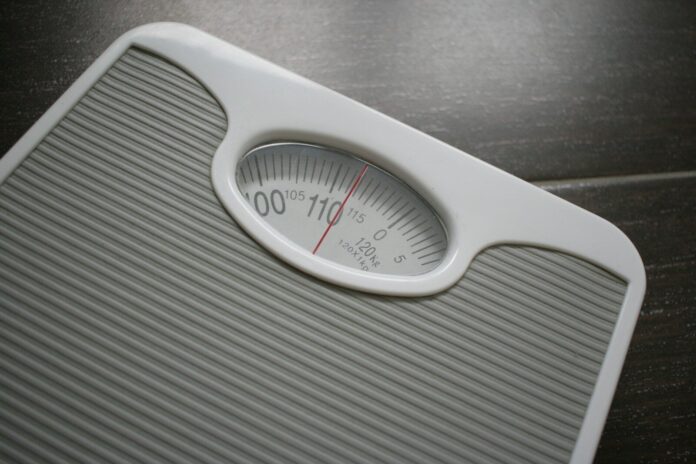

A weight loss plateau usually arrives around month six, and the main cause is rarely a broken metabolism. When researchers modelled why diets stall at that point, they found metabolic slowdown changed where your weight settles but not when it stopped falling; small, intermittent drifts in how closely people stuck to the plan explained the timing. The good news: that is the part you can fix, once you know whether you have a real plateau at all.
Key takeaways
- A real plateau means your weekly average weight and your waist have not moved for 3–4 weeks. One flat week is noise.
- Most diets stall at about six months. A 2014 modelling study found intermittent lapses in adherence, not metabolic adaptation, were the main driver of that timing.
- Your body does burn a little less as you get lighter, so the calories that took you from 95 kg to 88 kg will not take you to 80 kg.
- People who believe they are “diet resistant” can underestimate what they eat by close to half and overestimate exercise by about the same amount.
- Fixes that work: tighten tracking for two weeks, trim 100–200 kcal or add steps, keep protein and lifting high, and consider a planned two-week maintenance break.
What a weight loss plateau actually is
Mayo Clinic describes a plateau simply: your weight stops changing even though you are still eating carefully and exercising. It says this eventually happens to everyone who tries to lose weight. That is reassuring, but it also hides a practical problem. Most people decide they have plateaued far too early.
Your scale weight swings by a kilo or more from day to day because of water, salt, carbohydrate stored in muscle, digestion and, for women, the menstrual cycle. A salty dinner or a hard leg session can hide a week of fat loss. So before you change anything, check whether the trend has really stopped.
The 2-minute plateau self-test
Answer these six questions honestly. If you say “no” to any of the first three, you probably do not have a true plateau yet.
| Question | If yes | If no |
|---|---|---|
| 1. Have you weighed yourself at least 4 mornings a week, after the toilet, before food? | Your data is usable | Start now and wait 2 weeks before judging |
| 2. Has your 7-day average weight been flat for 3–4 weeks? | Possible plateau | You are still losing; the daily noise is fooling you |
| 3. Has your waist (measured at the navel, same time of day) also stayed the same? | Plateau likely | You may be losing fat while holding water or gaining a little muscle |
| 4. Have portions, snacks, drinks or weekend meals crept up since month one? | Adherence drift is the likely cause | Move to question 5 |
| 5. Are your daily steps lower than when you started? | Activity drift is the likely cause | Move to question 6 |
| 6. Have you lost more than about 10% of your starting weight? | You may simply need a new, lower calorie target | Recheck questions 4 and 5 with a food log |
Women of reproductive age can add one more check: compare the same week of your cycle, not consecutive weeks. In a 2023 study of 42 women, body weight was about 0.45 kg (1 lb) higher during menstruation than in the first week of the cycle, almost all of it extracellular water. That alone can make a good month look flat.
Why weight loss stalls: the three real causes
1. Your energy needs fall as you get lighter
A smaller body burns less energy, both at rest and when you move it. This is not damage; it is physics. In a 2011 Lancet paper, NIH researcher Kevin Hall and colleagues showed that body weight responds slowly to a change in intake, with about half the eventual change arriving in the first year. Their rule of thumb for an average overweight adult: every 100 kJ (about 24 kcal) a day you permanently cut leads to roughly 1 kg (2.2 lb) of eventual weight loss.
Turn that around and you see the plateau coming. If you cut 500 kcal a day, the deficit is largest on day one and shrinks as you lose weight, because your maintenance calories fall towards your new intake. Eventually they meet, and the scale stops. Nothing has gone wrong. You have reached the weight that your current habits support.
This is also why “my metabolism is slow because I’m over 35” is mostly a myth. Large studies of energy expenditure suggest metabolism stays fairly steady through midlife once you account for body size. Our guide to whether metabolism slows after 35 covers that research in detail.
2. Adherence drifts, quietly
This is the big one. A 2014 study in the American Journal of Clinical Nutrition built two mathematical models to explain why clinical weight loss typically stabilises at six months. One model gave the body extra metabolic slowdown. The other added random, intermittent days of not sticking to the calorie target. The metabolic model changed the final weight but did not move the plateau point. The adherence model reproduced the familiar six-month stall, and did so even with what the authors considered high adherence.
In plain terms, nobody has to “fall off the wagon”. A few more restaurant meals, a second glass of wine on Fridays, a heavier hand with olive oil and a couple of skipped workouts a month are enough to close a modest deficit.
3. We are poor judges of what we eat and burn
A classic 1992 study in the New England Journal of Medicine measured people who said they could not lose weight on fewer than 1,200 kcal a day. Their metabolic rates were within 5% of predicted values, so their bodies were normal. But they underreported their food intake by an average of 47% and overreported their physical activity by 51%.
Those were people with obesity and a history of failed diets, so the gap for you is likely smaller. The lesson still applies: the plateau is often a measurement problem. Cooking oil, sauces, nuts, “a bite” of the kids’ dinner and fitness-tracker calorie estimates are where the hidden calories live.
What about “metabolic adaptation”?
It is real, but usually modest. Your body can burn somewhat less than expected for its new size after a long diet. The famous extreme case is “The Biggest Loser”: six years after losing an average of about 58 kg (128 lb) in 30 weeks, 14 contestants still had resting metabolic rates around 500 kcal a day lower than predicted for their size. That was an unusually brutal intervention. For a typical person losing 5–10 kg (11–22 lb) at a sensible pace, adaptation is a small part of the story compared with adherence and lower body size.
Myth vs evidence
| Myth | What the evidence says |
|---|---|
| “You’re in starvation mode, eat more to lose more.” | Eating more raises maintenance needs only slightly. Planned maintenance breaks can help, but not because extra food “restarts” fat burning. |
| “Your metabolism is broken after 35.” | Energy expenditure adjusted for size stays fairly stable through midlife. Body size, muscle and activity explain most of the change. |
| “A plateau means the diet stopped working.” | It usually means the diet has done what it can at your current intake and activity, or that adherence has slipped. |
| “Cardio every day breaks plateaus.” | More activity helps, but people often eat back exercise calories and overestimate what they burned. Steps and lifting tend to be more reliable than extra hard cardio. |
| “Muscle gain hides fat loss for months.” | For a beginner lifter, possible for a few weeks. For most people on a calorie deficit, muscle gain is too slow to mask a true stall for long. Check your waist. |
How to break a weight loss plateau: a 4-week reset
Work through these in order. Most people only need the first two.
Week 1–2: audit, don’t cut
- Weigh and log everything for 14 days. Use a kitchen scale for oils, nuts, grains, cheese and sauces. Log drinks and weekend meals too. This is temporary; you are collecting data, not starting a new lifestyle.
- Track daily steps. Steps often fall as people get busier or more tired on a diet. If your average has dropped by a few thousand steps since you started, that alone can quietly shrink your deficit.
- Keep weighing daily and use the weekly average. Do not change two things at once.
Mayo Clinic’s own first tip is the same: look back at your food and activity records and check you have not loosened the rules, because off-and-on loosening contributes to plateaus.
Week 3: make one small change
If tracking shows you were eating what you thought and weight is still flat, recalculate. Your old target was set for a heavier body. Pick one lever:
- Cut 100–200 kcal a day, ideally from fats and drinks rather than protein. That is one tablespoon of oil plus a biscuit, or one beer.
- Or add 2,000–3,000 steps a day, for example a 20-minute walk after dinner.
Keep the deficit sensible. Losing about 0.5–1% of body weight a week protects muscle better than a crash cut. Our guide to how big a calorie deficit should be after 35 shows how to set the number.
Week 4: protect muscle so the loss is fat
- Protein: aim for about 1.6 g per kg of body weight a day (0.7 g per lb), spread across 3–4 meals. Vegetarian anchors: Greek yoghurt, cottage cheese or paneer, eggs, tofu, tempeh, lentils and beans.
- Strength training: 2–3 sessions a week, keeping the weights heavy even as you diet. This tells your body to keep muscle while it uses fat. See how to lose fat without losing muscle after 35.
- Sleep: short sleep raises hunger and lowers training quality. Aim for 7–9 hours; our guide on how much sleep you need to build muscle explains why.
Should you take a diet break?
A diet break means eating at maintenance, not overeating, for a planned period. The best-known trial is MATADOR, published in 2018. It randomised men with obesity to 16 weeks of continuous dieting (one-third below maintenance) or to the same 16 weeks of dieting split into two-week blocks, with two-week maintenance blocks in between (30 weeks in total). Among those who completed it, the intermittent group lost about 14.1 kg (31 lb) versus 9.1 kg (20 lb), mostly as fat, and their resting metabolism dropped less than expected for their new size.
Two cautions. MATADOR was small, included only men, and gave participants their food, which most of us do not have. And a break only works if “maintenance” really means maintenance. Still, if you are mentally tired after three or four months of dieting, a two-week break at maintenance calories, with training and protein unchanged, is a reasonable tool rather than a failure.
When to accept the plateau
Sometimes the right move is to stop pushing. If you have lost 10% or more of your starting weight, your blood pressure and waist have improved and you are training well, holding that new weight for a few months is a win. Maintenance is a skill, and the research on long-term weight loss shows keeping weight off is harder than losing it. Practising maintenance now makes the next phase easier.
Mayo Clinic makes the same point: when you hit a plateau you may have lost what your current plan can deliver, so ask whether you are satisfied with your weight or want to lose more. Both answers are valid.
Safety note: If you are losing weight without trying, feel unusually tired, cold or breathless, or have a plateau alongside new symptoms such as swelling, see your doctor. Some medicines, including certain antidepressants, steroids and diabetes treatments, can affect weight, so do not stop any medication without medical advice. If you take glucose-lowering or blood-pressure medication, check with your doctor before cutting calories further, because doses may need adjusting.
FAQ
How long does a weight loss plateau last?
A short stall of one to two weeks is usually water and noise. A true plateau lasts until something changes: your intake, your activity or your target. Mayo Clinic notes plateaus can last from a few days to a few months.
Is it a plateau if I’m losing inches but not weight?
Not really. A shrinking waist with a flat scale often means you are losing fat while holding extra water, especially if you have just increased training. Keep going for another two to three weeks before changing anything.
Should I eat more to break a plateau?
Only as a planned diet break at maintenance calories, not as random “refeed” days. Extra food does not restart fat loss by itself; it gives you a mental and physical rest before you resume the deficit.
Does a plateau happen faster after 35?
Not because of age alone. What changes after 35 is usually lifestyle: less daily movement, more desk time, worse sleep and less muscle if you have not been lifting. Fix those and plateaus behave the same at 45 as at 25.
Can women expect different plateau patterns?
The causes are the same, but water swings across the menstrual cycle can hide progress for a week or so. Compare the same phase of each cycle. If you are in perimenopause and notice new changes in weight or sleep, a short conversation with your doctor is worthwhile.
Free tool: recalculate your new calorie target with the calorie calculator, and see where your current habits lead with Future You.
Sources
- Thomas DM et al. Effect of dietary adherence on the body weight plateau: a mathematical model incorporating intermittent compliance with energy intake prescription. Am J Clin Nutr, 2014.
- Hall KD et al. Quantification of the effect of energy imbalance on bodyweight. Lancet, 2011.
- Lichtman SW et al. Discrepancy between self-reported and actual caloric intake and exercise in obese subjects. N Engl J Med, 1992.
- Fothergill E et al. Persistent metabolic adaptation 6 years after “The Biggest Loser” competition. Obesity, 2016.
- Byrne NM et al. Intermittent energy restriction improves weight loss efficiency in obese men: the MATADOR study. Int J Obes, 2018.
- Body weight and body composition changes during the menstrual cycle. Am J Hum Biol, 2023.
- Mayo Clinic. Getting past a weight-loss plateau.
This article is for general education and is not medical advice. Check with your doctor before starting a new training or nutrition plan, especially if you have a health condition.

