
If your knees complain on stairs or your lower back aches after a day at a desk, your hips are a good place to look. Women develop pain at the front of the knee at more than twice the rate of men (2.23 times, in a US cohort of 1,597 young adults), and people with that pain reliably test weaker in the hip muscles than pain-free peers. The fix is simple: a short hip and glute routine, twice a week, is one of the best-supported treatments for knee pain, outer-hip pain and a tired lower back.
Key takeaways
- Your glutes control how your thigh moves under your pelvis. When they are weak or slow to switch on, the knee drifts inward and the lower back picks up the slack.
- Hip-focused rehab beats quad-only rehab for front-of-knee pain, with a medium-sized advantage in pain and function at 3 to 12 months across 14 studies.
- In adults aged 35 to 70 with outer-hip pain (82% women), education plus exercise beat a steroid injection: 77% improved at 8 weeks versus 58%.
- A 2-minute self-test (single-leg bridge plus step-down) shows you which side is weaker and whether your glutes are actually doing the work.
- Six moves, two sessions a week, progressed over 8 weeks with a stair, a band and one heavy object. Step-ups and hip thrusts produce the highest glute activation measured in the lab.
Why weak hips show up as knee and back pain
Two muscles do most of the work. Gluteus maximus is the big one: it extends the hip and powers you up stairs, hills and out of chairs. Gluteus medius sits on the side of the hip and keeps your pelvis level every time you stand on one leg, which is every step you take.
When they are weak or late to switch on, the thigh falls inward, the knee collapses toward the midline and the kneecap tracks badly. The pelvis also drops on the unsupported side, so the lower back side-bends to catch it, step after step. That is why hip weakness so often shows up as pain somewhere else.
What the evidence says about knees
A 2014 meta-analysis in the British Journal of Sports Medicine found moderate evidence that adults with patellofemoral (front-of-knee) pain have weaker hips than people without it. Honest caveat: prospective studies in the same review did not find that weak hips predict who gets the pain, so some weakness may be a result rather than a cause.
That does not make hip work less useful. A 2015 review of 14 studies compared hip-focused rehab with quadriceps-only rehab for knee pain. In the first 3 months the hip approach had a small edge on pain; between 3 and 12 months the edge was medium-sized for both pain (standardised effect 1.07) and function (0.87), with strong evidence from the two best trials.
In plain terms: hip strength helps knee pain more, and for longer, than thigh work alone. If you run, the guide on knee pain when running after 40 covers the stride-level fixes.
What it says about the lower back
A 2016 study in the European Spine Journal compared 150 people with chronic non-specific low back pain against 75 matched controls. Gluteus medius weakness and a positive Trendelenburg sign (the pelvis dropping when you stand on one leg) were both more common in the back-pain group, and gluteus medius weakness predicted back pain in the analysis. If sitting is your trigger, pair this routine with the 4-week plan for lower back pain from sitting and lifting.
What it says about pain on the outside of the hip
Pain over the bony point on the side of your hip, worse lying on that side or climbing stairs, is often gluteal tendinopathy. A 2018 randomised trial in the BMJ recruited 204 adults aged 35 to 70 with it; 167 were women and the average age was 55. Education plus a physiotherapist-led exercise programme produced global improvement in 77% at 8 weeks, against 58% after a corticosteroid injection and 29% for wait-and-see. At one year the exercise group was still ahead: 78% versus 57% and 52%. For the commonest cause of outer-hip pain in women over 35, loading the glutes properly beat the injection.
Why this hits women over 35 harder
Sitting is the first culprit. Harvard Health describes how prolonged sitting weakens the glutes twice over: through inactivity, and because tight hip flexors damp down glute activation, leaving the hamstrings to work double duty.
Activity is the second: the World Health Organization reports that 31% of adults are insufficiently active, and women less so than men by about five percentage points. Around perimenopause tendons also tend to grumble more and recover more slowly; if a new hip or knee pain lasts more than a few weeks, talk to your doctor before pushing through it.
The 2-minute hip self-test
You need a floor, a stair or sturdy step about 15 to 20 cm (6 to 8 in) high, and a phone propped up to film yourself from the front.
Part 1: single-leg bridge (30 seconds per side)
- Lie on your back, knees bent, feet flat a hand’s width from your hips. Lift one foot and hold that knee at 90 degrees.
- Push through the heel of the standing foot and lift your hips until trunk and thigh make a straight line. Pause for one second. Lower slowly.
- Count clean reps for 30 seconds, then switch sides.
Note the rep difference between sides, and whether your hamstrings cramp or your lower back does the lifting.
Part 2: step-down (30 seconds per side)
- Stand on the step on one leg, hands on hips, the other foot hovering off the edge.
- Bend the standing knee and lower the free heel toward the floor over 3 seconds. Touch lightly, push back up. Do 5 slow reps per side while filming.
Watch the video for three things: the standing knee drifting inward past the big toe, the free-side hip dropping, and the trunk leaning hard to one side. Clinicians rating this kind of single-leg squat task found that “poor” performers had lower hip abduction strength and later gluteus medius activation than “good” performers.
| What you noticed | What it suggests | Emphasise |
|---|---|---|
| More than 3 reps’ difference between sides | A weaker side, often behind one-sided knee or back pain | Start every set on the weak side; match its reps on the strong side |
| Hamstring cramp or lower back arching in the bridge | Glutes are not leading the movement | Moves 1 and 4, with a 2-second squeeze at the top |
| Knee drifts inward or pelvis drops on the step-down | Gluteus medius is weak or slow to control the thigh | Moves 2 and 6, slow tempo, phone feedback |
| All clean, 12 or more bridges per side | Good baseline; load is what you need | Moves 3, 4 and 5 with weight, from week 1 |
The 6-move hip and glute routine
Do all six moves twice a week, at least 48 hours apart. Add them to the end of the lower-body days in the 3-day strength plan for women over 35, or run them as a standalone 20-minute session. Rest 60 to 90 seconds between sets.
1. Glute bridge
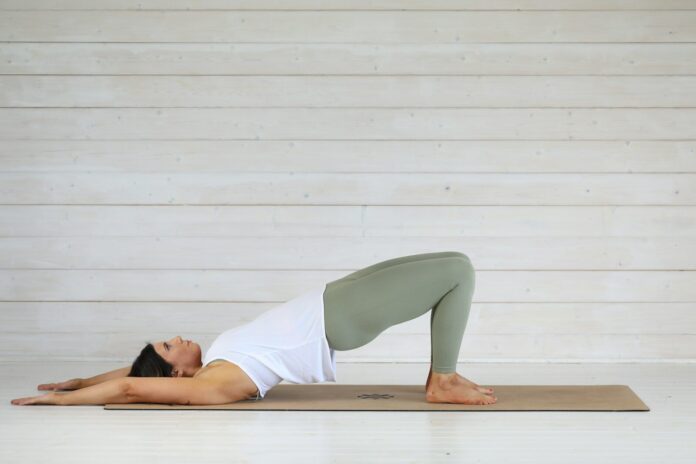
Lie on your back, feet flat, heels a hand’s width from your hips. Squeeze your glutes and push through your heels to lift your hips until thigh and trunk are in line. Hold for 2 seconds, lower slowly. Do not lift so high that your back arches.
2. Side-lying hip abduction
Lie on your side, hips stacked, bottom knee bent, top leg straight and slightly behind your body line. Lift the top leg about 30 cm (12 in), toes forward rather than up, and lower over 3 seconds. Do not let the hip roll backward.
3. Step-up
Use a step at or just below knee height. Place your whole foot on it, lean slightly forward and drive through that heel to stand tall, then lower slowly. In a 2020 systematic review of 16 EMG studies, step-up variations produced the highest gluteus maximus activation of any exercise, averaging 125% of a maximal contraction. The leg on the step does all the work; do not push off with the trailing foot.
4. Hip thrust
Sit with your upper back against a sofa or bench, knees bent, feet flat. Drive your hips up until your shins are vertical and your body is a flat table from shoulders to knees. Hold for 2 seconds. Add weight with a dumbbell, kettlebell or loaded backpack across your hips. The same review measured hip thrust activation at 49% to 105% of maximum. Keep your chin tucked so your lower back stays neutral.
5. Romanian deadlift
Stand tall holding two dumbbells, a kettlebell or a heavy bag in front of your thighs. Push your hips back and let the weight slide down your legs with a soft knee until the back of the thighs stretches hard, usually around mid-shin. Drive the hips forward to stand. This is the hinge that protects your back every time you lift a child or a suitcase. Your spine stays long; only the hips move.
6. Lateral step-down
The test becomes the exercise. Stand sideways on your step, lower the free heel to the floor over 3 seconds, tap and return. Keep the standing knee over the middle of the foot and the pelvis level. Too hard? Use a lower step. Too easy? Hold a dumbbell at your chest. The slowness is the point.
8-week progression table
Progress a move when you finish the top of the rep range with two clean reps still in the tank. If form breaks, drop back one column for a week.
| Move | Weeks 1 to 2: learn | Weeks 3 to 4: build | Weeks 5 to 6: load | Weeks 7 to 8: single-leg |
|---|---|---|---|---|
| 1. Glute bridge | 2 x 12, 2-s hold | 3 x 15, 2-s hold | 3 x 12 with band above knees | 3 x 8 to 10 per side, single-leg |
| 2. Hip abduction | 2 x 12 per side, slow | 3 x 15 per side | 3 x 12 per side with ankle weight or band | 3 x 12 banded side steps each way |
| 3. Step-up | 2 x 8 per side, low step | 3 x 10 per side, knee-height step | 3 x 8 per side holding 2 x 5 kg (11 lb) | 3 x 8 per side, heavier, 3-s lowering |
| 4. Hip thrust | 2 x 12 bodyweight | 3 x 12 bodyweight, 2-s hold | 3 x 10 with 10 to 15 kg (22 to 33 lb) | 3 x 8 per side, single-leg or heavier |
| 5. Romanian deadlift | 2 x 10 with 2 x 4 kg (9 lb) | 3 x 10 with 2 x 6 kg (13 lb) | 3 x 8 with 2 x 8 to 10 kg (18 to 22 lb) | 3 x 8 per side, single-leg, light |
| 6. Lateral step-down | 2 x 6 per side, low step | 3 x 8 per side | 3 x 8 per side, higher step | 3 x 8 per side holding 5 to 8 kg (11 to 18 lb) |
The weights are starting suggestions; if you already lift, begin where the loads feel like a 7 out of 10 effort. Bodyweight is enough for the first weeks, but after that the glutes need progressive load or they stop adapting. Protein builds the muscle you are asking for; the guide to how much protein women need after 35 gives the numbers.
Making it stick
- Attach the routine to something fixed, such as the school run or a podcast episode, and re-run the self-test at weeks 4 and 8. Watching the weak side catch up is the most motivating thing in this article.
- Stairs count. Taking them two at a time, driving through the heel, is a free step-up. Strong hips also protect your bones; see the guide to bone health for women after 35.
Safety note: Muscle ache the next day is normal; sharp joint pain, swelling, locking, or outer-hip pain that wakes you at night is not. Stop the move that provokes it and see your doctor or a physiotherapist, especially if pain has lasted more than 6 weeks or you have osteoporosis or a joint replacement. Start with the lighter columns of the table even if you feel strong; tendons adapt more slowly than muscles.
FAQ
How often should women over 35 do glute exercises?
Twice a week is the sweet spot for most people. It meets the World Health Organization recommendation of muscle-strengthening activity on 2 or more days a week and leaves time for walking, running or sport. Three sessions is fine if you recover well; more rarely adds anything.
Can weak glutes really cause knee pain?
People with front-of-knee pain consistently test weaker in the hips, but the evidence that weakness comes first is thin. The practical answer matters more: adding hip exercises to knee rehab produced medium-sized improvements in pain and function at 3 to 12 months compared with quad work alone. Whether cause or consequence, strengthening the hips helps; judge the routine at 8 weeks, not 2.
Why do my hamstrings cramp during glute bridges?
Because they are doing the glutes’ job. Harvard Health describes this as hamstrings working double duty after prolonged sitting has weakened the glutes. Move your feet a little closer to your hips, push through the heels, squeeze the glutes before you lift, and hold for 2 seconds at the top. The cramping usually fades within a few weeks.
Will glute exercises help pain on the outside of my hip?
For gluteal tendinopathy, the commonest cause in women over 35, a progressive education-plus-exercise programme beat a steroid injection in a 204-person trial: 77% versus 58% improved at 8 weeks, and the gap held at one year. Get the diagnosis confirmed first, and ask a physiotherapist to tailor the loading, because the wrong exercises can irritate the tendon.
Free tool: Tap the glutes on our interactive muscle map to see every exercise that targets them, and use the AI rep counter to count your squats and step-downs hands-free while you film your form.
Sources
- Boling MC. A Prospective Investigation of Biomechanical Risk Factors for Anterior Knee Pain (doctoral dissertation). University of North Carolina at Chapel Hill, 2008.
- Rathleff MS et al. Is hip strength a risk factor for patellofemoral pain? A systematic review and meta-analysis. British Journal of Sports Medicine, 2014.
- Lack S, Barton C, Sohan O, Crossley K, Morrissey D. Proximal muscle rehabilitation is effective for patellofemoral pain: a systematic review with meta-analysis. British Journal of Sports Medicine, 2015.
- Cooper NA et al. Prevalence of gluteus medius weakness in people with chronic low back pain compared to healthy controls. European Spine Journal, 2016.
- Neto WK et al. Gluteus Maximus Activation during Common Strength and Hypertrophy Exercises: A Systematic Review. Journal of Sports Science and Medicine, 2020.
- Mellor R, Bennell K, Grimaldi A et al. Education plus exercise versus corticosteroid injection use versus a wait and see approach on global outcome and pain from gluteal tendinopathy: randomised clinical trial. BMJ, 2018 (summarised in British Journal of Sports Medicine).
- Becker’s Spine Review. Study: Single-Leg Squat Task Can Identify Hip Muscle Dysfunction (Crossley KM et al., American Journal of Sports Medicine). 2011.
- Harvard Health Publishing. Are your hamstrings working double duty? 2019.
- World Health Organization. Physical activity: fact sheet. who.int, accessed 2026.
- World Health Organization, Regional Office for the Eastern Mediterranean. What is the recommended amount of exercise?
This article is for general education and is not medical advice. Check with your doctor before starting a new training or nutrition plan, especially if you have a health condition.

