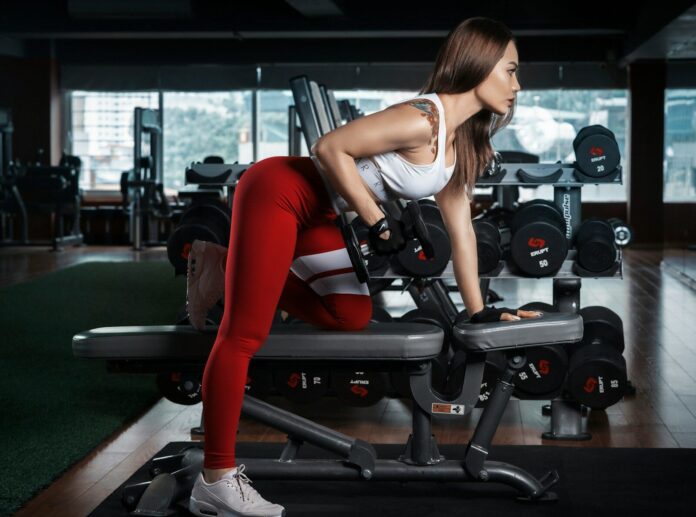

Two or three short strength sessions a week are enough for most women over 35 to get stronger, protect muscle and bone, and feel more capable in daily life. A large 2022 review found that just 30 to 60 minutes of muscle-strengthening a week was linked with roughly 10–20% lower risk of early death, heart disease and cancer. Below is a simple 3-day plan you can start this week, at the gym or at home.
Key takeaways
- Health guidelines from the WHO, CDC and NHS all ask adults to do muscle-strengthening work on at least 2 days a week, covering all major muscle groups.
- Inactive adults can lose about 3–8% of their muscle mass per decade. Strength training is the most direct way to slow that down.
- Women gain muscle at a similar relative rate to men, and in one meta-analysis gained relatively more upper-body strength.
- Start with 2–3 sets of 8–12 reps on six basic movements, three days a week, and add a little weight or a rep each week.
- Lifting heavier than you think is usually safe when you build up gradually and keep good form. It will not make you “bulky”.
Why strength training matters more after 35
Muscle is not just about looks. It is the tissue that lets you carry shopping up the stairs, lift a child, play a set of pádel or tennis, and get up off the floor without thinking about it. It also helps manage blood sugar and supports your joints and bones.
The problem is that muscle quietly fades if you do not use it. A widely cited review by exercise scientist Wayne Westcott reported that inactive adults lose about 3% to 8% of their muscle mass per decade, along with a drop in resting metabolic rate and a gain in fat. The same review found that 10 weeks of resistance training could add around 1.4 kg (3 lb) of lean weight, raise resting metabolic rate by about 7% and cut about 1.8 kg (4 lb) of fat.
Many women also notice changes in energy, sleep and body shape in their 40s as they approach perimenopause. Strength training will not fix everything, but it is one of the most useful habits you can build for that stage. If you have questions about symptoms or treatment, talk to your doctor.
The health payoff in numbers
A 2022 meta-analysis in the British Journal of Sports Medicine pooled cohort studies on muscle-strengthening activity. Compared with doing none, any regular strength work was linked with a 10–17% lower risk of death from any cause, cardiovascular disease, total cancer, diabetes and lung cancer. The biggest benefit appeared at about 30–60 minutes a week. People who combined strength work with aerobic exercise had about a 40% lower risk of early death than people who did neither.
These are observational studies, so they show a link rather than proof, and the authors rated the certainty of the evidence as very low. Still, they line up with the official guidelines, and you do not need hours in the gym to reach that sweet spot. Three 20–25 minute sessions get you there.
The gap is real. The World Health Organization reports that 31% of adults worldwide do not meet physical activity recommendations, and that women are less active than men by about 5 percentage points on average.
Myths that keep women away from weights
| Myth | What the evidence says |
|---|---|
| “Lifting will make me bulky.” | Big muscle gains take years of focused training and eating. Two or three sessions a week build firm, capable muscle, not bulk. |
| “Women respond less to training than men.” | A 2020 meta-analysis found similar relative muscle growth and lower-body strength gains in women and men, and larger relative upper-body strength gains in women. |
| “Light weights and lots of reps are better for women.” | The American College of Sports Medicine recommends that beginners use loads they can lift for 8–12 reps, for women and men alike. |
| “Heavy lifting is risky after menopause.” | In the LIFTMOR trial, supervised heavy lifting twice a week improved bone density in postmenopausal women with low bone mass, with only one minor adverse event. |
| “Cardio is enough.” | Guidelines treat strength work as a separate requirement on top of 150 minutes of aerobic activity a week. |
What the guidelines actually ask for
The WHO, the US Centers for Disease Control and Prevention (CDC) and the UK’s NHS all say much the same thing. Adults should do at least 150 minutes of moderate activity a week (or 75 minutes of vigorous activity) and, separately, muscle-strengthening activities on 2 or more days a week that work all the major muscle groups: legs, hips, back, abdomen, chest, shoulders and arms.
The NHS adds a useful rule for effort: work each exercise to the point where you need a short rest before repeating it. If you could keep going for another 20 reps, the weight is too light.
The American College of Sports Medicine’s position stand on resistance training suggests 2–3 days a week for beginners, using loads you can lift for 8–12 repetitions. That is exactly what the plan below uses.
Your 3-day strength plan
The plan uses full-body sessions on three non-consecutive days, for example Monday, Wednesday and Friday. Each session takes about 40–45 minutes including the warm-up. If you only have two days, do Workouts A and B and you still meet the guidelines.
| Workout | Exercise (gym) | Home option | Sets x reps |
|---|---|---|---|
| A (Mon) | Goblet squat | Goblet squat with a dumbbell or backpack | 3 x 8–12 |
| Dumbbell bench press | Push-up (hands on a bench or worktop) | 3 x 8–12 | |
| Seated cable row | One-arm dumbbell row | 3 x 10–12 each side | |
| Romanian deadlift (dumbbells) | Romanian deadlift with dumbbells | 3 x 8–12 | |
| Glute bridge | Glute bridge, feet on floor | 2 x 12–15 | |
| Dead bug | Dead bug | 2 x 8 each side | |
| B (Wed) | Trap-bar or kettlebell deadlift | Kettlebell or dumbbell deadlift | 3 x 6–10 |
| Lat pulldown | Band pulldown or doorway row | 3 x 8–12 | |
| Dumbbell overhead press | Dumbbell overhead press, seated | 3 x 8–12 | |
| Split squat | Split squat, holding the back of a chair if needed | 2 x 8–10 each side | |
| Farmer’s carry | Carry two heavy bags or dumbbells | 3 x 30–40 m | |
| Side plank | Side plank (knees down to start) | 2 x 20–30 s each side | |
| C (Fri) | Leg press or step-up | Step-up onto a sturdy step | 3 x 10 each side |
| Incline dumbbell press | Push-up, slowly lowering | 3 x 8–12 | |
| Chest-supported row | Band or towel row | 3 x 10–12 | |
| Hip thrust | Single-leg glute bridge | 3 x 10–12 | |
| Calf raise | Calf raise on a step | 2 x 12–15 | |
| Pallof press | Band Pallof press or bird dog | 2 x 10 each side |
How to warm up
Spend 5 minutes on easy cardio such as brisk walking, cycling or skipping, then do 1–2 light sets of the first exercise. A few bodyweight squats, hip hinges and arm circles are enough. You do not need a long stretching routine before lifting.
How heavy should you go?
Pick a weight you can lift for the target reps with good form, finishing each set feeling that you could do only 2–3 more reps. That is roughly 7–8 out of 10 effort. The last reps should feel slow and focused, not easy.
Rest about 60–90 seconds between sets of smaller exercises and up to 2 minutes for squats and deadlifts. To save time, pair an upper-body and a lower-body move and alternate them.
How to progress week by week
Progress is what turns exercise into results. Use a simple “double progression” approach:
- Start at the bottom of the rep range, for example 8 reps.
- Each week, try to add a rep to each set until you reach the top of the range, for example 12.
- When you hit the top of the range on all sets with good form, increase the weight by the smallest step available (often 1–2 kg / 2.5–5 lb per dumbbell) and drop back to 8 reps.
Write your weights down, on paper or in a phone note. After 8–12 weeks you will probably be lifting noticeably more than when you started. Once you have mastered the basics, you can add heavier sets of 5–6 reps on squats and deadlifts.
A 12-week outline
| Weeks | Focus | What to do |
|---|---|---|
| 1–2 | Learn the moves | 2 sets per exercise, moderate weights, perfect form |
| 3–6 | Build volume | 3 sets per exercise, add reps each week |
| 7–10 | Build strength | Increase weights; aim for 6–10 reps on big lifts |
| 11 | Lighter week | Drop one set per exercise to recover |
| 12 | Test yourself | Note your best weights and reps, then start a new cycle |
Heavy lifting and bone health
Bone responds to load, much like muscle. The Australian LIFTMOR trial is a useful example. Women past menopause with low bone mass did 30-minute supervised sessions twice a week for 8 months, using 5 sets of 5 reps at more than 85% of their one-rep max on lifts such as deadlifts and squats, plus jumping-type impact work.
Compared with a low-intensity home programme, the lifting group improved lumbar spine bone density by about 2.9% while the control group lost about 1.2%. Femoral neck bone density was also better, and the lifting group even gained a little height. Only one minor adverse event (a lower-back spasm) was reported.
Those women were older than most readers here and were closely supervised. The takeaway for you is not to jump straight to maximal weights, but that bones and muscles respond well to progressively heavier training, and that building strength in your late 30s and 40s gives you a bigger reserve for later.
Fitting it into a busy week
Most women reading this are juggling work, family and everything in between. These tactics help the plan survive real life:
- Book it like a meeting. Put your three sessions in your calendar at the start of each week.
- Use a 20-minute fallback. On a hectic day, do just the first three exercises for 2 sets each. Some is far better than none, as our guide to the minimum effective dose of exercise explains.
- Keep cardio easy. Walk, cycle or dance on other days. Easy aerobic work supports recovery; our zone 2 training guide shows how to pace it.
- Eat enough protein. Spread protein across your meals, using eggs, Greek yogurt, fish, chicken, lentils, beans, tofu or paneer. See our list of muscle-building foods, including vegetarian options.
- Protect your sleep. Muscle is built during recovery. Our guide to sleeping better after 35 has a simple routine.
Common mistakes to avoid
- Staying with the same light weights for months. If the last reps never feel hard, your body has no reason to change.
- Skipping the back and legs. Rows, deadlifts and squats give you the most return for your time.
- Doing too much too soon. Starting with five sessions a week usually ends in soreness and quitting. Three is plenty.
- Judging progress only by the scale. As you gain muscle and lose fat, your weight may barely move. Track your lifts, how clothes fit and your waist measurement instead.
Safety note: If you have a heart condition, high blood pressure, osteoporosis, a recent injury, joint pain or are recovering from surgery, check with your doctor or a physiotherapist before starting. Stop and get checked if you feel chest pain, unusual breathlessness, dizziness or sharp joint pain. If you have leaking urine or a feeling of heaviness in the pelvis when lifting, a pelvic-health physiotherapist can help.
FAQ
Is it too late to start strength training at 40 or 45?
No. Muscles respond to training at any age, and studies show meaningful gains within about 10 weeks. Start with lighter weights, focus on form for the first two weeks, and build up gradually.
How many days a week should a woman over 35 lift weights?
Two or three days a week is ideal for most people. Guidelines ask for at least two days, and the biggest health benefit in research appeared at about 30–60 minutes of strength work per week.
Do I need a gym?
No. A pair of adjustable dumbbells, a resistance band and a sturdy step or chair are enough to follow this plan at home. A gym makes it easier to keep adding weight over time.
Will strength training help me lose weight?
It helps by building muscle and slightly raising your resting metabolic rate, but fat loss still depends mostly on eating and daily movement. Combining lifting with walking and enough protein works best.
Should I lift during my period?
Yes, if you feel up to it. There is no need to avoid training. On days you feel tired or crampy, lighten the weights or do the 20-minute version and listen to your body.
Free tool: Check your squat and push-up form and count reps hands-free with the AI Rep Counter, or tap any muscle on the Muscle Map to find more exercises for it.
Sources
- Momma H et al. Muscle-strengthening activities are associated with lower risk and mortality in major non-communicable diseases: a systematic review and meta-analysis of cohort studies. Br J Sports Med, 2022.
- Westcott WL. Resistance training is medicine: effects of strength training on health. Curr Sports Med Rep, 2012.
- Roberts BM, Nuckols G, Krieger JW. Sex differences in resistance training: a systematic review and meta-analysis. J Strength Cond Res, 2020.
- Watson SL et al. High-intensity resistance and impact training improves bone mineral density and physical function in postmenopausal women with osteopenia and osteoporosis: the LIFTMOR randomized controlled trial. J Bone Miner Res, 2018.
- American College of Sports Medicine. Position stand: Progression models in resistance training for healthy adults. Med Sci Sports Exerc, 2009.
- World Health Organization. Physical activity fact sheet, 2024.
- CDC. Adult activity: an overview.
- NHS. Physical activity guidelines for adults aged 19 to 64.
This article is for general education and is not medical advice. Check with your doctor before starting a new training or nutrition plan, especially if you have a health condition.

