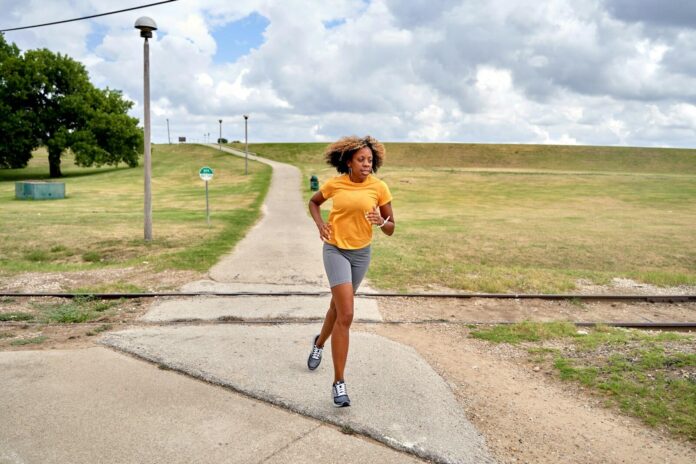

Belly fat in women over 35 responds to the same things at any age: overall fat loss from steady aerobic exercise, strength training, a modest calorie deficit, enough sleep and less alcohol. Crunches will not burn it off. The encouraging part: in a meta-analysis of exercise trials, aerobic training without any diet cut the deep, harmful belly fat in women by more than 30 cm² on CT scans, in as little as 12 weeks.
Key takeaways
- Belly fat comes in two layers: subcutaneous (the soft layer you can pinch) and visceral (deep around your organs). Visceral fat carries most of the health risk.
- For women, the NHS says a waist above 80 cm (31.5 in) means a higher risk of health problems, and above 88 cm (34.5 in) a higher risk still. A simpler rule: keep your waist to less than half your height.
- Ab exercises alone do not shrink belly fat. In a six-week trial, five days a week of ab work improved endurance but not belly fat or waist size.
- Moderate or vigorous aerobic exercise has the strongest evidence for reducing visceral fat, even without dieting. Strength training also helped in the same analysis.
- When you start losing weight, visceral fat tends to go first, so your health can improve before the mirror shows much change.
Why belly fat builds up after 35
If your weight has barely moved but your jeans fit differently around the middle, you are not imagining it. Mayo Clinic lists three main drivers of belly fat in women: the balance of calories in and calories out, age and genetics. As you get older, you tend to lose some muscle and become less active without noticing, which makes fat gain easier.
Daily life after 35 often adds its own push: more hours sitting at a desk or in the car, shorter nights, more stress and more evenings with a glass of wine. None of these is a personal failing. They are just the conditions most busy women are working with.
Hormones play a part later on. Mayo Clinic notes that falling oestrogen around menopause seems to affect where fat is stored, shifting more of it to the belly. If you are in your 40s and noticing changes along with hot flushes or irregular periods, talk to your doctor, who can go through what is happening and your options. The habits in this guide still help whatever your stage.
Visceral vs subcutaneous fat: which one matters?
Subcutaneous fat sits just under your skin. It is the soft layer you can grab around your lower belly and hips. Visceral fat lies deeper, packed around your liver, intestines and other organs, and you cannot pinch it.
Harvard Health describes visceral fat as a key player in a variety of health problems. Mayo Clinic links excess belly fat with a higher risk of heart disease, type 2 diabetes, high blood pressure, sleep apnoea and some cancers. That is why waist size tells you more about your health than the number on the scale.
You cannot measure visceral fat precisely at home; that needs a scan. But your waist is a good everyday proxy, and a cheap sewing tape is all you need.
The 2-minute waist test for women
Do this in the morning before breakfast, standing up, without sucking in. The NHS method:
- Find the bottom of your ribs and the top of your hip bones.
- Breathe out naturally.
- Wrap the tape around your waist midway between those two points. For many women this is a little above the belly button.
Now compare your number with two simple checks. The NHS waist thresholds for women are more than 80 cm (31.5 in) for a higher risk and more than 88 cm (34.5 in) for a higher risk still. Mayo Clinic uses a similar line: a waist above about 89 cm (35 in) signals excess belly fat. NICE, the health guidance body in England, adds a rule that adjusts for your height: keep your waist to less than half your height.
| Your height | Aim for a waist below |
|---|---|
| 150 cm (4’11”) | 75 cm (29.5 in) |
| 155 cm (5’1″) | 77.5 cm (30.5 in) |
| 160 cm (5’3″) | 80 cm (31.5 in) |
| 165 cm (5’5″) | 82.5 cm (32.5 in) |
| 170 cm (5’7″) | 85 cm (33.5 in) |
| 175 cm (5’9″) | 87.5 cm (34.4 in) |
| 180 cm (5’11”) | 90 cm (35.4 in) |
If you are above your line, you are not alone, and you do not need a dramatic change. The plan below is built for that. Measure once a month, same time of day, and judge the trend, not a single reading. If your waist is well above both checks, it is worth asking your doctor for a routine check of blood pressure, blood sugar and cholesterol.
Belly fat myths vs evidence
| Myth | What the evidence says |
|---|---|
| “Crunches burn belly fat.” | In a randomised trial, six weeks of ab training five days a week did not reduce belly fat, body fat or waist size. |
| “You have to diet hard to lose visceral fat.” | Aerobic exercise alone reduced visceral fat in a meta-analysis of 15 studies with 852 overweight adults. |
| “Lifting weights makes your waist bigger.” | Strength training also reduced visceral fat in the same analysis, and Mayo Clinic recommends it at least twice a week. |
| “A crash diet melts belly fat fastest.” | Very low-calorie diets gave an early burst of visceral fat loss, but the advantage was gone by 12 to 14 weeks in a review of 61 studies. Steady loss works just as well. |
| “If the scale has not moved, nothing is happening.” | Modest weight loss tends to remove visceral fat first, so the deep fat can shrink before you see much change. |
Can you spot-reduce belly fat with ab exercises?
No. In a trial published in the Journal of Strength and Conditioning Research, 24 sedentary adults aged 18 to 40, including 10 women, were split into two groups. One did nothing new. The other did seven ab exercises, two sets of ten reps, five days a week for six weeks. Both groups kept their eating the same.
The ab group got much better at curl-ups. But body fat, belly fat, waist size and skinfolds did not change meaningfully. The authors concluded that ab exercise alone was not enough to reduce belly fat under the skin. Mayo Clinic says the same in plain terms: crunches alone will not get rid of belly fat.
Core work is still worth keeping. A strong trunk helps you lift, carry shopping and children, and play sport with less back strain. Just treat it as strength training, not fat burning.
What actually reduces belly fat in women over 35
1. Aerobic exercise most days
The best evidence for visceral fat is aerobic exercise. A 2013 meta-analysis in PLoS One pooled 15 studies and found that exercise reduced visceral fat, with moderate- or high-intensity aerobic training having the highest potential. Without any calorie-restricted diet, an aerobic programme reduced visceral fat by more than 30 cm² in women, even after 12 weeks.
How much? The CDC and WHO recommend at least 150 minutes of moderate activity a week, such as 30 minutes on 5 days, or 75 minutes of vigorous activity. Brisk walking counts. So do cycling, swimming, dancing, rowing, jogging and racket sports. If walking is your easiest win, follow our 12-week walking plan for busy women.
“Moderate” means you can talk but not sing. Once you have a base, one or two harder sessions a week, such as short intervals on a bike or a hill walk, add intensity without adding much time.
2. Strength training twice a week or more
The CDC recommends muscle-strengthening activity on at least 2 days a week, working all major muscle groups. In the 2013 meta-analysis, strength training also reduced visceral fat, though the evidence was a little less certain than for aerobic work. Strength training helps you keep muscle while you lose fat, which matters more each decade after 35.
You do not need a gym. Squats, lunges, push-ups against a bench, rows with a backpack and glute bridges work at home. For a full routine, use our 3-day strength plan for women over 35, or the 20-minute home workouts on busy weeks.
3. A modest, sustainable calorie deficit
A review of 61 studies in the International Journal of Obesity found that the percentage of weight you lose was the main thing linked to how much visceral fat you lose, not the type of diet. In other words, pick an eating pattern you can keep for months, not one you will drop in a fortnight.
Practical ways to eat a little less without feeling deprived:
- Protein at every meal. It keeps you fuller and protects muscle. Eggs, Greek yoghurt, fish, chicken, tofu, tempeh, lentils, chickpeas, beans, paneer and cottage cheese all count. See how much protein women need after 35.
- Half the plate vegetables or salad. High volume, few calories.
- Whole grains and pulses over refined carbs. Oats, brown rice, wholegrain bread, quinoa, dal and bean stews.
- Watch liquid calories. Sweetened coffees, juices, fizzy drinks and alcohol add up quickly.
- Keep treats, lose the guilt. A plan that bans every favourite food rarely lasts.
Avoid very low-calorie crash diets unless your doctor supervises one. They are hard to sustain, they can cost you muscle, and the review above found their early belly-fat advantage faded within about three months.
4. Sleep 7 hours or more
The NHLBI notes that short sleep raises ghrelin, a hormone that drives hunger, and lowers leptin, which helps you feel full. It also reports that adults who regularly sleep 7 to 8 hours a night have a lower risk of obesity.
In a five-year study of 1,107 adults, 62% of them women, people under 40 who slept 5 hours or less gained more visceral fat than those sleeping 6 to 7 hours. This was observational, so it shows a link rather than proof. Our 4-week sleep plan for women over 35 helps you protect your nights.
5. Cut back on alcohol
Mayo Clinic notes that alcohol can increase belly fat. A 175 ml glass of 12% wine can contain up to about 158 kcal, according to the NHS, and alcohol carries about 7 kcal per gram, almost as much as fat. Two glasses on four evenings a week can add up to about 1,260 kcal. The UK guideline for both women and men is no more than 14 units a week, spread over three or more days. Alcohol-free weeknights are often the easiest single change.
A 4-week starter plan for busy women
This fits into about 3 to 4 hours a week. Change one thing at a time.
| Week | Movement | Food, drink and sleep |
|---|---|---|
| 1 | Brisk walk 30 min on 4 days; 2 strength sessions of 20–30 min | Measure your waist; note your drinks for the week |
| 2 | Walks on 5 days; 2 strength sessions | Add protein to breakfast; fill half your plate with vegetables |
| 3 | Swap one walk for 20 min of intervals (e.g. 6 × 1 min hard, 2 min easy); 2–3 strength sessions | Alcohol-free weeknights; set a fixed wake time |
| 4 | 150+ min of cardio total; keep 2–3 strength sessions | Check sleep is 7+ hours most nights; re-measure your waist at the end of the month |
Expect slow, steady progress. A centimetre or two off your waist in the first month is a good start, and the deeper fat may be going faster than the tape suggests. Keep the plan going for 12 weeks before judging it.
Safety note: A belly that swells quickly, persistent bloating, pain, feeling full very quickly, changes in bowel habits or unexplained weight loss are not signs of ordinary fat gain. See your doctor promptly. If you have a heart condition, high blood pressure, joint problems or have been inactive for a long time, check with your doctor before stepping up exercise.
FAQ
Why am I gaining belly fat after 35 when I eat the same?
Muscle and daily activity tend to drop with age, so the same food can tip you into a small surplus. Shorter sleep, more sitting, stress and alcohol add to it, and around menopause fat tends to shift towards the belly. Strength training, more daily movement and the habits above help reverse the trend.
What is a healthy waist size for a woman?
The NHS says a waist above 80 cm (31.5 in) raises health risk for women, and above 88 cm (34.5 in) raises it more. NICE suggests keeping your waist to less than half your height, which adjusts for whether you are tall or petite.
What is the best exercise to lose belly fat for women?
Moderate or vigorous aerobic exercise, such as brisk walking, cycling, swimming or dancing, has the strongest evidence for reducing visceral fat. Pair it with strength training at least twice a week to keep muscle.
Does walking reduce belly fat?
Yes. Brisk walking is aerobic exercise, and aerobic training reduced visceral fat even without dieting in the 2013 meta-analysis. Build up to 30 to 60 minutes on most days.
How long does it take to lose belly fat?
In exercise trials, visceral fat fell measurably within 12 weeks. Visible change around your waist often takes longer, because the pinchable layer tends to go after the deep fat. Track your waist monthly and give a plan at least three months.
Free tool: check where you stand in seconds with the waist-to-height ratio calculator, and make your home squats count with the AI rep counter.
Sources
- Vissers D et al. The effect of exercise on visceral adipose tissue in overweight adults: a systematic review and meta-analysis. PLoS One, 2013.
- Vispute SS et al. The effect of abdominal exercise on abdominal fat. J Strength Cond Res, 2011.
- Chaston TB, Dixon JB. Factors associated with percent change in visceral versus subcutaneous abdominal fat during weight loss: findings from a systematic review. Int J Obes, 2008.
- Mayo Clinic. Belly fat in women: Taking — and keeping — it off.
- NHS. Why is my waist size important?
- NICE. Keep the size of your waist to less than half of your height, NICE recommends. 2022.
- Harvard Health Publishing. Abdominal fat and what to do about it.
- CDC. Adult activity: an overview.
- World Health Organization. Physical activity fact sheet.
- NHLBI. Sleep deprivation and deficiency: how sleep affects your health.
- American Academy of Sleep Medicine. Extremes in sleep duration related to increases in abdominal fat (Hairston KG et al., SLEEP, 2010).
- NHS. Calories in alcohol.
This article is for general education and is not medical advice. Check with your doctor before starting a new training or nutrition plan, especially if you have a health condition.

