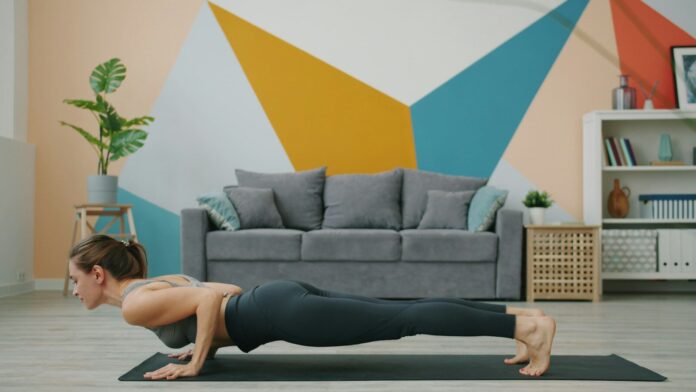

Yes, 20 minutes at home is enough to get stronger and fitter, as long as you do it about three times a week and make the work feel hard. US guidelines dropped the old rule that activity only counts in 10-minute blocks, and a 2024 study of more than 13,000 women found that just 3.4 minutes a day of short, vigorous bursts was linked with 45% lower risk of heart attack, heart failure, stroke or cardiovascular death. Below is a three-workout plan you can do in the living room, with no gym and very little kit.
Key takeaways
- Three 20-minute sessions a week give you about 60 minutes of muscle strengthening, which is the range a 2022 meta-analysis linked with the largest drop in mortality risk.
- Every minute counts. Guidelines no longer require activity to come in bouts of 10 minutes or more.
- Short bursts of vigorous effort in daily life, such as fast stair climbs or carrying shopping up a hill, add real value on top of your workouts.
- Work all major muscle groups: legs, hips, back, abdomen, chest, shoulders and arms.
- Pick a fixed time, keep kit ready and let the kids join in. Consistency beats the perfect plan.
Why 20 minutes at home is enough
Becoming a parent tends to cut the time you spend being active. A 2026 University of Victoria systematic review and meta-analysis of 62 papers found that parents do less moderate-to-vigorous activity than adults without children, and that activity drops after the move into parenthood for both mothers and fathers. So if your old one-hour gym routine has vanished, you are not alone and you are not lazy. Your week changed.
The good news is that the guidelines now fit real life better. The second edition of the US Physical Activity Guidelines removed the requirement for adults to be active in bouts of at least 10 minutes. Its expert committee concluded that bouts of any length add to the health benefits. The World Health Organization makes the same point more simply: any amount of activity is better than none, and muscle strengthening benefits everyone.
What the guidelines ask of you
The WHO, NHS and CDC broadly agree on two targets for adults:
- Cardio: 150 to 300 minutes of moderate activity a week, or 75 to 150 minutes of vigorous activity, or a mix.
- Strength: muscle-strengthening work on at least 2 days a week that covers legs, hips, back, abdomen, chest, shoulders and arms.
Three 20-minute home circuits cover the strength target with room to spare, and because the circuits keep your heart rate up, they also chip away at the cardio target. Add brisk walking on other days and you are there. Our 12-week walking plan for busy women slots in neatly alongside this one.
How much strength work pays off
A 2022 meta-analysis in the British Journal of Sports Medicine pooled 16 cohort studies. Muscle-strengthening activity was linked with 10 to 17% lower risk of death from any cause, cardiovascular disease, total cancer and diabetes. The biggest reduction, about 10 to 20%, appeared at roughly 30 to 60 minutes a week. People who combined strength work with aerobic activity had about 40% lower all-cause mortality than those who did neither.
These are observational studies, and the authors rated the certainty as low, so treat the numbers as a strong hint rather than a guarantee. But the message is encouraging for a busy week: you do not need hours. One hour of strength work, split into three short sessions, is right in the sweet spot.
The 20-minute home workout plan
Each session follows the same shape, so you never have to think about what comes next:
- Warm-up, 3 minutes: march on the spot, arm circles, 10 bodyweight good mornings, 10 slow squats to a chair, 10 wall push-ups.
- Circuit, 14 minutes: 4 exercises, 40 seconds of work and 20 seconds of rest each. That is 4 minutes per round. Do 3 rounds, then a 2-minute finisher.
- Cool-down, 3 minutes: slow walk around the room, then calf, hip flexor and chest stretches.
Use a phone interval timer so you are not counting. Aim to finish each 40-second block feeling that you could do only a few more good reps. The NHS advises doing strength moves to the point where you need a short rest before repeating them, and that is the effort you want.
| Workout | Exercise 1 | Exercise 2 | Exercise 3 | Exercise 4 | 2-min finisher |
|---|---|---|---|---|---|
| A: Legs and push | Squat (chair box squat for beginners) | Push-up (wall, kitchen counter or floor) | Glute bridge | Dead bug | Fast step-ups on the bottom stair |
| B: Hinge and pull | Hip hinge with a backpack or dumbbells (Romanian deadlift) | Bent-over row with backpack, dumbbells or water bottles | Reverse lunge, alternating | Side plank, switch halfway | Skater steps side to side |
| C: Full body | Split squat, switch legs each round | Overhead press with dumbbells or filled water bottles | Single-leg glute bridge | Plank shoulder taps | Squat to calf raise, quick pace |
Your week at a glance
| Day | Option 1: three mornings | Option 2: evenings after bedtime |
|---|---|---|
| Monday | Workout A | Brisk walk, 20–30 min |
| Tuesday | Brisk walk or school run on foot | Workout A |
| Wednesday | Workout B | Rest or gentle stretch |
| Thursday | Brisk walk, 20–30 min | Workout B |
| Friday | Workout C | Brisk walk, 20–30 min |
| Saturday | Family activity: bike ride, swim, park games | Workout C |
| Sunday | Rest | Family activity or rest |
Missed a day? Do the next workout in the sequence when you can. Two sessions in a week still meet the strength guideline.
Make it easier or harder
| Movement | Easier | Standard | Harder |
|---|---|---|---|
| Squat | Sit to stand from a chair | Bodyweight squat | Goblet squat holding a dumbbell or a 5 kg (11 lb) bag of rice |
| Push-up | Wall push-up | Hands on a counter or sofa arm | Floor push-up, slow 3-second lowering |
| Lunge | Hold a chair for balance | Reverse lunge | Rear foot on the sofa (split squat) |
| Row | Resistance band around a door handle | Backpack row | Single-arm dumbbell row, heavier load |
| Plank | Hands on a counter | Forearm plank on the floor | Plank with shoulder taps |
The NHS strength exercise series includes the easier versions, such as sit-to-stand and wall press-ups, if you are starting from scratch. When 40 seconds feels comfortable for two sessions in a row, move one column to the right.
Minimal kit that makes a big difference
You can do every workout with bodyweight and household items. If you want to spend a little, these give the most value per square metre of floor space:
- A pair of adjustable dumbbells or two fixed pairs (for example 4–6 kg and 8–10 kg, roughly 10–12 lb and 18–22 lb). Legs can usually handle more than arms.
- A resistance band set for rows and glute work.
- A non-slip mat so floor work is comfortable.
No dumbbells? A backpack loaded with books, a bag of flour or a shopping bag full of water bottles works. The NHS even lists lifting and carrying children as a strength activity.
Exercise snacks: the bonus minutes
Your 20-minute sessions are the base. Short bursts of hard effort during the day are the bonus. Researchers call these vigorous intermittent lifestyle physical activity, or VILPA: climbing stairs fast, walking very briskly uphill, carrying heavy shopping, or a quick sprint for the bus.
In the 2024 UK Biobank study mentioned above, 13,018 women who did no formal exercise wore activity trackers for a week and were followed for about 8 years. Those who logged a median of 3.4 minutes a day of these bursts had 45% lower risk of major cardiovascular events than women who did none. Even 1.2 to 1.6 minutes a day was linked with 30% lower risk. The study is observational, so it cannot prove cause and effect, but it shows that small efforts add up.
Easy ways to add them:
- Take the stairs two at a time (or just fast) whenever you can.
- Walk the school run at a pace where talking is hard for a minute or two.
- Do 10 fast squats while the kettle boils.
- Race the kids to the end of the park, then walk back.
How to actually stick with it
Most plans fail because of logistics, not willpower. A few practical rules help:
- Anchor it to something that already happens. After the school drop-off, during nap time, or straight after the kids’ bedtime.
- Put it in your calendar like a meeting you would not cancel.
- Keep kit visible. A mat rolled out by the sofa removes the first barrier.
- Let the kids join in. Children love counting reps, timing planks or doing the step-ups with you. It also shows them that exercise is normal.
- Lower the bar on bad days. If 20 minutes is impossible, do one round of the circuit. Something always beats nothing.
- Track sessions, not weight. Tick off each workout. Seeing three ticks a week builds momentum.
Protein matters too. Muscle grows from training plus enough food to repair it. Our guide to how much protein women need after 35 covers targets and vegetarian sources such as lentils, Greek yogurt, tofu, eggs and paneer.
Your 2-minute starting test
Before week one, take a quick baseline. You will repeat it every four weeks to see progress. There are no pass marks here; you are only competing with yourself.
- Chair stands, 30 seconds: sit on a dining chair, arms crossed, and count how many times you can stand up fully and sit back down.
- Push-ups, 30 seconds: at whatever level you can do with good form (wall, counter or floor). Note the level and the count.
- Plank hold: forearms on the floor or hands on a counter. Stop when your hips sag.
Write the numbers in your phone. Most people see a clear jump after four to eight weeks of regular sessions.
Where this fits with your other training
If you can find a little more time or a gym, our 3-day strength training plan for women over 35 is the natural next step, with heavier lifts and progressive loading. Strength work is also one of the best things you can do for your skeleton; see bone health after 35 for women. For your cardio days, keeping most walks or rides at an easy, conversational pace works well, and our zone 2 training guide explains how.
Perimenopause can bring changes in energy, sleep and recovery for some women in their 40s. Strength training stays useful through that stage, but if symptoms are getting in the way, talk to your doctor.
Safety note: Stop and get checked if you feel chest pain, unusual breathlessness, dizziness or palpitations. If you are pregnant or have recently given birth, this plan is not designed for you; ask your doctor or a pelvic-health physiotherapist what is right. If you leak urine, feel heaviness or have pain during jumping or lifting, swap to lower-impact options and get advice. Start with the easier column if you have joint pain or have not trained for a long time.
FAQ
Is a 20-minute workout really enough for a busy mom?
Yes, if you do it about three times a week and push to the point where the last few reps are hard. That gives you around an hour of strength work a week, the range linked with the largest health benefits in cohort studies, and it meets the guideline of strength training on at least two days.
Can I lose weight with 20-minute home workouts?
They help you keep and build muscle while you lose fat, which is what you want. Fat loss itself comes mostly from a modest calorie deficit, enough protein and daily walking. Expect slow, steady change rather than fast results.
Should I do cardio or strength in my 20 minutes?
This circuit does both: strength moves with short rests keep your heart rate up. Add brisk walking or family activities on other days for the rest of your weekly cardio.
What if my kids interrupt me?
Pause the timer and pick up where you left off. Splitting the session into two 10-minute halves still counts, because guidelines say bouts of any length add up.
Is it safe to work out every day?
Walking daily is fine. For the strength circuits, leave a day between sessions when you can, so your muscles recover. If you feel unusually sore or tired, take an extra rest day.
Free tool: count your reps hands-free with the AI rep counter, and see where your habits could take you with Future You.
Sources
- World Health Organization. Physical activity fact sheet, 2024.
- US Department of Health and Human Services. Physical Activity Guidelines for Americans, 2nd edition, 2018.
- NHS. Physical activity guidelines for adults aged 19 to 64.
- NHS. Strength exercises.
- CDC. Adult activity: an overview.
- Momma H et al. Muscle-strengthening activities are associated with lower risk and mortality in major non-communicable diseases. Br J Sports Med, 2022.
- Stamatakis E et al. Device-measured vigorous intermittent lifestyle physical activity (VILPA) and major adverse cardiovascular events: evidence of sex differences. Br J Sports Med, 2024.
- Hilgartner J. Delivering inactivity: a systematic review and meta-analysis of parenthood and physical activity. University of Victoria, 2026.
This article is for general education and is not medical advice. Check with your doctor before starting a new training or nutrition plan, especially if you have a health condition.

