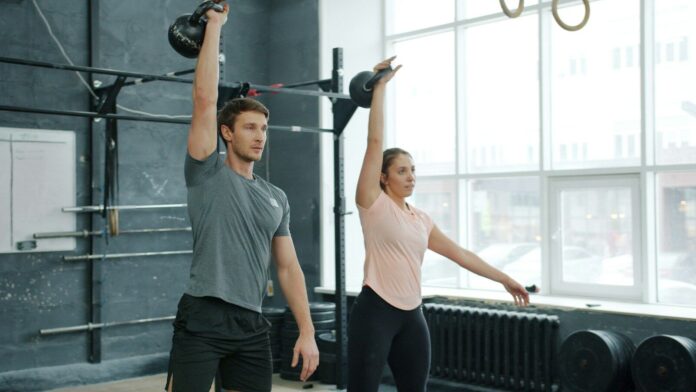

One kettlebell, 20 minutes, three times a week is enough to get measurably stronger and fitter after 35. In a six-week trial, men who did two 12-minute kettlebell swing sessions a week raised their half-squat strength by 9.8% and their vertical jump by 19.8%, matching a group doing jump-squat power training. This plan uses the same tool with five moves that cover your whole body, and it puts swing technique first, because the swing is where backs get hurt.
Key takeaways
- A single kettlebell covers hinge, squat, press, pull and carry. You do not need a second bell to start.
- The swing is a hip hinge, not a squat. Your arms are ropes; your hips do the work.
- Most research used a 16 kg (35 lb) bell for two-hand swings. If you are new to lifting, 12 kg (26 lb) is a better first buy.
- Two to three 20-minute sessions a week meets the WHO target of muscle-strengthening work on at least 2 days a week.
- Kettlebell training clearly improves strength, grip and everyday function. The cardio benefit is real but smaller than marketing suggests.
- The swing loads your lower back in a specific way (posterior shear). If you have a back history, start lighter and slower than you think you should.
Why a kettlebell suits men over 35
After 35 the big wins are strength, power and work capacity, not more time in the gym. A kettlebell delivers all three in one object that fits under a desk.
The handle sits the weight away from your hand, so swings, cleans and carries become ballistic hip-driven movements that a dumbbell does not replicate well. That hip drive is exactly the quality that fades fastest with age and sitting.
It also trains your grip hard without you thinking about it, and grip strength is one of the better simple predictors of how you age. We cover why in our guide to grip strength and longevity.
If you already own dumbbells, our 30-minute dumbbell home workout covers similar ground. The kettlebell plan below is shorter and more hinge-heavy, which is a good complement.
What the evidence says
Strength and power
The clearest finding comes from Lake and Lauder’s 2012 trial. Twenty-one healthy men trained twice a week for six weeks doing 12 rounds of 30 seconds of swings and 30 seconds of rest, with a 12 kg bell if they weighed under 70 kg (154 lb) and 16 kg if they weighed more. Half-squat one-rep max rose 9.8% and vertical jump 19.8%, with no significant difference from the jump-squat group.
Kettlebells are not the best tool for maximal barbell strength, though. A six-week comparison summarised by exercise physiologist Len Kravitz found kettlebell training improved back squat by about 4% versus 14% for traditional weightlifting. If your goal is a heavy squat or deadlift, see our 3-day strength plan; if your goal is to be strong, athletic and pain-free with minimal kit, kettlebells are hard to beat.
Function and grip in older adults
The BELL trial (2022) put 32 insufficiently active adults aged 59 to 79 through three months of supervised hardstyle kettlebell training. Right-hand grip strength rose by 7.1 kg (15.7 lb), six-minute walk distance by 41.7 m (7%), 30-second sit-to-stand by 3.3 repetitions (23%), and the time to get up and down from the floor five times fell by 14.3%.
No serious adverse events were reported. Four non-serious ones were, including two intercostal strains and one flare of existing low-back pain, and 71% of participants had delayed muscle soreness in the early weeks. Attendance was 91.5%, which tells you people enjoyed it enough to keep coming.
Pain
In a Danish workplace trial, 40 adults with an average age of 44 trained with kettlebells three times a week for eight weeks. Compared with the control group, neck and shoulder pain fell by 2.1 points on a 0 to 10 scale and low-back pain by 1.4 points, and trunk extensor strength increased.
Cardio
Here the picture is more mixed. In female college footballers, four weeks of a 20-minute 15-seconds-on, 15-seconds-off snatch protocol raised VO2 max by 2.3 ml/kg/min, about 6%. A 2024 trial in obese young men found 12 weeks of kettlebell training improved estimated VO2 max and body fat as much as bodyweight circuit training did.
But a 2019 scoping review of 99 kettlebell publications concluded that cardio effects are “often over-reported”, and the Danish trial above found no change in aerobic fitness. Treat kettlebells as strength and conditioning that also makes you breathe hard, not as a replacement for your VO2 max work.
Swing technique that protects your back
Stuart McGill’s lab measured spine loads during the swing in seven men using a 16 kg bell. Compression at L4/L5 reached about 3,200 N, in the range of a moderate deadlift, but the swing also produced a posterior shear force of about 461 N at the bottom of the arc, in the opposite direction to a conventional lift.
That shear pattern is why some strong lifters feel fine deadlifting and irritated swinging. It also means technique is not optional. The good news from the same study: the swing lit up the glutes at roughly 76% of maximal activation, which is why it is such an efficient hip exercise.
The five cues
- Set up like a deadlift. Bell 30 cm (12 in) in front of you. Push your hips back, soft knees, flat back, shoulders over the bell. Grip the handle and tilt it toward you.
- Hike it back. Pull the bell back between your legs like a long snap in American football. Forearms touch high on your inner thighs, not your knees.
- Snap the hips. Stand up fast by driving your hips forward and squeezing your glutes. Your arms are ropes; the bell floats to chest height because your hips sent it there.
- Finish in a standing plank. Ribs down, glutes tight, knees straight but not locked. Do not lean back at the top. This is where lower backs get pinched.
- Let it fall, then hinge late. Wait until your forearms are about to touch your thighs before you break at the hips. Hinging early turns the swing into a squat and pulls the load onto your back.
Two mistakes to film yourself for: squatting the swing (knees travel forward, chest drops) and rounding at the bottom (looking at the floor). Fix both by swinging lighter and filming from the side. If you already have back trouble, read our 4-week lower-back fix first and start with deadlifts, not swings.
Which kettlebell weight? A table by experience
Most studies used 16 kg for two-hand swings, and the 2019 review calls it the most common load in the research. But the men in those trials were mostly college age. The table below is our practical starting guide for men over 35 buying one bell. If in doubt, buy the lighter one; a swing you can do with crisp form beats a heavier one you survive.
| Your situation | Two-hand swing | Goblet squat | One-arm press | Row and carry |
|---|---|---|---|---|
| New to lifting, or back after a year off | 12 kg (26 lb) | 12 kg (26 lb) | 8 kg (18 lb) | 12 kg (26 lb) |
| Train 1 to 2 times a week, comfortable with hinges and squats | 16 kg (35 lb) | 16 kg (35 lb) | 12 kg (26 lb) | 16 kg (35 lb) |
| Consistent strength training for a year or more | 20 to 24 kg (44 to 53 lb) | 20 kg (44 lb) | 16 kg (35 lb) | 20 to 24 kg (44 to 53 lb) |
| Strong, athletic, two-hand swings feel easy | 24 to 28 kg (53 to 62 lb) | 24 kg (53 lb) | 20 kg (44 lb) | 24 to 28 kg (53 to 62 lb) |
With one bell, buy for the swing and goblet squat and accept that the press will feel heavy at first. Use push presses (a small dip and drive) or do fewer reps until a strict press is possible. In the BELL trial even healthy older adults struggled to press 8 kg overhead at the start and progressed fine.
The 20-minute one-kettlebell workout
Five moves, one bell, a running clock. Do it two or three times a week on non-consecutive days. It fits the pattern of minimum effective dose training: short, hard enough to matter, repeatable for years.
Warm-up (3 minutes)
- Kettlebell deadlift x 8: the hinge pattern with no momentum.
- Bodyweight squat x 8 and halo x 5 each direction (circle the bell around your head).
- Two-hand swing x 10 at easy effort to groove the hike and snap.
Main block (15 minutes, 5 rounds of 3 minutes)
Start a timer. Every 3 minutes, begin a new round. Do the five moves in order, then rest whatever is left of the 3 minutes. If you have less than 30 seconds left, drop a rep or two next round.
| Move | Reps | Pattern | Coaching cue |
|---|---|---|---|
| Two-hand swing | 12 to 15 | Hinge | Hips snap, arms are ropes, stand in a plank at the top |
| Goblet squat | 8 | Squat | Bell at chest, elbows inside knees at the bottom, drive up through the whole foot |
| One-arm press | 5 each side | Push | Squeeze the handle, brace the free arm, finish with biceps by the ear |
| One-arm row | 8 each side | Pull | Hinge, free hand on a bench or knee, pull the elbow to the hip |
| Suitcase carry | 20 m (65 ft) each side | Carry | Stand tall, do not lean away from the bell, walk slowly |
Cool-down (2 minutes)
Hip-flexor stretch 30 seconds each side, then a slow walk while your heart rate comes down.
How to progress over 8 weeks
- Weeks 1 to 2: 4 rounds, bottom of the rep ranges. Learn the moves.
- Weeks 3 to 4: 5 rounds. Add reps: swings to 15, squats to 10, press to 6 each side.
- Weeks 5 to 6: Swap the two-hand swing for one-arm swings, 10 each side. Add 10 m to the carry.
- Weeks 7 to 8: If every round finishes with 45 seconds to spare, it is time for the next bell up, usually 4 kg heavier. Drop back to 4 rounds with the new weight.
Once you own two bells, the second can be the press-and-row weight and the heavier one the swing-and-squat weight, which removes the main compromise of a one-bell plan.
Common questions about kettlebells after 35, answered honestly
Expect sore glutes and hamstrings after your first week and calluses at the base of your fingers. Hold the handle in your fingers rather than deep in your palm during swings and rub chalk or a little moisturiser into your hands after training.
Expect forearm bruises from cleans if you learn them later; the swing, goblet squat, press, row and carry in this plan carry no such risk. The 2019 review found only three published injury case reports across all kettlebell research, and each involved a training-load error, usually doing far too much, far too soon.
Safety note: Swings put a specific shear load on the lower spine, so if you have a disc history, spinal stenosis or current back pain, get the deadlift pain-free first and ask a physiotherapist before you swing. Stop any set where your form changes. If you have high blood pressure, avoid holding your breath during presses and get your doctor’s agreement before starting ballistic training.
FAQ
What size kettlebell should a man over 35 start with?
If you are new to lifting, 12 kg (26 lb). If you already train and are comfortable with a hinge, 16 kg (35 lb), which is the weight most research used for two-hand swings. Buy one bell for the swing and goblet squat and accept a heavier-than-ideal press for a few weeks.
Is 20 minutes of kettlebells enough?
Yes, if it is done two or three times a week with real effort. The strongest trial on swings used two 12-minute sessions a week and still produced a 9.8% strength gain in six weeks. Twenty minutes, three times a week, also clears the WHO target of muscle-strengthening on at least two days a week.
Are kettlebell swings bad for your back?
Not for most people, but they load the lower back differently from a deadlift, with more posterior shear. People with shear-intolerant backs may feel irritation even when their technique looks fine. Learn the deadlift first, keep the bell light while learning, and stop if the top of the swing makes you arch.
Can kettlebells replace cardio?
Partly. Hard swing intervals push your heart rate high, and some trials show modest VO2 max gains. The research overall suggests kettlebells are better at building strength and work capacity than at building aerobic fitness, so keep one or two easy cardio sessions a week as well.
How many times a week should I do this workout?
Two or three times on non-consecutive days. Three sessions gives faster progress; two keeps you stronger than most men your age with very little time. Pair it with walking, cycling or your sport on the other days.
Free tool: Count your swings and squats hands-free with our AI Rep Counter, and tap any muscle on the Muscle Map to see which kettlebell moves work it.
Sources
- Lake JP, Lauder MA. Kettlebell swing training improves maximal and explosive strength. Journal of Strength and Conditioning Research, 2012.
- McGill SM, Marshall LW. Kettlebell swing, snatch, and bottoms-up carry: back and hip muscle activation, motion, and low back loads. Journal of Strength and Conditioning Research, 2012.
- Meigh NJ et al. Effects of supervised high-intensity hardstyle kettlebell training on grip strength and health-related physical fitness in insufficiently active older adults: the BELL pragmatic controlled trial. BMC Geriatrics, 2022.
- Meigh NJ et al. Kettlebell training in clinical practice: a scoping review. BMC Sports Science, Medicine and Rehabilitation, 2019.
- Jay K et al. Kettlebell training for musculoskeletal and cardiovascular health: a randomized controlled trial. Scandinavian Journal of Work, Environment & Health, 2011.
- Falatic JA et al. Effects of kettlebell training on aerobic capacity. Journal of Strength and Conditioning Research, 2015.
- Govindasamy K et al. The effects of kettlebell training versus resistance training using the own body mass on physical fitness and physiological adaptations in obese adults: a randomized controlled trial. BMC Sports Science, Medicine and Rehabilitation, 2024.
- Kravitz L. Kettlebell Research Update. University of New Mexico.
- World Health Organization. What is the recommended amount of exercise? WHO Regional Office for the Eastern Mediterranean.
This article is for general education and is not medical advice. Check with your doctor before starting a new training or nutrition plan, especially if you have a health condition.

