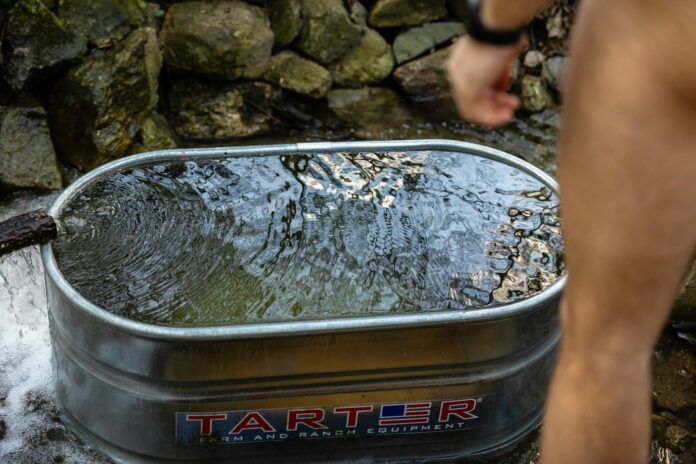

A cold plunge can ease muscle soreness and may lower stress for a few hours, but it is not the miracle the internet sells. Used straight after strength training, it can actually blunt muscle gains: in a 12-week trial, men who took a 10-minute ice bath at 10°C after each session gained less strength and muscle than men who did an easy cool-down. The smart move is to use cold for the right goal, at the right time.
Key takeaways
- For soreness, cold water at about 10–15°C (50–59°F) for 10–15 minutes works best in meta-analyses, and the benefit is real but modest.
- Regular ice baths straight after lifting may reduce muscle and strength gains, so keep them away from strength days if growth is your goal.
- Stress fell 12 hours after cold immersion in a 2025 meta-analysis, but mood did not improve and the evidence base is small.
- The famous “250% dopamine” figure comes from a full hour at 14°C, not a 2-minute plunge.
- The first minute is the risky part: cold shock triggers gasping and a spike in heart rate and blood pressure.
Cold plunge myths vs evidence
Ice baths have moved from rugby changing rooms to backyard tubs and morning routines. Here is how the popular claims hold up.
| Claim | What the evidence shows | Verdict |
|---|---|---|
| “Ice baths speed recovery.” | Meta-analyses find less soreness than passive rest; effects are small to moderate | Partly true |
| “Ice baths help you build muscle.” | Trials and a 2024 meta-analysis suggest they blunt muscle growth when used after lifting | False, often the opposite |
| “Cold plunges fix your mood.” | A 2025 meta-analysis found no improvement in mood | Not supported |
| “They lower stress.” | Stress was lower 12 hours later, but not at 1, 24 or 48 hours | Short-lived effect |
| “They boost your immune system.” | Cold showers cut sick days off work by 29% in one trial, without fewer days of illness | Interesting, not proven |
| “Cold sends dopamine up 250%.” | Measured after 1 hour at 14°C, far beyond a typical plunge | Misquoted |
Does a cold plunge help recovery?
Yes, for soreness, modestly. A 2016 meta-analysis of 9 randomised trials in Sports Medicine found cold water immersion was slightly better than passive rest for muscle soreness, both immediately and in the following days. The best results came from water at about 10–15°C for 10–15 minutes.
A larger 2025 network meta-analysis of 55 trials (1,139 participants) reached a similar conclusion. Medium-length immersions of 10–15 minutes at 5–15°C were the only protocols that improved soreness, jump performance and a blood marker of muscle damage (creatine kinase). Shorter, longer and warmer dips showed weaker or inconsistent effects.
Two caveats. Many of these trials were small with some risk of bias, and most looked at one hard session, not months of training. Feeling less sore is not the same as adapting better.
Do ice baths kill your gains?
This is the most important finding for anyone who lifts. Roberts and colleagues published a two-part study in the Journal of Physiology in 2015.
In the training study, 21 active men lifted twice a week for 12 weeks. After each session, half sat in 10°C water for 10 minutes and half did 10 minutes of easy cycling. The active recovery group gained more strength and muscle: their type II (fast-twitch) muscle fibres grew by 17% and their isokinetic work by 19%, while the ice bath group’s fibres did not grow significantly.
In a second experiment, ice baths after a single session dampened the signalling and stem-cell activity that drive muscle repair and growth. The authors concluded that lifters should reconsider using cold water immersion for recovery.
A 2024 meta-analysis of 8 studies in the European Journal of Sport Science backed this up. Resistance training alone produced a small increase in muscle size, while training followed by cold water produced a smaller, near-negligible one. The authors rated the studies fair to poor in quality, so the effect is likely but not certain.
The practical message: if building muscle and strength is the goal, do not jump in an ice bath straight after lifting. Our guide to strength training after 35 covers the recovery habits that do support growth, and the biggest one is sleep: here is how much sleep you need to build muscle.
Cold plunge benefits for mood and stress
The mood claims are the loudest and the least proven. A 2025 systematic review and meta-analysis in PLOS ONE pooled 11 trials with 3,177 healthy adults, mostly using water at 10–15°C for at least 30 seconds.
- Stress: lower 12 hours after cold exposure, but not straight after, nor at 1, 24 or 48 hours.
- Sleep and quality of life: some improvement, though the sleep data came only from men.
- Mood: no improvement.
- Inflammation: a temporary rise immediately after and an hour later, which the authors see as a normal stress response.
The biggest single trial in that field is Dutch. Over 3,000 adults were randomised to finish their daily shower with 30, 60 or 90 seconds of cold water for 30 days, or to keep showering normally. The cold groups took 29% fewer sick days off work, but they did not report fewer days of illness.
What about the dopamine claim?
The widely shared figure comes from a 2000 study in which young men sat in water up to their necks for a full hour. At 14°C, noradrenaline rose by 530% and dopamine by 250%. That is real physiology, but an hour at 14°C is a very different stress from a 2-minute plunge, and a rise in blood dopamine is not proof of better mood.
If you like how cold makes you feel, that is a valid reason to do it. Just do not expect it to replace proven tools. Regular exercise has much stronger evidence; see our guide to exercise for stress and mood.
When to use a cold plunge, and when not to
| Your situation | Use cold? | How |
|---|---|---|
| Straight after a strength or muscle-building session | No | Easy cool-down instead; plunge on a rest day if you enjoy it |
| Tournament, double-header or two matches in two days | Yes | 10–15 min at 10–15°C after the first match |
| Very sore after a one-off hard session or event | Optional | 10–15 min at 10–15°C, or a cold shower if that is all you have |
| You enjoy it for alertness or routine | Fine | Short dips or cold showers, away from lifting days |
| Heart disease, high blood pressure or circulation problems | Ask first | Get your doctor’s advice before any cold immersion |
A beginner cold plunge protocol
- Start with cold showers. End your usual shower with 30 seconds of cold for a week, then build to 60–90 seconds. This is how the Dutch trial began.
- Move to a tub at 12–15°C (54–59°F). Enter slowly, feet first, and keep your face out of the water.
- Breathe through the first minute. Slow, long exhales help you ride out the gasp. Our free breathing exercise is good practice on dry land.
- Stay 2–5 minutes at first. Build towards 10 minutes only if your goal is post-event soreness; longer is not better.
- Rewarm gently. Dry off, dress warmly and move around. Avoid a very hot shower straight away if you feel light-headed.
If you also use the sauna, our guide to sauna benefits after 35 covers the heat side of the evidence and its safety rules.
Cold plunge safety: the first minute matters most
Sudden immersion in cold water triggers the cold shock response: a reflex gasp within the first seconds, then fast, hard-to-control breathing and a sharp rise in heart rate and blood pressure. It typically settles over the first few minutes.
In open water, that gasp is what drowns people. Below about 15°C, breath-holding time drops sharply, and the sudden strain on the heart raises the risk of dangerous rhythms in people with heart disease.
- Never plunge or swim in open cold water alone, and never put your head under in the first minute.
- Skip cold immersion after alcohol.
- Get your doctor’s advice first if you have heart disease, high blood pressure, a history of fainting or circulation problems.
- Get out if you start shivering hard, feel confused, or your hands stop working properly.
- Repeated exposure helps: in one study, the heart rate response was lower after several short immersions in 15°C water, even though the initial gasp remained.
Cold immersion puts real strain on the heart. Our guide to heart health after 35 explains the risk factors worth checking first.
Safety note: Get out and seek help immediately if you have chest pain, palpitations, severe breathlessness that does not settle, confusion or fainting. If you have heart disease, high blood pressure, Raynaud’s or another circulation problem, or you are unsure, speak to your doctor before trying cold plunges or open-water dips.
FAQ
How long should you stay in a cold plunge?
For soreness after hard events, studies point to 10–15 minutes at about 10–15°C. For general wellbeing, most trials used much shorter exposures, from 30 seconds to a few minutes. Beginners should start with 1–2 minutes and build up.
Is a cold plunge better before or after a workout?
If you lift for muscle and strength, avoid it straight after. Ice baths after training blunted muscle growth in trials. Use cold on rest days, or after matches and endurance events when fast recovery matters more than long-term adaptation.
What temperature should a cold plunge be?
Most recovery research uses 10–15°C (50–59°F), which is cold enough to work and easier to tolerate than ice-filled water. Colder is not automatically better, and the cold shock response becomes more intense as temperature drops.
Is a cold shower as good as an ice bath?
For wellbeing, cold showers have the strongest single trial behind them: 30–90 seconds a day reduced sick days off work. For muscle soreness, the research mostly used immersion of the legs or whole body, so a shower is a weaker version of the same idea.
Do cold plunges help you lose fat?
Cold exposure raises metabolic rate sharply while you are in the water, but a short plunge burns very little in the grand scheme. It will not replace a calorie deficit, protein and training for fat loss.
Free tool: time your cold dips and cool-downs with the workout timer, and practise slow breathing for the first minute with the guided breathing exercise.
Sources
- Roberts LA et al. Post-exercise cold water immersion attenuates acute anabolic signalling and long-term adaptations in muscle to strength training. J Physiol, 2015.
- Piñero A et al. Throwing cold water on muscle growth: a systematic review with meta-analysis of post-exercise cold water immersion on resistance training-induced hypertrophy. Eur J Sport Sci, 2024.
- Machado AF et al. Can water temperature and immersion time influence the effect of cold water immersion on muscle soreness? A systematic review and meta-analysis. Sports Med, 2016.
- Wang H, Wang L, Pan Y. Impact of different doses of cold water immersion on recovery from acute exercise-induced muscle damage: a network meta-analysis. Front Physiol, 2025.
- Cain T et al. Effects of cold-water immersion on health and wellbeing: a systematic review and meta-analysis. PLOS ONE, 2025.
- Buijze GA et al. The effect of cold showering on health and work: a randomized controlled trial. PLOS ONE, 2016.
- Šrámek P et al. Human physiological responses to immersion into water of different temperatures. Eur J Appl Physiol, 2000.
- Eglin CM et al. Rapid habituation of the cold shock response. Extreme Physiol Med, 2015.
- National Center for Cold Water Safety. Cold shock.
This article is for general education and is not medical advice. Check with your doctor before starting a new training or nutrition plan, especially if you have a health condition.

