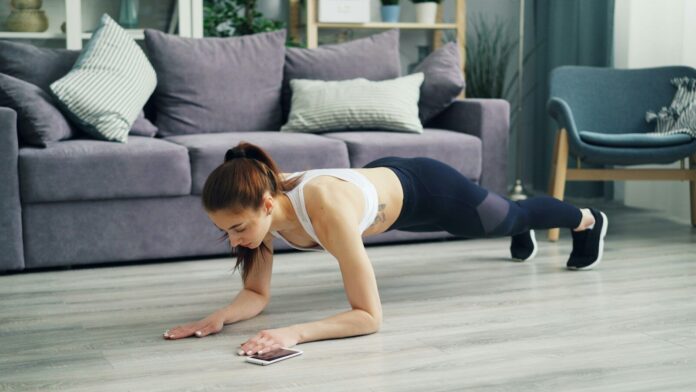

Yes, you can learn to do full push-ups and even a pull-up after 35, whatever your starting point. The trick is to start at a level you can do with good form, usually against a wall or a kitchen counter, and move down one small step at a time. Two or three short sessions a week for eight to twelve weeks is enough for most beginners to see clear progress.
Key takeaways
- Inactive adults lose roughly 3–8% of their muscle mass per decade, and upper-body moves like push-ups and pulls are a simple way to fight back.
- The NHS names push-ups as a strength exercise that counts toward the two strength days a week adults should do.
- In a small trial, push-ups adjusted to a lighter, kneeling-style load built chest strength and muscle about as well as bench pressing.
- Start with the 2-minute self-test below, then follow the six-step ladders for each move.
- Pull-ups take longer. Rows, hangs and slow lowering build the strength first, so expect months, not weeks.
Why push-ups and pull-ups are worth learning after 35
After your mid-30s, muscle quietly becomes a use-it-or-lose-it tissue. A review in Current Sports Medicine Reports found that inactive adults lose about 3–8% of their muscle mass each decade, along with a drop in resting metabolic rate and a rise in body fat. The same review reported that ten weeks of resistance training can add around 1.4 kg of lean weight and cut about 1.8 kg of fat.
Most women’s routines lean heavily on the lower body: walking, squats, lunges, glute work. That is great, but your arms, chest, shoulders and upper back carry shopping bags, lift children, push a stroller up a hill and get you up off the floor. Push-ups train the “push” muscles (chest, front of the shoulders, triceps) and pull-ups train the “pull” muscles (upper back, the lats, biceps and grip).
Both moves also need you to hold your trunk steady, so they double as core training. And neither needs a gym membership. A wall, a sturdy table edge, a pull-up bar or a park’s monkey bars will do.
The official guidelines back this up. The NHS advises adults to do strengthening activities that work all the major muscle groups, including chest, shoulders and arms, on at least two days a week, and lists push-ups as an example. The CDC gives the same two-day target. If you already follow our 3-day strength plan for women over 35, the ladders below slot straight into it.
Myth vs evidence
| Myth | What the evidence says |
|---|---|
| “Knee or incline push-ups don’t count.” | In an 8-week trial, push-ups with the body position adjusted (for example, kneeling) to match a light bench press load gave similar gains in chest muscle thickness and 1RM strength as bench pressing. |
| “Push-ups are only for endurance, not real strength.” | A study comparing elastic-band push-ups with bench presses at similar muscle activity found similar strength gains after five weeks. |
| “Women simply can’t do pull-ups.” | Women in a structured strength and aerobic programme gained upper-body strength and lost body fat. Those who succeeded had higher strength relative to body mass, which is trainable. |
| “You need to train every day to improve.” | The ACSM recommends 2–3 days a week for beginners. Rest days are when you adapt. |
The 2-minute self-test: find your starting level
Warm up with 30 seconds of arm circles and a few easy wall push-ups. Then test each move once. Stop when your form breaks: hips sag, you hold your breath or you can’t control the lowering.
Push-up test (60 seconds)
Start at the lowest level you think you can manage from the ladder below. Count clean reps. If you hit 12 or more with good form, rest a minute and try the next level down.
Pull test (60 seconds)
If you have a bar, hang with straight arms for as long as you can, up to 30 seconds. If you don’t, do inverted rows under a sturdy, low bar or a suspension trainer and count clean reps.
| Your result | Push-up starting step | Pull starting step |
|---|---|---|
| Fewer than 8 wall push-ups, or a hang under 10 seconds | Step 1: wall push-up | Step 1: band or towel row |
| 8–12 counter push-ups, or a hang of 10–20 seconds | Step 2–3: high and low incline | Step 2: high inverted row |
| 8–12 knee or low-incline push-ups, or a hang of 20–30 seconds | Step 4: slow lowering from the floor | Step 3–4: low row and hangs |
| 3–8 full push-ups, or 8+ low rows | Step 5: full push-up | Step 5: band-assisted pull-up and negatives |
These steps are a training guide, not a medical or fitness score. Write your numbers down and retest every four weeks. Our free AI Rep Counter can count your push-ups for you through your phone camera.
The push-up ladder: six steps to full push-ups
Every step uses the same body shape: a straight line from head to heels (or knees), hands just wider than your shoulders, and elbows angled back at roughly 45 degrees, not flared out to the sides. Lower your chest toward your hands, then press away.
- Wall push-up. Stand an arm’s length from a wall, hands at chest height. The further your feet are from the wall, the harder it gets.
- High incline push-up. Hands on a kitchen counter or a sturdy table, about hip height.
- Low incline push-up. Hands on a stair, bench or a solid box at knee height. Many coaches prefer this to knee push-ups because you practise the full-body plank.
- Knee push-up or slow lowering. On the floor, either from your knees with hips straight, or from your toes, lowering over 3–5 seconds and then dropping to your knees to come back up.
- Full push-up. From your toes, chest to about a fist’s height from the floor. Quality first: three perfect reps beat ten sloppy ones.
- Progress further. Add reps, pause for two seconds at the bottom, or slow the lowering. Feet-elevated push-ups come later.
Progressing through harder versions works. In a 4-week study of trained young men, a programme that moved through progressively harder push-up variations raised bench press strength as well as push-up ability.
Move to the next step when you can do 3 sets of 12 clean reps. Expect it to take 2–4 weeks per step, sometimes longer. That is normal.
The pull-up ladder: building your first pull-up
The pull-up is one of the hardest bodyweight moves for anyone, because you lift your entire body with your upper back and arms. Research on college-age women found that the ones who achieved a pull-up after training had higher strength relative to their body mass. So the job is to build pulling strength step by step.
- Band or towel row. Loop a resistance band around a sturdy post or door anchor, or use a band at home. Pull your elbows back and squeeze your shoulder blades together.
- High inverted row. Use a suspension trainer, gym rings or a waist-height bar on a Smith machine or park frame. Lean back with a straight body and pull your chest to your hands. The more upright you stand, the easier it is. Avoid using a kitchen table, which can tip.
- Low inverted row. Same move with the bar lower, so your body is closer to horizontal.
- Dead hang and scapular pulls. Hang from a bar with straight arms, then gently pull your shoulders down away from your ears without bending your elbows. This builds grip and shoulder control.
- Negatives and band-assisted pull-ups. Step up so your chin is above the bar, then lower yourself over 3–5 seconds. Or loop a thick band over the bar and put one foot or knee in it for help. A lat pulldown machine is a good gym option at this stage.
- Your first pull-up. Use an underhand grip (a chin-up) first, as most people find it a bit easier. Then build to 2–3 sets of 1–3 reps.
Be patient. Plenty of fit, strong women take months to get their first rep.
Your 8-week plan
The ACSM position stand on resistance training recommends 2–3 sessions a week for beginners, using a load you can lift about 8–12 times. This plan follows that, and each session takes about 15–20 minutes. Do it on non-consecutive days, either on its own or tagged onto the end of your main strength session.
| Weeks | Push-ups | Pulls | Sessions/week |
|---|---|---|---|
| 1–2 | 2 sets of 8–10 at your starting step, slow and controlled | 2 sets of 8–10 rows + 2 hangs of 10–20 s (if you have a bar) | 2 |
| 3–4 | 3 sets of 8–12 | 3 sets of 8–12 rows + 2 hangs | 2–3 |
| 5 | Retest. Move up a step if you hit 3 × 12 | Retest. Lower the bar or add negatives | 2–3 |
| 6–7 | 3 sets of 6–10 at the new step, plus 1 set at the old step | 3 sets of 6–10 rows + 3 negatives of 3–5 s | 3 |
| 8 | Easier week: 2 sets, then retest | Easier week: 2 sets, then retest | 2 |
Rest 60–90 seconds between sets. Finish each set with one or two reps still “in the tank”. The NHS describes the right effort as working to the point where you need a short rest before going again.
Fitting it into a busy week
- Do one set of wall or counter push-ups while the kettle boils. Small sets across the day add up.
- Pair push-ups with rows in a superset: one set of each, then rest. You finish in half the time.
- Short on time? Our 20-minute home workouts for busy women already include push-up variations.
Form cues that protect your shoulders and wrists
- Brace your middle. Squeeze your glutes and tighten your stomach as if someone were about to poke it. Your hips should not sag or pike up.
- Elbows at 45 degrees. Wide, flared elbows put more stress on the front of the shoulder.
- Wrist comfort. If your wrists ache, spread your fingers, press through the base of your fingers, or hold push-up handles or dumbbells so your wrists stay straight.
- Shoulders down for pulls. Start every row and pull-up by drawing your shoulder blades down and back. Avoid shrugging up to your ears.
- Breathe. Breathe in on the way down and out on the way up. Holding your breath raises pressure in your chest and abdomen.
- Control the lowering. A 2–3 second descent builds strength and keeps your joints happy.
Safety note: Mild muscle soreness for a day or two is normal. Sharp pain, pain that wakes you at night, or tingling or numbness down an arm is not. Stop and see your doctor or a physiotherapist. If you have a shoulder, neck or wrist injury, high blood pressure that is not controlled, or a heart condition, check with your doctor first. If you notice leaking or heaviness in your pelvic area (our pelvic floor exercises guide explains why) during push-ups or hangs, move back to an easier step and talk to a doctor or a pelvic-health physiotherapist.
Help your muscles grow: protein and recovery
Strength comes from the training, but your muscles rebuild between sessions. Two simple habits make a real difference:
- Eat enough protein. Spread it across your meals: eggs or Greek yoghurt at breakfast, chicken, fish, tofu, lentils or chickpeas at lunch and dinner. See how much protein women need after 35 for daily targets and vegetarian options.
- Sleep and rest days. Leave at least one day between upper-body sessions so your muscles can recover.
Strength work also loads your bones. Our guide to bone health for women after 35 explains why that matters more with every decade.
Around perimenopause and menopause, some women find recovery and strength gains feel slower. Keep training, and talk to your doctor if your energy or joint aches change a lot.
FAQ
How many push-ups should a woman over 35 be able to do?
There is no single right number. Fitness test norms differ by test method and population. A practical goal is 10–15 full push-ups with good form, but going from wall push-ups to counter push-ups is real progress worth celebrating.
Are knee push-ups a waste of time?
No. A trial that adjusted push-up position, such as kneeling, to a set load found strength and muscle gains similar to bench pressing. Low incline push-ups are also a great option because they train the full plank position.
How long does it take to do a first pull-up?
It varies a lot with your starting strength and body weight. Many beginners need several months of consistent rows, hangs and negatives. Track your progress on each step rather than only counting pull-ups.
Can I train push-ups every day?
Small, easy sets every day are usually fine, but your hard sessions should be 2–3 times a week with rest days in between, as the ACSM recommends for beginners.
I don’t have a pull-up bar. What can I do?
Band rows, dumbbell or water-bottle rows, and inverted rows under a sturdy park bar or on a suspension trainer all build the same muscles. A lat pulldown machine at the gym is another good choice.
Free tool: Count your push-ups with the AI Rep Counter, and tap any muscle on the Muscle Map to find more exercises for your chest, back and arms.
Sources
- Westcott WL. Resistance training is medicine: effects of strength training on health. Curr Sports Med Rep, 2012.
- NHS. Physical activity guidelines for adults aged 19 to 64.
- CDC. Adult activity: an overview.
- American College of Sports Medicine. Position stand: Progression models in resistance training for healthy adults. Med Sci Sports Exerc, 2009.
- Kikuchi N, Nakazato K. Low-load bench press and push-up induce similar muscle hypertrophy and strength gain. J Exerc Sci Fit, 2017.
- Calatayud J et al. Bench press and push-up at comparable levels of muscle activity results in similar strength gains. J Strength Cond Res, 2015.
- Kotarsky CJ et al. Effect of progressive calisthenic push-up training on muscle strength and thickness. J Strength Cond Res, 2018.
- Flanagan SP, Vanderburgh PM, Borchers SG, Kohstall CD. Training college-age women to perform the pull-up exercise. Res Q Exerc Sport, 2003.
This article is for general education and is not medical advice. Check with your doctor before starting a new training or nutrition plan, especially if you have a health condition.

