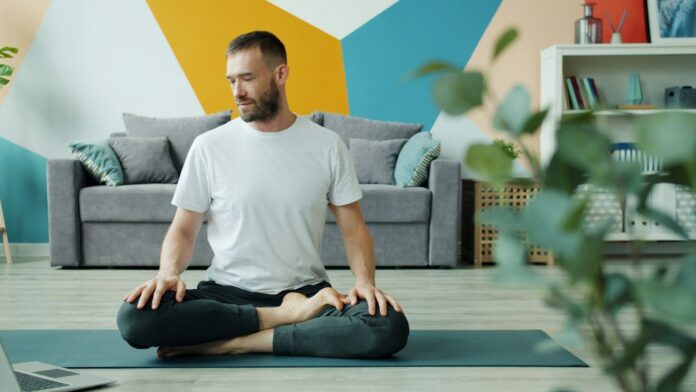

The sitting-rising test asks one thing: can you sit down on the floor and stand back up without using your hands? In a Brazilian study of more than 2,000 adults aged 51 to 80, people who scored 0–3 out of 10 had 5 to 6 times the risk of dying over about six years compared with those who scored 8–10. A sister test, standing on one leg for 10 seconds, was linked to an 84% higher risk of death for those who could not do it, and you can try both in your living room in under two minutes.
Below: what the studies found, step-by-step instructions with scoring, what your score means, and a simple plan if it is lower than you would like.
Key takeaways
- The sitting-rising test scores you from 0 to 10. You lose 1 point for each hand, knee or other support you use, and half a point for a wobble.
- In a 12-year follow-up of 4,282 adults, 42% of people scoring 0–4 died, compared with under 4% of those scoring a perfect 10.
- One in five adults aged 51–75 could not stand on one leg for 10 seconds, and failure was linked to an 84% higher risk of death.
- Both studies are observational. A low score is a warning light, not a prediction of your personal lifespan.
- Leg strength, hip mobility, body weight and balance all drive your score, and all of them respond to training.
What the sitting-rising test predicts
Brazilian sports physician Claudio Gil Araújo developed the sitting-rising test (SRT) to check musculoskeletal fitness in his Rio de Janeiro clinic. In 2012 his team, with Leonardo Barbosa Barreto de Brito as first author, published the first study of its link with survival.
They tested 2,002 adults aged 51 to 80 and followed them for a median of 6.3 years. There were 159 deaths, and only two of them were among people who scored a perfect 10.
After adjusting for age, sex and body mass index, people scoring 0–3 had 5 to 6 times the death risk of those scoring 8–10. Each extra point on the test was linked to a 21% lower risk of death.
The 2025 update: bigger and longer
In 2025 the same group published a larger study in the European Journal of Preventive Cardiology. They followed 4,282 adults with an average age of 59 for about 12 years.
| Sitting-rising score | Died during follow-up |
|---|---|
| 10 | 3.7% |
| 8.5–9.5 | 7.0% |
| 8 | 11.1% |
| 4.5–7.5 | 20.4% |
| 0–4 | 42.1% |
The lowest scorers had about 3.8 times the risk of death from natural causes and 6 times the risk of cardiovascular death compared with the top scorers. At 10 years, 97% of people with a perfect score were alive, compared with 73% of those scoring 0–4.
What the 10-second one-leg balance test predicts
In 2022 Araújo and an international team published a second test in the British Journal of Sports Medicine. They asked 1,702 adults aged 51 to 75 to stand on one leg for 10 seconds, then followed them for about seven years.
About one in five (20.5%) could not do it. Among those who failed, 17.5% died during follow-up, compared with 4.5% of those who passed. After adjusting for age, sex and existing health conditions, failing was linked to an 84% higher risk of death from any cause.
Failure climbed steeply with age:
| Age | Could not stand 10 s on one leg |
|---|---|
| 51–55 | About 5% |
| 56–60 | 8% |
| 61–65 | Just under 18% |
| 66–70 | Just under 37% |
| 71–75 | About 54% |
The pattern is the point. Balance tends to hold up well into your 50s and then fall away fast, so your 40s are the best time to build a buffer.
How to do the sitting-rising test at home
Find a clear, non-slip floor, take your shoes and socks off, and ask someone to stand nearby in case you lose balance. The test is not timed, so move at whatever speed feels controlled.
- Stand tall. Feet close together. You can cross your feet if it helps.
- Sit down. Lower yourself to sit on the floor, cross-legged, using as little support as you can. Ideally no hands, knees or forearms touch the floor.
- Stand up. From that seated position, rise back to standing, again using as little support as you can.
- Score each half out of 5. Start with 5 for sitting and 5 for rising, then take off points as below.
- Add them up. Your total is out of 10. Have a couple of goes and keep your best.
Sitting-rising test scoring
| What happens | Points lost |
|---|---|
| Hand on the floor | −1 each time |
| Knee on the floor | −1 each time |
| Forearm or arm on the floor | −1 each time |
| Hand bracing on your knee or thigh | −1 each time |
| Clear wobble or near loss of balance | −0.5 |
Example: you sit down cleanly (5), then push off the floor with one hand to stand (4) and wobble on the way up (3.5). Your score is 8.5.
Filming yourself side-on helps you spot sneaky supports, like a hand brushing your knee. In the research, trained doctors did the scoring, and the lead researcher describes the test as a supervised screening tool. Treat your home score as a good estimate, not a diagnosis.
How to do the 10-second one-leg balance test
This follows the protocol used in the 2022 study. Stand near a wall or chair you can grab if needed.
- Stand tall, arms by your sides, eyes looking straight ahead.
- Lift one foot and rest the front of it against the back of your standing calf.
- Hold for 10 seconds without touching anything or moving your standing foot.
- You get up to three attempts on each foot, as in the study. Holding for the full 10 seconds is a pass.
Passed easily? Try it with your eyes closed, or count how long you can hold up to 30 seconds. That gives you more room to track progress.
What your scores mean
| Your result | What it suggests | Next step |
|---|---|---|
| SRT 8–10 and balance pass | Good strength, mobility and balance for your weight | Keep training; retest yearly |
| SRT 6–7.5 | One link is weak: strength, hips or balance | Follow the plan below for 8 weeks |
| SRT under 6, or balance fail | Clear room to improve | Start the plan and mention it at your next check-up |
| SRT under 4 before 60 | Well below what most people your age manage | See your doctor or a physiotherapist first |
Why do these simple tests track survival?
The researchers think the sitting-rising test captures several things at once: leg strength, flexibility, balance, coordination and power relative to body weight. The one-leg stance adds balance and the nervous system’s ability to keep you upright.
Body weight matters too. Extra kilos make every rise heavier, which is one reason losing fat while keeping muscle can lift your score. Our guide to losing fat and keeping muscle after 35 shows how.
What the studies cannot show is cause and effect. People who are already unwell often score lower.
The authors also note that their participants were Brazilian clinic patients, and that whether improving your score adds years is still unproven. Better strength and balance do pay off in daily life, though, and they reduce falls.
What to do if you score low
The best evidence comes from falls research. A 2019 Cochrane review of 108 randomised trials found that exercise cut the rate of falls in older people by about 23%, with balance and functional exercises backed by high-certainty evidence. The WHO also recommends balance training on 3 or more days a week for older adults.
You do not need to be 70 to start. Use this 8-week plan three times a week, at home, in about 20 minutes.
| Block | Exercises | Dose |
|---|---|---|
| Leg strength | Goblet squat to a low box, split squats, step-ups | 3 sets of 8–12 each |
| Hip mobility | Deep squat hold, 90/90 hip switches, cross-legged sitting | 2–3 minutes total |
| Floor practice | Sit down and stand up, using one less support each week | 5–8 slow reps |
| Balance | One-leg stand, then eyes closed, then on a cushion | 3 x 20–30 s each leg |
How to progress
- Weeks 1–2: Use a hand or chair for floor practice and balance. Focus on control.
- Weeks 3–5: Drop one support. Add a dumbbell or kettlebell to squats and step-ups.
- Weeks 6–8: Try hands-free floor rises and eyes-closed balance. Retest both tests at the end of week 8.
Brush your teeth on one leg and you have done a balance session before breakfast. For the strength side, our 3-day strength training plan builds the leg and hip strength that hands-free rising needs. Our guide to grip strength and longevity covers another simple strength test with strong data behind it.
Do not forget your engine
Strength and balance are only part of the picture. Aerobic fitness is one of the strongest predictors of long life, and our VO2 max after 35 guide explains how to raise it. Pull it all together with our longevity habits guide.
Safety note: Do both tests on a soft, clear floor with someone nearby, and skip the sitting-rising test if you have had a recent hip or knee replacement, acute back or knee pain, or a fall. See a doctor if you notice sudden balance problems, dizziness, numbness, or weakness on one side of the body. Sudden weakness on one side, a drooping face or slurred speech can be a stroke and needs emergency help.
FAQ
What is a good sitting-rising test score?
A score of 8 or more is good. In both Araújo studies, people scoring 8–10 had the lowest death rates, and scores below 8 were linked with clearly higher risk.
Can a 40-year-old use these tests?
Yes, as a fitness check. The studies focused on adults aged about 50 and over, so the survival numbers do not directly apply to younger men. At 40, aim for a sitting-rising score of 8 or more and an easy pass on the balance test.
Can you improve your sitting-rising test score?
Yes. Leg strength, hip mobility, balance and body weight all affect it, and all can change with training. Whether a better score lengthens life has not been tested yet.
Why is standing on one leg linked to death risk?
Balance relies on muscles, joints, vision, the inner ear and the nervous system working together. Poor balance can reflect problems in any of these and raises the risk of falls, which become a major health threat with age.
Is it bad if I use one hand to get up off the floor?
Not on its own. One hand costs you a point, so you could still score 8 or 9. Use it as a target to work on rather than a cause for worry.
Free tool: Check your strength, cardio and mobility for your age with the free Fitness Test, then see how your fitness at 50, 60 and 70 changes with and without training in Future You.
Sources
- European Society of Cardiology. Ability to sit and rise from the floor is closely correlated with all-cause mortality risk (on Brito LBB, Araújo CGS, et al. Eur J Prev Cardiol, 2012).
- TCTMD. Simple sitting-rising test linked to natural and CV mortality (on Araújo CGS, et al. Eur J Prev Cardiol, 2025).
- University of Bristol. Inability to stand on one leg in mid to later life linked to higher risk of death (on Araújo CG, et al. Br J Sports Med, 2022).
- El Camino Health. The sitting/rising test: can it predict how long you’ll live?
- Cochrane. Exercise for preventing falls in older people living in the community (Sherrington C, et al. 2019).
- World Health Organization. Physical activity recommendations for adults and older adults.
This article is for general education and is not medical advice. Check with your doctor before starting a new training or nutrition plan, especially if you have a health condition.

