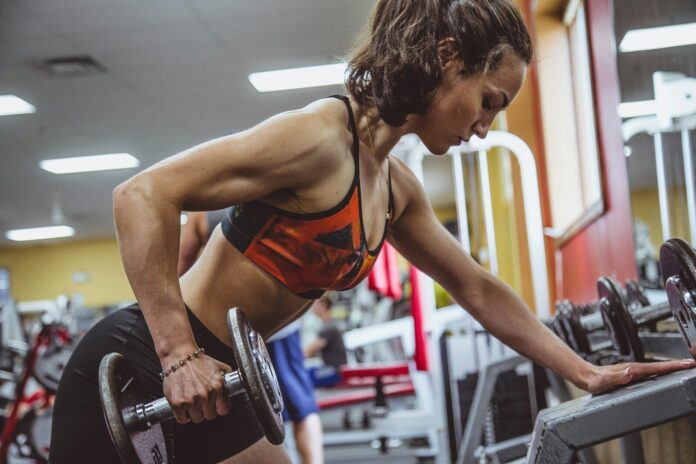

No, lifting does not make women bulky. In the largest review of women-only strength trials (24 randomised trials, 912 women), about 15 weeks of lifting three times a week added roughly 1.45 kg (3.2 lb) of lean mass in total, while strength jumped 25–27%. That is about 100 g (3.5 oz) of muscle a week, spread over your whole body.
The look most women call “bulky” comes from fat sitting over muscle, not from the muscle itself. Here is what the evidence shows, what makes you look bigger, and three exercises to start this week.
Key takeaways
- Women and men gain muscle at a similar rate relative to their starting size; women gain less in absolute terms because they start with less muscle.
- In trials of untrained women, a full-body programme added about 1.45 kg (3.2 lb) of lean mass over roughly 15 weeks, with 25–27% strength gains.
- Women’s testosterone sits around 15–70 ng/dL, versus 193–824 ng/dL in men, which caps how fast and how far muscle can grow without drugs.
- Muscle is denser than fat: the same weight of muscle takes up less space, so trading fat for muscle makes you look firmer and smaller, not bigger.
- Age is not the barrier: hypertrophy responses did not differ between women aged 18–30 and 31–50 in the same review.
- Start with three moves (goblet squat, hip hinge, row), 2–3 sets of 8–12 reps, 2–3 days a week, and add weight when 12 reps feel clean.
Where the “bulky” fear comes from
If you picture a female bodybuilder on a competition stage, you are picturing years of specialised training, a very strict diet and, in many cases, a body that is unusually responsive to training. That image has very little to do with what happens when a 42-year-old with a job and a family lifts twice a week.
The fear also mixes up two different things: muscle size and body size. You can add muscle and get smaller at the same time, and most women who lift do exactly that.
Myth vs evidence: the table to screenshot
| The myth | What the evidence shows | Source |
|---|---|---|
| “Lifting makes women bulky fast.” | Untrained women gained about 1.45 kg (3.2 lb) of lean mass in roughly 15 weeks of training three times a week. Range across studies: 0.4–3.3 kg (0.9–7.3 lb). | Hagstrom et al., 24 trials, 912 women |
| “Women can’t really build muscle.” | Relative muscle growth was almost identical between the sexes (difference 0.69%, described by the authors as negligible). Women start with less muscle, so absolute gains are smaller. | Refalo et al., 29 studies |
| “Women gain muscle like men do.” | Men gained slightly more in absolute terms (small effect), with the biggest gap in the upper body. Women’s relative gains matched men’s. | Refalo et al.; Roberts et al. |
| “Lifting will make me as strong and big as a man.” | In 585 adults who trained one arm for 12 weeks, biceps size rose 17.9% in women vs 20.4% in men, but women’s strength rose 64% vs 40%. Women got stronger faster, not bigger. | Hubal et al., 585 adults |
| “My hormones will make me huge.” | Typical total testosterone is about 40 ng/dL in women (range 15–70) versus 193–824 ng/dL in men. Hormones set a much lower ceiling on how large muscles can get. | Cleveland Clinic |
| “Heavy weights bulk you up; light weights tone.” | How heavy the weight was did not change strength or size results in women. “Toned” is simply muscle with less fat over it. | Hagstrom et al. |
| “Muscle will make me heavier and bigger.” | Muscle is denser than fat, so the same weight of muscle takes up less space. Gaining muscle while losing fat makes you look firmer, not larger. | Cleveland Clinic |
| “Cardio burns fat; lifting doesn’t.” | Lifting alone cut body fat by about 1.4 percentage points and about 0.5 kg (1 lb) of fat mass in around five months, in 58 studies with roughly 3,000 untrained adults. | Wewege et al., 58 studies |
| “After 35 it’s too late to start.” | Muscle growth did not differ between women aged 18–30 and 31–50. Meanwhile, adults can lose 3–5% of muscle per decade after 30 if they do nothing. | Hagstrom et al.; Harvard Health |
How fast do women actually gain muscle?
Slowly, and in a very predictable way.
The Hagstrom review pooled 24 randomised controlled trials of women with no lifting experience. Programmes averaged about 15 weeks, three sessions a week, three sets of around 10 reps at roughly 70% of a one-rep max. Lean mass rose by about 3.3%, or 1.45 kg (3.2 lb), in the full-body programmes.
Think about what 1.45 kg looks like spread across your legs, hips, back, shoulders and arms. It is not a visible “bulk”. It is slightly firmer thighs, a shoulder line under your T-shirt, and jeans that fit the same or better.
Strength improves much faster than size. In the same review, upper-body strength rose about 25% and lower-body strength about 27%. You will feel stronger long before you see any change in the mirror.
And this was in untrained women training three times a week with supervision. If you lift twice a week between work and school runs, expect less, not more.
The 585-person study that settled the sex question
Hubal and colleagues trained the non-dominant arm of 585 adults (342 women, 243 men) for 12 weeks. Biceps cross-sectional area grew 17.9% in women and 20.4% in men. In absolute terms that was 2.4 cm² for women versus 4.2 cm² for men, because men’s arms were bigger to begin with.
The surprise was strength. Women’s one-rep max rose 64% on average, men’s 40%. The individual spread was huge: size gains ranged from about 2% to 59% across the whole group, in both sexes.
What the newest meta-analysis adds
A 2025 Bayesian meta-analysis by Refalo and colleagues pooled 29 studies (1,278 male and 1,537 female data points, ages 18–45). Absolute muscle gains favoured men by a small margin, more so in the upper body. Relative gains were essentially the same: a 0.69% difference that the authors call negligible.
In plain terms: your muscles respond to training the same way a man’s do. You just start from a smaller base and have a lower hormonal ceiling.
The hormone question, without the hype
Testosterone is the main reason men carry more muscle. Cleveland Clinic puts a typical woman’s total testosterone at about 40 ng/dL, with a normal range of 15–70 ng/dL. Men’s range is 193–824 ng/dL.
That gap matters for the maximum size a muscle can reach, which is why women do not accidentally become bodybuilders. It does not stop the muscle you have from getting stronger, denser and more visible.
If you are in perimenopause or menopause, you may notice body-composition shifts and find that strength training helps you hold on to muscle and bone. If you have specific symptoms, talk to your doctor; this article stays on the training side.
What actually makes you look “bulky”
When women say they got bulky after starting to lift, three things are usually going on, and none of them is excess muscle.
1. Fat sitting over new muscle
Cleveland Clinic’s David Creel explains it simply: a pound of muscle and a pound of fat weigh the same, but muscle has a smaller volume, so it looks tighter and firmer. Fat has a much larger volume, so it looks softer and takes up more room.
If you add a little muscle without changing your eating, the muscle sits under the same layer of fat. Your legs can feel firmer yet look slightly larger. The fix is not to stop lifting; it is to pair lifting with a modest calorie deficit and enough protein, which is exactly what our guide to belly fat in women over 35 walks through.
2. Eating “to build muscle”
Some programmes tell women to eat in a big surplus to grow. A large surplus mostly builds fat, because muscle growth is capped at around 100 g a week in the trials above. Eat enough protein (see how much protein women need after 35) and keep calories near maintenance or slightly below if fat loss is the goal.
3. The first-weeks swell
A new programme causes short-term soreness and some fluid retention in the muscles you trained. That can make thighs or arms feel tight and look fuller for a few days. It settles as your body adapts, and it is not muscle growth.
One more cause is worth naming: posture. Rounded shoulders and a forward-tilted pelvis make the upper back and thighs look wider than they are. Rows and hip hinges, two of the three starter moves below, fix exactly that.
Why this matters more after 35
Harvard Health estimates that men can lose as much as 3–5% of their muscle mass per decade after 30, and women are not exempt from age-related muscle loss. Doing nothing is the real body-composition risk: less muscle, a slower engine, and a softer shape at the same weight.
Lifting also protects your skeleton. Resistance work is one of the few things that loads bone enough to keep it strong, which is why it sits at the centre of our bone health guide for women after 35.
The World Health Organization recommends that all adults do muscle-strengthening activity on two or more days a week, working the major muscle groups, alongside 150–300 minutes of moderate aerobic activity. That is a public-health minimum, not a bodybuilding plan.
The three-exercise starter
You do not need a complicated split. Three movement patterns cover the body: squat, hinge, pull. Add a push (push-ups) once these feel smooth.
- Goblet squat. Hold one dumbbell or kettlebell at your chest, feet shoulder-width, sit down between your heels, stand up tall. Start with 6–10 kg (13–22 lb). Trains thighs, glutes and core.
- Dumbbell Romanian deadlift (hip hinge). Dumbbells in front of your thighs, soft knees, push your hips back until the weights reach mid-shin, then drive your hips forward. Start with 2 × 6–8 kg (13–18 lb). Trains hamstrings, glutes and lower back.
- One-arm dumbbell row. Knee and hand on a bench, pull the dumbbell to your hip, lower slowly. Start with 6–10 kg (13–22 lb). Trains upper back, rear shoulders and grip, and fixes rounded posture.
Do 2–3 sets of 8–12 reps of each, 2–3 days a week with a rest day between sessions. When you can do 12 clean reps on every set, add the next dumbbell up. That is progressive overload, and it is the whole secret.
The review above found that three sessions a week produced larger strength gains than one or two, so three is ideal. Two still works and is far better than zero.
When you want more than three moves, our simple 3-day strength plan for women over 35 builds on these patterns, and the push-up and pull-up progression adds the pressing and pulling strength most women have never been taught.
How to tell muscle from “bulk” in the mirror
The bathroom scale cannot tell the difference, because muscle and fat weigh the same per kilo. Use these instead:
- Waist tape. Measure at the navel every two weeks. If it is stable or falling while your lifts go up, you are recomposing, not bulking.
- Clothes. Jeans that fit the same or looser in the waist with firmer thighs is the classic sign of muscle replacing fat.
- Strength log. If your row went from 6 kg to 10 kg (13 to 22 lb) in eight weeks, that is the result the research predicts.
- Photos. Same light, same spot, every four weeks. Changes are too slow to see day to day.
Give any programme at least 12 weeks before judging it. Most of the trials above ran that long or longer before measuring anything.
Safety note: Start lighter than you think you need and learn the movement before adding weight. If you have a joint injury, a heart condition, high blood pressure or are new to exercise after a long break, check with your doctor first. Sharp pain, dizziness or chest discomfort are reasons to stop the set and seek advice. Pelvic-floor symptoms when lifting are common and treatable; a physiotherapist can help you adjust breathing and load.
FAQ
Will lifting heavy weights make a woman bulky?
Not under normal conditions. In trials of untrained women, full-body programmes added about 1.45 kg (3.2 lb) of lean mass over roughly 15 weeks, and the weight used did not change the size result. What people call bulk is usually fat over muscle, which lifting plus a sensible diet reduces.
How long does it take for a woman to build noticeable muscle?
Strength improves within weeks; visible shape changes typically take two to three months of consistent training. In the Hubal study, 12 weeks of arm training grew the biceps about 18% in women, but whole-body lean mass changes in trials were around 3%. Patience and progression matter more than any single programme.
Should women use light weights for toning instead?
“Toning” is not a separate process; it is muscle with less fat over it. In the women-only meta-analysis, training load did not change strength or hypertrophy outcomes, so pick a weight that makes 8–12 reps genuinely hard. Very light weights for endless reps mostly waste time.
Why do I look bigger after a few weeks of lifting?
Early soreness and fluid retention in trained muscles can make limbs feel fuller for a few days. If it persists, you are probably eating above maintenance and adding fat alongside a little muscle. Keep lifting, trim calories slightly and track your waist rather than the scale.
Can women over 40 still build muscle?
Yes. In the women-only review, hypertrophy did not differ between women aged 18–30 and 31–50, and the 585-person Hubal study included adults up to 40. Age slows recovery a little, so two to three sessions a week with rest days between them is a sensible rhythm.
Free tool: Not sure what each exercise trains? Our Muscle Map shows which muscles the squat, hinge and row hit, and the AI Rep Counter counts your reps with your phone camera so you can focus on form.
Sources
- Hagstrom AD, Marshall PW, Halaki M, Hackett DA. The Effect of Resistance Training in Women on Dynamic Strength and Muscular Hypertrophy: A Systematic Review with Meta-analysis. Sports Medicine, 2020.
- Refalo MC et al. Sex differences in absolute and relative changes in muscle size following resistance training in healthy adults: a systematic review with Bayesian meta-analysis. PeerJ, 2025.
- Roberts BM, Nuckols G, Krieger JW. Sex Differences in Resistance Training: A Systematic Review and Meta-Analysis. Journal of Strength and Conditioning Research, 2020.
- Hubal MJ et al. Variability in muscle size and strength gain after unilateral resistance training. Medicine & Science in Sports & Exercise, 2005.
- UNSW Sydney (Wewege M, Hagstrom AD et al.). Strength training alone reduces body fat: The Effect of Resistance Training in Healthy Adults on Body Fat Percentage, Fat Mass and Visceral Fat. Sports Medicine via EurekAlert, 2021.
- Cleveland Clinic (Crawford T). Testosterone in Women: What’s Normal. Health Essentials, 2025.
- Cleveland Clinic (Creel D). Does Muscle Weigh More Than Fat? Health Essentials, 2024.
- Harvard Health Publishing. Declining muscle mass is part of aging, but not inevitable. Harvard Men’s Health Watch, 2016.
- World Health Organization. Physical activity: recommendations for adults. WHO Be Healthy initiative.
This article is for general education and is not medical advice. Check with your doctor before starting a new training or nutrition plan, especially if you have a health condition.

