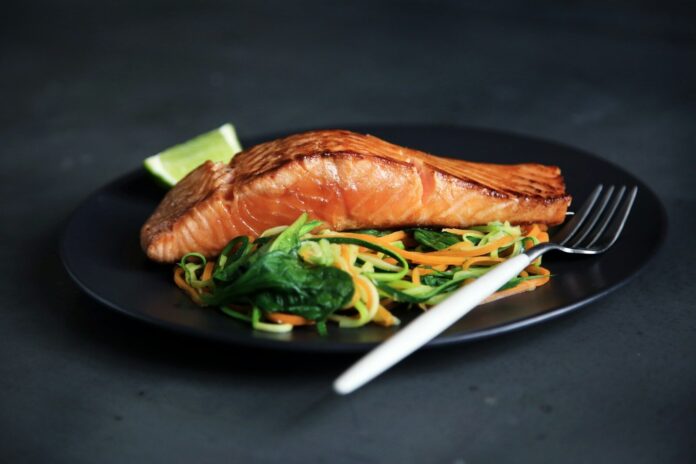

This baked salmon with lentils is the dinner to make on a training day when you want something that actually fills you up: about 44 g of protein and 10 g of fibre per serving, on the table in roughly 35 minutes. The lentils simmer in one pot with tomato, carrot and onion while the salmon bakes on a tray, so there is almost no hands-on time. Compared with salmon and a side of white rice, you get more protein, more fibre and far steadier energy for the same effort.
At a glance
- Time: 10 minutes prep + 25 minutes cook (about 35 minutes total)
- Serves: 2
- Protein per serving: about 44 g
- Calories per serving: about 615 kcal
- Diet: Omnivore, gluten-free, dairy-free; vegan option below
Ingredients
Makes 2 servings.
- 2 salmon fillets, 140 g (5 oz) each, 280 g (10 oz) in total, skin on or off
- 100 g (1/2 cup) dried brown or green lentils, rinsed
- 1 tbsp plus 1 tsp (18 g) olive oil
- 1 small onion, about 80 g (1/2 cup chopped)
- 1 medium carrot, about 80 g (2/3 cup diced)
- 2 garlic cloves, about 6 g, finely chopped
- 200 g (3/4 cup plus 1 tbsp, half a standard can) canned chopped tomatoes
- 400 ml (1 2/3 cups) water or low-salt stock, plus more if needed
- 60 g (2 cups) baby spinach
- 2 tbsp (30 ml / 30 g) lemon juice, about half a lemon
- 2 tsp (10 g) mustard (Dijon or yellow)
- 2 tbsp (8 g) chopped fresh parsley
- 1 tsp smoked paprika, 1/2 tsp salt and black pepper to taste (not counted)
Method
- Start the base. Heat 1 tbsp of the olive oil in a medium saucepan over medium heat. Add the onion and carrot and cook for 5 minutes until softened, then add the garlic and cook for 1 minute more.
- Simmer the lentils. Stir in the rinsed lentils, canned tomatoes and the water or stock. Bring to a boil, then lower the heat, cover loosely and simmer for 20 to 25 minutes until the lentils are tender but still hold their shape. Top up with a splash of water if the pot looks dry.
- Heat the oven. While the lentils cook, preheat the oven to 200 C (400 F) and line a baking tray with parchment.
- Glaze the salmon. Pat the fillets dry and place them on the tray. Mix the mustard with 1 tsp of the lemon juice and the remaining 1 tsp of olive oil, then brush it over the top of the fish. Season with the smoked paprika, a pinch of salt and black pepper.
- Bake. Bake for 12 to 14 minutes, depending on thickness, until the salmon flakes easily with a fork and the centre is just opaque. A thermometer should read 55 to 60 C (130 to 140 F) in the thickest part.
- Finish the lentils. Stir the spinach into the hot lentils until it wilts, about 1 minute. Add the remaining lemon juice, the parsley, 1/2 tsp salt and pepper to taste.
- Serve. Divide the lentils between two plates or bowls and set a salmon fillet on top. Add an extra squeeze of lemon if you like it sharper.
Nutrition per serving
Approximate values per serving, calculated from the ingredient weights above (USDA SR Legacy data).
| Nutrient | Per serving (approx.) |
|---|---|
| Calories | 615 kcal |
| Protein | 44 g |
| Carbohydrate | 46 g |
| Fat | 29 g |
| Fibre | 10 g |
Salt, pepper and smoked paprika are not counted. Stock in place of water adds a little sodium but almost no calories. Values assume farmed Atlantic salmon; wild salmon is leaner and will come out slightly lower in fat and calories.
Make it higher protein / lighter
- More protein: Use 170 g (6 oz) fillets instead of 140 g. That adds roughly 6 g of protein per serving and about 60 kcal. Stirring 100 g (3.5 oz) of cooked white beans into the lentils adds a further 3 to 4 g per serving.
- Lighter: Drop to 120 g (4 oz) fillets, skip the oil on the salmon and cook the base in 1 tsp of oil. You land near 520 kcal and 40 g of protein per serving with almost no change in flavour.
- Make it vegan: Swap the salmon for 300 g (10.5 oz) tempeh, cut into two slabs, brushed with the same mustard glaze and baked for 15 minutes. Protein stays almost the same at about 46 g per serving (tempeh and salmon are close per 100 g). With 300 g (10.5 oz) extra-firm tofu instead, protein falls to about 30 g per serving.
- Batch and meal prep: The lentil base doubles well and keeps for 4 days in the fridge. Cook salmon fresh if you can; leftover salmon is best eaten cold over the reheated lentils rather than reheated itself.
- Variation: Add 1 tsp ground cumin and a pinch of chilli flakes to the base for a warmer, North African feel, or swap parsley for fresh dill and skip the paprika for a Scandinavian version.
FAQ
Can I use canned lentils instead of dried?
Yes. Use one 400 g (14 oz) can, drained, which is about 240 g of cooked lentils. Add them with the tomatoes and simmer for only 8 to 10 minutes so they do not turn to mush. The nutrition is close to the dried version but slightly lower in protein, since a drained can holds a little less lentil than 100 g dried.
How do I know the salmon is done without overcooking it?
Press the top gently with a fork: when the flakes separate and the centre has just turned from translucent to opaque, it is done. Salmon continues to cook for a minute after it leaves the oven, so take it out when the very middle still looks a touch glossy. Thinner tail pieces may need only 10 minutes.
Is this a good post-workout dinner?
It works well. The 44 g of protein covers a solid dose of leucine-rich protein for muscle repair, and the lentils supply slow carbohydrate and fibre to refill energy stores without a sugar spike. If you train late and eat within an hour of bed, keep the portion as written rather than going for the higher-protein version, so digestion does not interfere with sleep.
How long does it keep?
Store the lentils and salmon in separate airtight containers in the fridge for up to 3 days. Reheat the lentils on the hob or in the microwave with a splash of water. Do not freeze cooked salmon; the texture suffers. The lentil base alone freezes well for up to 3 months.
Not sure whether 44 g per meal is the right amount for you? Run your numbers through the protein calculator, then slot this dish into the 7-day meal planner. For the bigger picture on daily targets, read how much protein you need after 35, and if fat loss is the goal, see how to lose fat without losing muscle.
Sources
- USDA National Nutrient Database for Standard Reference, Release 28 (SR Legacy), NDB No. 15236 Fish, salmon, Atlantic, farmed, raw. fdc.nal.usda.gov
- USDA National Nutrient Database for Standard Reference, Release 28 (SR Legacy), NDB No. 16069 Lentils, raw. fdc.nal.usda.gov
- USDA National Nutrient Database for Standard Reference, Release 28 (SR Legacy), NDB No. 04053 Oil, olive, salad or cooking. fdc.nal.usda.gov
- USDA National Nutrient Database for Standard Reference, Release 28 (SR Legacy), NDB No. 11531 Tomatoes, red, ripe, canned, packed in tomato juice. fdc.nal.usda.gov
- USDA National Nutrient Database for Standard Reference, Release 28 (SR Legacy), NDB No. 11457 Spinach, raw. fdc.nal.usda.gov
- National Institutes of Health, Office of Dietary Supplements. Omega-3 Fatty Acids: Fact Sheet for Consumers. Cold-water fatty fish such as salmon are listed as sources of EPA and DHA, and the American Heart Association advice of one to two servings of seafood per week is summarised. ods.od.nih.gov
Nutrition values are estimates and vary by brand and portion. This is general information, not medical advice.

