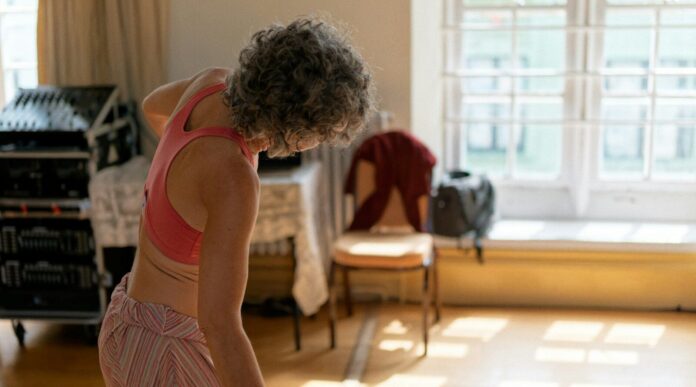

Stiff hips in the morning, a shoulder that complains when you reach for the top shelf, ankles that make deep squats feel impossible: none of it is “just age”. In a study of 436 adults aged 55 to 86, women lost about 7 degrees of hip flexion and 6 degrees of shoulder reach per decade, and the shoulder decline in women started around age 63. What you do in your 40s decides how much of that range you keep.
The good part: you do not need an hour of yoga. A 10-minute daily routine for the four areas that stiffen first (hips, upper back, shoulders, ankles) is enough to move the needle, and the evidence says strength work through a full range counts just as much as stretching.
Key takeaways
- Women lose roughly 6 to 7 degrees of shoulder and hip range per decade in later life, and general activity like walking does not protect you on its own. Targeted work does.
- A meta-analysis of 11 trials (452 people) found strength training improved range of motion as much as stretching, so lifting through a full range is mobility work too.
- The ACSM recommends flexibility work at least 2 to 3 days a week, holding stretches 10 to 30 seconds for a total of about 60 seconds per muscle group; daily practice gives bigger gains.
- Test four areas in 2 minutes (hips, thoracic spine, shoulders, ankles), then run the 10-minute routine below, ideally after a walk, a shower or your workout.
- Aim for both sides to match rather than for a dancer’s range. Stop at tension, never pain, and skip bouncing.
Why mobility drops after 40 (and why it is not inevitable)
Flexibility is how far a joint can go when something else moves it. Mobility is how far you can take it under your own control, with enough strength at the end of the range to be useful. A tight hip flexor limits your stride; a weak, tight upper back pulls your shoulders forward and steals overhead reach.
Harvard Health puts the mechanism simply: muscles that are not regularly taken through their length shorten and tighten, and a day of sitting is enough to tighten hamstrings and hip flexors. Tight muscles raise the risk of joint pain and strains and make balance worse.
The surprising part comes from the Journal of Aging Research study above. Age predicted the loss of hip and shoulder range, but how physically active people were did not. In other words, being “active” in general does not keep your joints moving. You have to ask for the range on purpose, which is exactly what this routine does.
Many women also notice extra stiffness around perimenopause and menopause. If stiffness comes with swelling, redness, or pain that wakes you at night, talk to your doctor before you start.
Stretching or strength? What the evidence says
A 2021 systematic review and meta-analysis in Healthcare compared strength training with stretching across 11 randomised trials and 452 participants, with programmes lasting 5 to 16 weeks. The pooled difference in range of motion was tiny and not significant (effect size −0.22, 95% CI −0.55 to 0.12). The authors concluded the two methods were not different in their effect on range.
That is good news for busy women: a goblet squat to full depth, a Romanian deadlift that lengthens the hamstrings, or an overhead press with ribs down is mobility training. If you already follow our 3-day strength plan for women over 35, you are halfway there. This routine fills in the gaps on the other days.
The American College of Sports Medicine position stand (Garber et al., 2011) gives the dose: flexibility exercise at least 2 to 3 days a week, each stretch held 10 to 30 seconds (30 to 60 seconds works better for older adults), repeated 2 to 4 times for a total of about 60 seconds per muscle group, with greater gains from daily practice. Mayo Clinic adds that even 5 to 10 minutes helps, and that the benefits fade when you stop.
The 2-minute self-test: four areas, four fixes
Do these once now, write down what you find, and repeat every four weeks. You are not chasing a number; you are chasing symmetry between sides and progress over time. Mayo Clinic notes that unequal flexibility between sides may raise injury risk more than a modest range on both.
| Area | 30-second test | What “tight” looks like | The fix (in the routine) |
|---|---|---|---|
| Hips (hip flexors, glutes) | Lie on your back on the edge of a bed with both legs hanging. Hug one knee to your chest. | The thigh of the hanging leg lifts away from the bed, or the knee drifts out to the side. | Half-kneeling hip flexor stretch with a glute squeeze; 90/90 hip switches. |
| Thoracic spine (upper back) | Sit on a chair, knees together, arms crossed on your chest. Rotate as far as you can each way. | You turn less than you expect, you lean rather than rotate, or one side goes clearly further. | Open book rotation; cat-camel. |
| Shoulders | Stand with heels, bottom, upper back and head against a wall. Raise straight arms forward and overhead. | Your lower back arches off the wall, ribs flare, or your arms cannot reach the wall overhead. | Wall slides; doorway chest stretch. |
| Ankles | Kneel facing a wall, front toes a hand-width away. Drive your knee forward to touch the wall, heel down. | Your heel lifts, the knee cannot reach, or one side is clearly shorter. Measure the distance. | Knee-to-wall rocks; calf stretch; supported deep squat. |
If your ankle result is poor, do not be surprised if squats feel awkward and your lower back grumbles after lifting. Stiff ankles push the knees inward and the torso forward, and the back picks up the slack.
The 10-minute mobility routine
Do it daily if you can; the ACSM notes bigger gains with daily work, and 2 to 3 days a week is the minimum that still helps. Ideal timing is after a walk, a shower, or at the end of a workout, because Mayo Clinic and Harvard Health both advise against stretching cold muscles hard. If you do it first thing in the morning, keep the first two minutes slow and gentle.
Move smoothly, breathe out as you move into range, and stop at tension, not pain. The whole thing fits on one yoga mat and needs a wall and a doorway.
- Marching with arm swings, 1 minute. March on the spot, lifting the knees to hip height while the arms swing forward and back. This is your warm-up; by the end you should feel slightly warmer.
- 90/90 hip switches, 1 minute. Sit with your front shin parallel to your hips and your back shin behind you, both knees at roughly 90 degrees. Lift both knees and rotate to the other side without using your hands. Slow and controlled, 8 to 10 switches.
- Half-kneeling hip flexor stretch, 30 seconds each side. Kneel with one foot forward. Tuck your tailbone under and squeeze the glute of the back leg; shift forward only until you feel the front of the back hip. The glute squeeze is what makes this work.
- Open book rotation, 45 seconds each side. Lie on your side with knees bent at 90 degrees and stacked. Reach the top arm forward, then open it towards the floor behind you, following the hand with your eyes. Keep the knees stacked so the rotation comes from the upper back. 8 to 10 slow repetitions.
- Cat-camel, 1 minute. On hands and knees, round the whole spine towards the ceiling, then lift the chest and tailbone. 10 to 12 slow cycles. This wakes up every segment of the spine, not just the stiff bits.
- Wall slides, 1 minute. Back to the wall as in the test, forearms on the wall in a goalpost shape. Slide the arms up as high as you can while the lower back stays on the wall, then down. 8 to 10 repetitions.
- Doorway chest stretch, 30 seconds each side. Forearm on the door frame, elbow at shoulder height, step through until you feel the front of the chest and shoulder. Keep the ribs down.
- Knee-to-wall rocks, 45 seconds each side. Same position as the ankle test. Rock the knee towards the wall and back, heel glued to the floor, 10 to 12 slow rocks. Move the foot back a finger-width when the wall becomes easy.
- Supported deep squat, 1 minute. Hold a door frame or a sturdy table, lower into the deepest squat you can with heels down, and breathe there. Stand and repeat 3 to 5 times, or hold for the full minute if it feels good.
Total: 10 minutes. If you only have five, do moves 2, 4, 6 and 8 for 45 seconds each side.
How to progress over four weeks
| Week | Focus | What changes |
|---|---|---|
| 1 | Learn the moves | Do the full routine 3 to 4 days. Take your test scores and note your tighter side. |
| 2 | Go daily | Add the routine to a fixed anchor (after the morning walk, before the evening shower). Spend extra time on your tighter side. |
| 3 | Add load | On strength days, take squats and hip hinges through a full, controlled range with light weight. Strength at end-range is what makes new mobility stick. |
| 4 | Retest | Repeat the four tests. Keep whichever drills moved the most; swap in a new variation where you have plateaued. |
Foam rolling before the routine is optional. It can make the first minutes feel easier, but it does not replace moving through range; our guide to foam rolling and stretching after 35 explains what it does and does not do.
Making it stick
Ten minutes a day is 70 minutes a week, which is more flexibility work than most adults get in a month. The trick is not motivation; it is attaching the routine to something you already do. After the school run, during the kettle boiling, at the end of a bone-friendly strength session: the anchor matters more than the time of day.
Expect the first week to feel clumsy, the second to feel easier, and real changes in how you move (deeper squats, easier overhead reach, less morning stiffness) somewhere between weeks 4 and 8. The trials in the 2021 meta-analysis ran 5 to 16 weeks, and that is a realistic window for noticeable change.
Safety note: Stretch to tension, never pain, and do not bounce. If you have a current injury, osteoporosis, a joint replacement, or a chronic condition that affects your joints, ask your doctor or a physiotherapist which moves to modify before you start. Sharp pain, pins and needles, or swelling after a session means stop and get it checked.
FAQ
Is 10 minutes of mobility a day really enough after 40?
Yes, for most women who also walk or train a few times a week. The ACSM says flexibility work on 2 to 3 days a week with about 60 seconds per muscle group is the effective minimum, and Mayo Clinic notes that 5 to 10 minutes at a time helps. Daily practice simply gets you there faster.
Should I do mobility before or after a workout?
Dynamic moves like marching, cat-camel and hip switches work well before training. Longer holds such as the hip flexor and chest stretches are better after, when muscles are warm. Mayo Clinic also notes that static stretching right before sprinting or jumping can slightly reduce performance.
Is yoga or Pilates better than a mobility routine?
Both improve flexibility, and Mayo Clinic notes that tai chi, Pilates and yoga may also reduce falls in older adults. A class is a great weekly addition, but a 10-minute daily routine you actually do beats a 60-minute class you skip. Combine them if you can.
Why are my hips tight when I walk every day?
Walking moves the hip through a small arc and never asks for full flexion, extension or rotation. The 2013 flexibility study found that general physical activity did not predict better hip or shoulder range, only age did. Range is use-it-or-lose-it, and you have to ask for the full range deliberately.
How long before I notice a difference?
Most people feel looser within a session or two, but that is temporary. Lasting change in how far you can move comes over weeks; the studies comparing stretching and strength ran 5 to 16 weeks. Retest every four weeks and expect the gains to fade if you stop, as Mayo Clinic warns.
Free tool: Build a sport-specific warm-up that includes these moves with our Sport Warm-Up and Injury Prevention Routines, and tap any tight area on the interactive Muscle Map to see which exercises strengthen it.
Sources
- Stathokostas L, McDonald MW, Little RMD, Paterson DH. Flexibility of Older Adults Aged 55–86 Years and the Influence of Physical Activity. Journal of Aging Research, 2013.
- Afonso J, Ramirez-Campillo R, Moscão J, et al. Strength Training versus Stretching for Improving Range of Motion: A Systematic Review and Meta-Analysis. Healthcare, 2021.
- Garber CE, Blissmer B, Deschenes MR, et al. ACSM Position Stand: Quantity and Quality of Exercise for Developing and Maintaining Cardiorespiratory, Musculoskeletal, and Neuromotor Fitness in Apparently Healthy Adults (summary by L. Kravitz, University of New Mexico). Medicine & Science in Sports & Exercise, 2011.
- Mayo Clinic Staff. Stretching: Focus on flexibility. Mayo Clinic, 2023.
- Harvard Health Publishing. The importance of stretching. Harvard Medical School, 2024.
- NHS. Flexibility exercises. National Health Service (UK), reviewed 2023.
This article is for general education and is not medical advice. Check with your doctor before starting a new training or nutrition plan, especially if you have a health condition.

