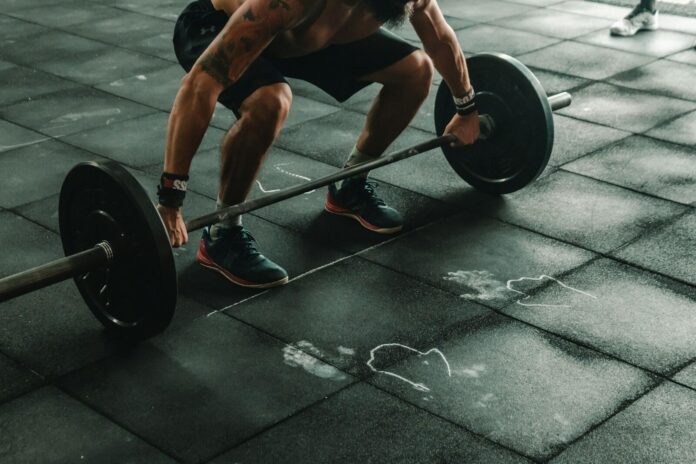

Yes, you can deadlift after 40, and for most people you should. Competitive powerlifters, who pull far heavier than you ever will, record about 1 to 4.4 injuries per 1,000 training hours, below track and field and far below contact sports. The lift is not the problem. Rushed technique and adding weight too fast are.
This guide shows you how to choose between the trap bar, the conventional deadlift and the Romanian deadlift, how to test your hip hinge in two minutes, and how to build up over eight weeks without your lower back paying for it.
Key takeaways
- Strength sports have low injury rates: 1.0 to 4.4 injuries per 1,000 training hours in powerlifting, against 9.6 in American football.
- The trap bar reduces peak load on the lumbar spine and hips and let experienced lifters pull about 8% more weight. It is the best starting point for a deadlift after 40.
- The Romanian deadlift works the hamstrings and glutes with less than half the quad involvement of a conventional pull, which makes it the better tool for learning the hinge.
- In an 8-week trial, supervised deadlift training improved pain in adults with recurrent lower back pain as much as gentle motor-control exercise did.
- Pass the 2-minute hinge self-test before you load a bar, then add weight no faster than the 8-week table below.
- Anyone with an acute disc problem with leg symptoms, diagnosed osteoporosis or uncontrolled blood pressure should get medical clearance first.
Why the deadlift matters more after 40
Lifting something heavy off the floor is the movement of real life: a suitcase, a sleeping child, a bag of compost, a parent who needs a hand up. The deadlift trains that exact pattern with the glutes, hamstrings, back extensors, trunk and grip working as one unit.
Age quietly takes strength and muscle away from everyone, and in 2019 a global expert panel supported by the National Strength and Conditioning Association published a position statement saying resistance training is both safe and beneficial for older adults, and that fear and confusion are what keep people from doing it. Their point applies at 40 as much as at 70.
If you already follow a plan like our 3-day strength programme after 35, the deadlift is the lift that pays the biggest dividend per minute. It also builds the grip strength that, as we explain in our grip strength and longevity guide, tracks closely with how well people age.
Trap bar vs conventional vs Romanian: which deadlift after 40?
All three are hip hinges. They differ in where the load sits relative to your spine, how much knee bend you use, and how forgiving they are of imperfect technique.
Trap bar (hexagonal bar) deadlift
You stand inside the bar, so the load is in line with your body rather than in front of your shins. In a study of 19 powerlifters, Swinton and colleagues found the trap bar produced lower peak moments at the lumbar spine, hip and ankle than a straight bar, with a higher moment at the knee. The lifters also handled more weight (265 kg vs 245 kg, about 8% more) and generated more peak power (4,872 W vs 4,388 W).
Translation: more leg, a little less back, and an easier bar path. That is why we recommend it as your default deadlift after 40. If your gym has no trap bar, a heavy kettlebell or two dumbbells held at your sides reproduces most of the same mechanics; our 20-minute kettlebell plan uses this version.
Conventional deadlift
The bar starts on the floor in front of you, which puts a longer lever on the lower back and demands more hip and hamstring mobility to reach the bar with a neutral spine. It is the classic strength test and still a superb exercise, but it is the least forgiving of the three when you are tired, stiff or rushing.
Romanian deadlift (RDL)
You start standing, lower the bar to mid-shin by pushing the hips back with only a soft knee bend, and come back up. Lee and colleagues compared the two lifts in 21 men at 70% of their RDL max: the conventional deadlift activated the rectus femoris (a quad muscle) at 58.6% of peak versus 25.3% for the RDL, with gluteus maximus at 51.5% versus 46.9%. In plain terms, the RDL is a hamstring-and-glute lift with very little quad. That is exactly what you want when you are teaching your body what a hinge feels like.
| Variation | Lower-back load | Main muscles | Learning curve | Best for |
|---|---|---|---|---|
| Trap bar | Lowest of the three at a given weight | Glutes, quads, hamstrings, back, grip | Easiest; hard to get badly wrong | Your main heavy pull after 40, especially with a desk job or a history of back niggles |
| Conventional | Highest; load sits in front of the shins | Glutes, hamstrings, back extensors, grip | Steepest; needs mobility and patience | Lifters who already hinge well and want the classic test of strength |
| Romanian (RDL) | Moderate; lighter weights, long lever | Hamstrings, glutes, back extensors | Moderate; the best drill to learn the hinge | Learning the pattern, hamstring strength, runners and footballers |
A sensible plan after 40 uses two of them: the trap bar (or kettlebell) for heavier sets and the RDL for lighter, slower sets. Add the conventional pull later if you want it, not because you think you must.
The 2-minute hip hinge self-test
Do this before your first loaded set and again whenever your lower back feels tight after training. You need a broomstick, dowel or PVC pipe.
- Stand with feet hip-width apart. Hold the stick vertically along your spine, one hand behind your neck and the other behind your lower back.
- Make three points of contact: back of the head, between the shoulder blades, and the tailbone.
- Soften your knees slightly and push your hips straight back, as if closing a car door with your backside. Let your torso tip forward until it is roughly 45 degrees or your hands would reach your knees.
- Pause for two seconds. Stand up by driving the hips forward. Repeat 10 times.
You pass if all three contact points stay on the stick for all 10 reps, you feel a stretch in the hamstrings (not strain in the lower back), and your shins stay close to vertical.
You fail if the stick leaves your head (you are looking down and rounding), leaves your tailbone (your lower back is flexing), or your knees drive forward so the movement turns into a squat.
If you fail, spend a week on two fixes. First, the wall tap: stand a foot (30 cm) in front of a wall and push your hips back until they touch it, then move your feet another few centimetres forward each set. Second, light RDLs with a stick or empty bar, 3 sets of 10, filming yourself from the side. Most people pass within a week. This is a coaching screen, not a medical test, so if hinging hurts rather than feels tight, see a physiotherapist first.
Technique: five cues that protect your back
- Set the bar over mid-foot. With a straight bar, your shins are about 2 to 3 cm (an inch) from it. In a trap bar, stand centred so the handles are in line with your ankles.
- Take the slack out. Grip the bar, pull your chest up and your shoulder blades down until you feel tension through your arms and back before the weight moves. Think about squeezing oranges in your armpits.
- Brace, do not just suck in. Breathe into your belly and tighten your whole trunk as if someone were about to poke you in the stomach. On light sets, exhale steadily through the hardest part rather than holding your breath.
- Push the floor away. Drive through the legs first and keep the bar touching or brushing your legs. Your hips and shoulders should rise at the same rate; if the hips shoot up first, the weight is too heavy for today.
- Stand tall, then reverse it. Finish upright with glutes tight. Do not lean back. Lower by pushing the hips back first, exactly as in the self-test.
When learning, reset fully between reps: stand, breathe, re-grip. Speed and bounce come later, if ever.
8-week deadlift progression after 40
This plan assumes you train strength 2 to 3 times a week and have passed the hinge test. Deadlift twice a week at most, with at least 48 hours between sessions. Loads use RPE, a 1 to 10 scale of effort: RPE 6 means you could have done about four more reps, RPE 8 means two more.
| Week | Main lift | Sets x reps | Effort | Second hinge | Notes |
|---|---|---|---|---|---|
| 1 | Trap bar or kettlebell deadlift | 3 x 8 | RPE 5 to 6 | Stick RDL 2 x 10 | Film from the side; the weight should feel almost too light |
| 2 | Trap bar | 3 x 8 | RPE 6 | Empty-bar RDL 2 x 10 | Add 2.5 to 5 kg (5 to 10 lb) only if every rep of week 1 was clean |
| 3 | Trap bar | 3 x 6 | RPE 6 to 7 | Light RDL 2 x 8 | Reset between reps; no touch-and-go |
| 4 | Trap bar | 3 x 6 | RPE 7 | RDL 2 x 8 | If your back feels tight, repeat week 3 instead of adding load |
| 5 | Trap bar | 4 x 5 | RPE 7 | RDL 3 x 8 | Redo the hinge self-test; it should feel easy now |
| 6 | Trap bar | 4 x 5 | RPE 7 to 8 | RDL 3 x 8 | Smaller jumps now: 2.5 kg (5 lb) at a time |
| 7 | Trap bar | 3 x 4 | RPE 8 | Optional light conventional 2 x 5 | Only add the straight bar if the hinge is solid at every rep |
| 8 | Trap bar | 1 x 5 top set, then 2 x 5 lighter | RPE 8 to 9 | RDL 2 x 8 | Use your 5-rep set to estimate your max; no grinding singles |
After week 8, drop back to about 85% of your best working weight and climb again over the next six to eight weeks. Judge progress against your own week-1 load, not against anyone else’s numbers. Two clean kilos a month is excellent progress at any age.
Deadlifts are hungry work. Recovery, and above all enough protein, decides whether the effort turns into strength; our guide to protein needs after 35 covers meat, vegetarian and mixed options.
What the evidence says about deadlifts and back pain
The fear that deadlifts wreck backs does not match the data, but the data also do not say “pull heavy and everything gets better”. Here is the honest picture.
A 2017 systematic review in the British Journal of Sports Medicine pooled nine studies of 472 powerlifters and 663 weightlifters. Injury incidence was 1.0 to 4.4 per 1,000 training hours in powerlifting and 2.4 to 3.3 in weightlifting. For comparison, the authors cite 3.57 for track and field, 5.7 for wrestling and 9.6 for American football. The lower back was the most common site, accounting for about half of injuries in one powerlifting study, but most problems were short-lived: in one weightlifting cohort, 90.5% of injuries kept athletes out for less than a day. If you train 3 to 4 hours a week, that works out at one niggle every one to five years, and these were competitive lifters pulling far beyond your loads.
What about people who already have back pain? In a randomised trial of 70 adults with recurrent lower back pain, Aasa and colleagues compared 8 weeks (12 sessions) of supervised deadlift training with low-load motor-control exercise. Both groups improved in pain intensity with no significant difference between them, and both got stronger. The low-load group improved more on a daily-activity score (4.2 vs 2.5 points) and on movement control. A companion analysis by Berglund and colleagues of 35 deadlift-trained participants found that those who started with less pain, less disability and better back-extensor endurance on the Biering-Sørensen test gained the most.
Put together, that means: if your pain is mild and you can hold your trunk steady, a supervised deadlift programme is a reasonable way to build a resilient back. If pain is high or you cannot yet hinge comfortably, start with the gentler programme in our 4-week lower back pain fix and bring the deadlift in once the basics feel easy.
Who should avoid deadlifts, or get cleared first
- Acute disc problem with leg symptoms. Pain, numbness or weakness running down a leg needs a diagnosis before you load the spine.
- Diagnosed osteoporosis or a past vertebral fracture. Strength training protects bone, but how you load the spine matters. Ask your doctor or physiotherapist which variation and load they are happy with; the trap bar and lighter RDLs are usually the starting point.
- Uncontrolled high blood pressure or a recent cardiac event. Heavy bracing briefly spikes blood pressure. Get your numbers under control and your doctor’s agreement before heavy sets.
- Recent abdominal, hernia or back surgery. Follow your surgeon’s timeline.
- A flare-up where you cannot hinge pain-free. Train around it this week, not through it.
Very limited hip or ankle mobility is not a reason to avoid the lift. Pull from blocks or the safety pins so the bar starts at mid-shin, and work your range down over months.
A note for women: the trials above included women and men, and the technique, progression and back-pain evidence apply equally. Two practical points. Grip often gives out before the legs do, so a mixed grip or straps on your heaviest set lets you keep training the muscles that matter. And if you notice any pelvic-floor symptoms when you brace, exhale through the hardest part of the lift instead of holding your breath, and ask a pelvic-health physiotherapist for a plan. If bone density is on your mind, the deadlift is one of the best loaded movements you can do; our bone health guide for women after 35 explains how to combine it with impact work.
Safety note: Deadlift with a neutral spine and a load you can control for every rep. Stop a set when your hips rise faster than your shoulders or your lower back starts to round. Sharp pain, pain that travels down a leg, numbness, or pain that does not settle within 48 hours means stop and see a doctor or physiotherapist. If you have a heart condition, high blood pressure, a hernia or osteoporosis, get clearance before heavy lifting.
Fitting the deadlift into your week
One heavy trap-bar session and one lighter RDL session is plenty. Pair the heavy day with a press (push-ups or bench) and a row; pair the RDL day with squats or lunges and a carry. Warm up with five minutes of easy cardio, two sets of the hinge drill and two or three ramping sets of the lift itself.
Leave 48 to 72 hours between hinge sessions. If you also play a sport at the weekend, put your heavy pull early in the week so your hamstrings are fresh for the match.
FAQ
Is deadlifting bad for your back after 40?
Not when it is done with a neutral spine and sensible loads. Strength-sport injury rates are lower than those of most field sports, and a randomised trial found supervised deadlift training improved pain in adults with recurrent lower back pain. The risks come from rounding under load, jumping weight too quickly and lifting through a flare-up.
Trap bar or conventional deadlift after 40?
Start with the trap bar. It lowers the peak load on the lumbar spine and hips, is easier to learn and lets most people lift a little more. Add the conventional deadlift later if you enjoy it and your hinge is solid at every rep.
How much should a 40-year-old deadlift?
There is no number you need to hit. Build from a weight that feels almost too light in week 1 and add 2.5 to 5 kg (5 to 10 lb) a week while every rep stays clean. After the 8-week block, estimate your max from a 5-rep set and plan the next block from there.
How often should I deadlift after 40?
Once or twice a week, with at least 48 hours between sessions. Recovery is slower in your 40s than in your 20s, so two quality sessions beat four tired ones. Treat the RDL day as the lighter one.
Should I use a belt or lifting straps?
Learn to brace without a belt first; a belt can help on your heaviest sets later. Straps are fine once grip, not your legs or back, is the limit on a set, but keep some beltless, strapless sets so your grip keeps improving too.
Free tool: Turn your week-8 set of 5 into a training max with our One Rep Max Calculator, and tap any muscle on the Muscle Map to see which deadlift variation works it hardest.
Sources
- Swinton PA, Stewart A, Agouris I, Keogh JWL, Lloyd R. A biomechanical analysis of straight and hexagonal barbell deadlifts using submaximal loads. Journal of Strength and Conditioning Research, 2011.
- Lee S, Schultz J, Timgren J, Staelgraeve K, Miller M, Liu Y. An electromyographic and kinetic comparison of conventional and Romanian deadlifts. Journal of Exercise Science and Fitness, 2018.
- Aasa U, Svartholm I, Andersson F, Berglund L. Injuries among weightlifters and powerlifters: a systematic review. British Journal of Sports Medicine, 2017.
- Aasa B, Berglund L, Michaelson P, Aasa U. Individualized low-load motor control exercises and education versus a high-load lifting exercise and education to improve activity, pain intensity, and physical performance in patients with low back pain: a randomized controlled trial. Journal of Orthopaedic and Sports Physical Therapy, 2015.
- Berglund L, Aasa B, Hellqvist J, Michaelson P, Aasa U. Which patients with low back pain benefit from deadlift training? Journal of Strength and Conditioning Research, 2015.
- Fragala MS, et al. Resistance Training for Older Adults: Position Statement From the National Strength and Conditioning Association. Journal of Strength and Conditioning Research, 2019 (summary via ScienceDaily).
This article is for general education and is not medical advice. Check with your doctor before starting a new training or nutrition plan, especially if you have a health condition.

